A common worry for new fishkeepers: what happens to my fish when I go on vacation? The reassuring answer is that fish are far more tolerant of skipped meals than you'd think — and most "vacation feeding" solutions cause more harm than good. Here's how to actually handle different lengths of absence, and why doing less is usually the right call.
At a glance: what not to do
| Don't | Why |
|---|---|
| Dump in extra food before leaving | It doesn't stock them up. They eat what they can, the rest fouls the water, and you return to an ammonia spike and cloudy water |
| Use cheap vacation feeder blocks | They raise water hardness, dissolve unpredictably and usually release more than the fish eat |
| Ask an inexperienced helper to feed as much as the fish want | A well-meaning helper feeding several times a day is a tank disaster. Pre-portion the food and give simple instructions |
| Leave a struggling tank | Resolve it, or get someone to manage it. A struggling tank gets worse while you are away; a healthy one coasts |
| Change anything just before you go | New fish, swapped equipment or a big water change all introduce variability. Leave a stable, known-good tank |
Fish are cold-blooded, so they don't burn energy keeping warm, and they evolved as opportunistic feeders that handle feast and famine routinely. A few days of fasting is closer to their natural pattern than the constant feeding we give them.
The Key Fact: Fish Don't Need Daily Food
The starting point is understanding how fish handle missed meals. Unlike mammals (us), fish are cold-blooded, meaning they don't burn energy keeping warm. Their metabolic needs are much lower than ours, and they evolved as opportunistic feeders that handle feast-and-famine cycles routinely.
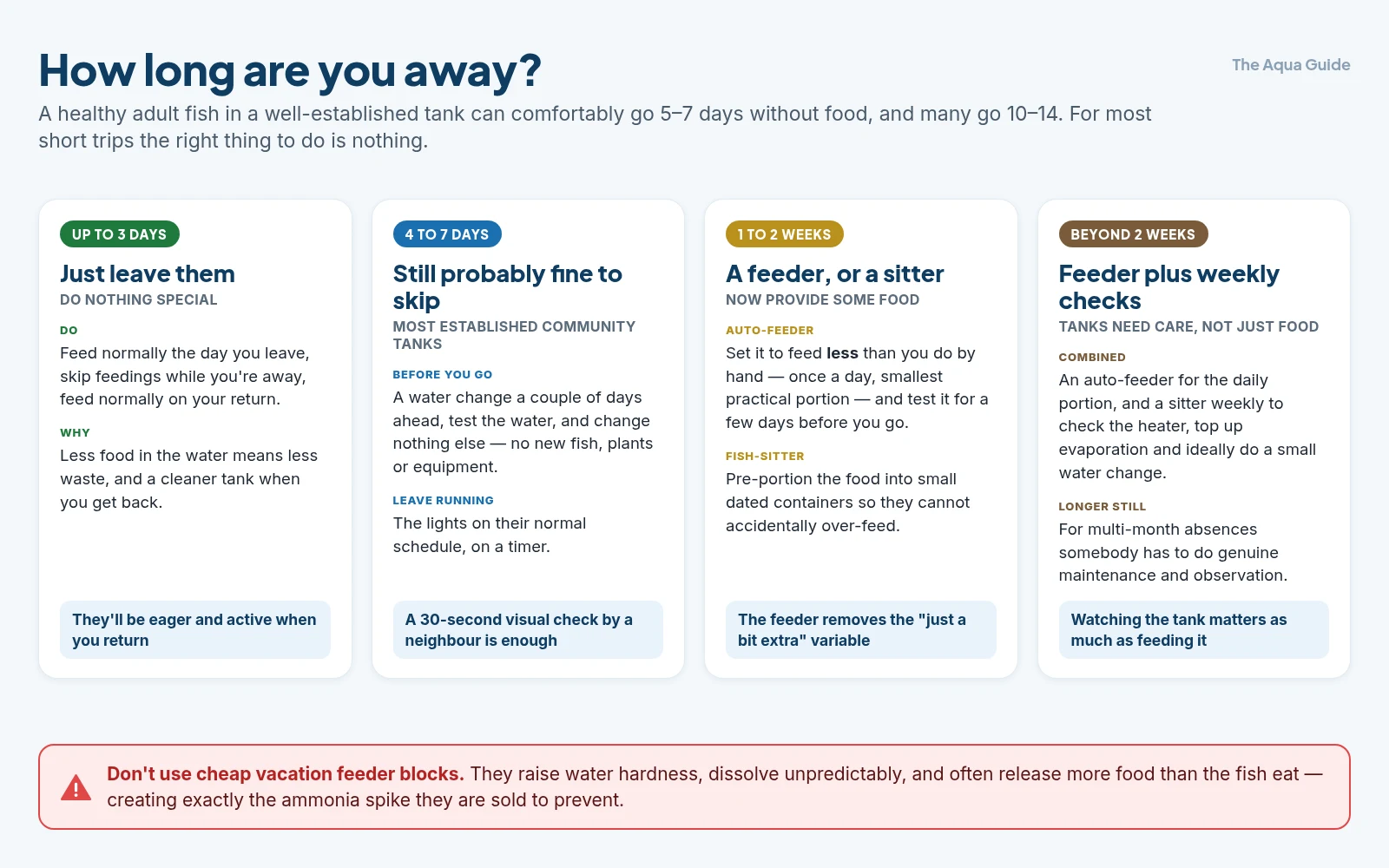
In practical terms: a healthy adult fish in a well-established tank can comfortably go 5–7 days without food with no harm. Many can go 10–14 days fine. They've evolved for this. A few days of fasting is closer to their natural pattern than the constant feeding they get from us.
This single fact changes the whole picture. For most short trips, the "right" thing to do is nothing at all.
Up to 3 Days: Just Leave Them
If you're gone for a long weekend — say, 3 days — do nothing special. Feed normally the day you leave, skip any feedings while you're away, feed normally on return. Your fish won't notice; in fact, they'll be eager and active when you come back.
This is genuinely better than over-feeding before you leave or arranging some elaborate solution. Less food in the water = less waste = cleaner tank when you return.
4 to 7 Days: Still Probably Fine to Skip
For trips up to a week, most established community tanks are fine with no feeding at all. Healthy adult fish handle a week's fast without issue.
A few practical considerations:
Feed normally the day you leave. Not extra — normally. No "stocking up" by feeding double or triple; that just creates waste.
The tank should be in good shape before you leave. A water change a couple of days before you go ensures parameters are good. Test water to confirm everything's in order. A struggling tank gets worse when you're away; a healthy tank coasts fine.
Don't add extra fish, plants, or changes right before leaving. New introductions can cause cycles or issues that develop while you're away. Make your tank changes well before vacation.
Leave the lights on the same schedule (use a timer if you don't already — and you should anyway). A normal light cycle keeps the tank stable.
Have someone check in if possible — not to feed, just to glance at the tank and make sure there's no obvious problem (heater failure, leak, etc). A 30-second visual check by a neighbor is enough.
If you have fry, very young fish, or some particularly demanding species, a week without food may be too long — these specific cases need feeding. For typical community tanks, it's fine.
1 to 2 Weeks: Use an Automatic Feeder or a Fish-Sitter
For trips of 8–14 days, providing some food is sensible. Two reliable options:
An automatic fish feeder is a battery-powered device that drops measured portions of food at scheduled times — usually once or twice a day. They're affordable, easy to set up, and reliable when properly configured.
The key with automatic feeders: set them to feed less than you do manually, not more. A typical setup is once a day, with the smallest practical portion. Test the feeder for a few days before you leave (with you home, watching) to confirm portion sizes are right. The biggest auto-feeder mistake is leaving without testing it and returning to a tank fouled by oversized portions.
A fish-sitter is a person you trust to come by once or twice during your absence, feed a measured portion, and look at the tank. If you choose this option, pre-portion the food in small dated pill organizers or labeled containers (Monday, Wednesday, Friday) so they can't accidentally over-feed. Make it impossible to add too much. Provide clear written instructions including "less is much better than more" and your contact info if anything looks off.
For most 1-to-2-week trips, a properly-set auto-feeder is the simpler, more reliable option than a fish-sitter, since it removes the human-error variable of "let me add a bit extra just in case."
Beyond 2 Weeks
For longer absences, a combined approach works best:
Automatic feeder for daily feedings.
Fish-sitter for weekly checks — coming by once a week to look at the tank, check the heater is working, top up evaporation, and ideally do a small water change.
For multi-month absences, more involvement is needed: someone doing genuine maintenance (water changes, observation). Tanks need ongoing care, not just food.
What NOT to Do
A few common vacation-feeding mistakes worth avoiding.
Don't dump in extra food before leaving. This doesn't "stock up" your fish — they'll eat what they can, the rest fouls the water, and you return to ammonia spikes and cloudy water.
Don't use cheap "vacation feeder blocks" that dissolve over days. These calcium-and-food blocks raise water hardness, dissolve unpredictably, and often release more food than fish eat — creating exactly the ammonia spike they're supposed to prevent. They're a bad solution to a problem that mostly doesn't exist.
Don't ask someone with no aquarium experience to "just feed them as much as they want." A well-meaning helper feeding multiple times a day in your absence is a tank disaster. If you use a sitter, pre-portion the food and give simple instructions.
Don't leave a struggling tank. If your tank has issues before you leave (cycling, ammonia, sick fish), resolve them or get someone to manage them — don't just hope it'll be fine.
Don't change anything just before you leave. Adding fish, swapping equipment, big water changes — all introduce variability. Leave a stable, known-good tank, not a freshly-changed one.
A Practical Vacation Checklist
For a typical trip away:
1–2 weeks before: confirm tank is healthy, parameters good, equipment working.
A few days before: do your normal water change. Test water.
Day before: feed normally. Check equipment one more time. If using an auto-feeder, do a final test and confirm portions are right.
Departure day: feed normally one last time. Confirm timer is on for lights. Leave instructions for any sitter, with pre-portioned food.
While away: ideally have someone do a quick visual check once or twice.
Return: check water level, equipment status, fish behavior. Resume normal feeding. Don't compensate with extra food — go straight back to normal portions.
A Note on Long-Term Travel
If you're away frequently for extended periods, consider whether your stocking and setup match your lifestyle. Heavily-stocked, demanding tanks need consistent care that frequent travel disrupts. A lightly-stocked, well-planted tank with a reliable auto-feeder is much more forgiving of absences than a fully-stocked, high-maintenance display.
The Bottom Line
Fish handle missed meals far better than mammals, so vacation feeding is usually less of a problem than beginners worry about: for 3 days do nothing, for a week most healthy tanks are fine being skipped entirely, for 1–2 weeks use a properly-tested automatic feeder set to small portions or a pre-portioned plan for a fish-sitter. Avoid the bad solutions — dumping extra food, vacation feeder blocks, asking helpers to feed "as much as they want" — all of which cause exactly the ammonia and quality problems they're meant to prevent. Leave a stable, healthy tank, automate the small amount of feeding actually needed, and your fish will be there when you get back.
Related guides
- How often and how much to feed your fish
- Should you fast your fish, and when?
- Why overfeeding is the #1 beginner mistake
- Aquarium lighting basics: brightness and photoperiod
- The daily, weekly and monthly maintenance checklist
- Heater sizing and placement
- How often should you do a water change — and how much?
- The beginner's guide to feeding and daily care
Got questions about your specific setup? Drop them in our Community Forum — we love helping new fishkeepers get started right.