Beyond ich, fin rot, and fungus, several other diseases show up regularly in beginner tanks. Velvet is a parasite often mistaken for ich. Columnaris is a bacterial infection that looks fungal but is far more aggressive. Dropsy is the dramatic-looking systemic infection. Understanding each of these — and knowing which is which — makes the difference between effective treatment and wasted time. Here's the guide to the trickier conditions.
How do I tell velvet, columnaris and dropsy apart?
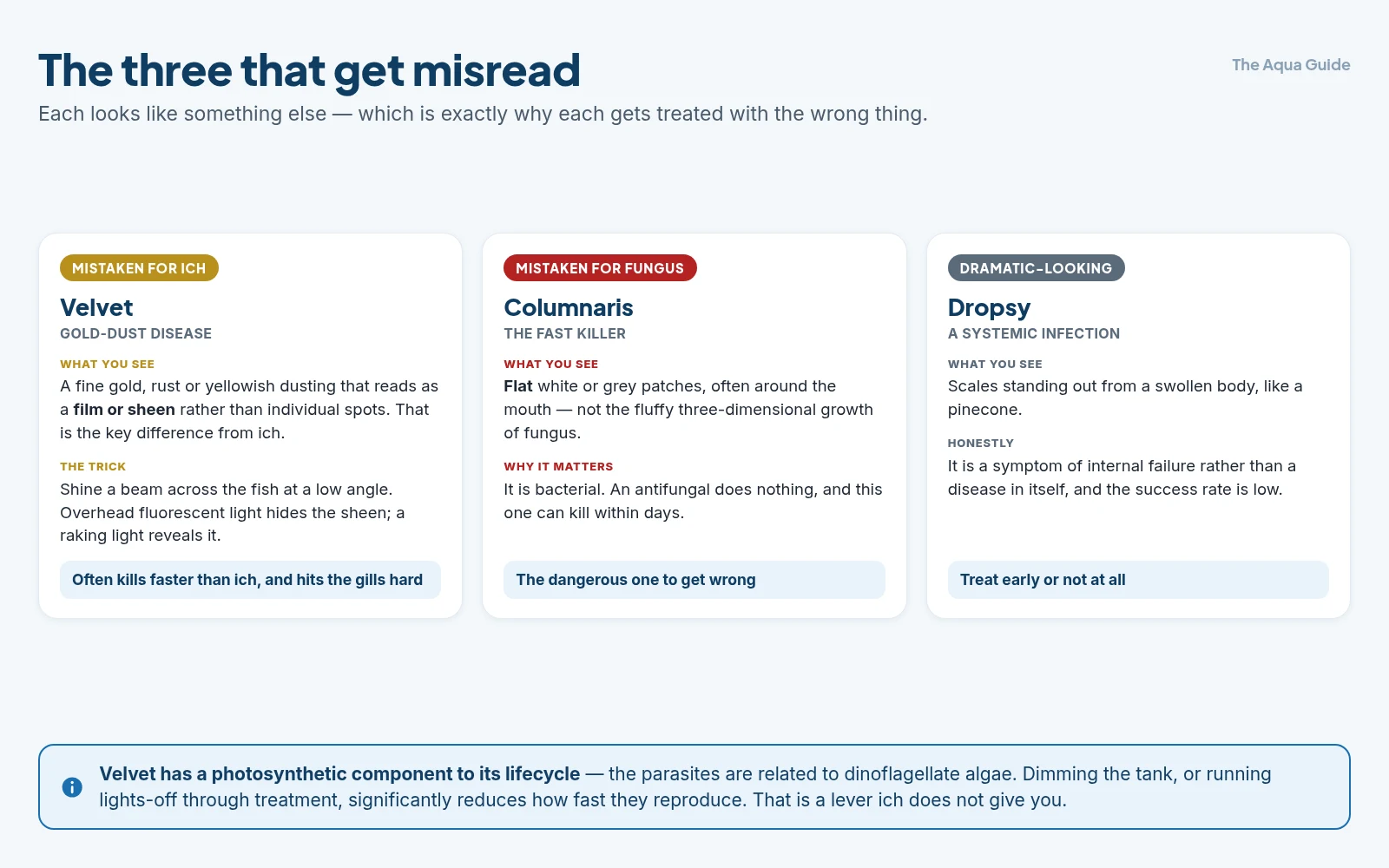
Velvet shows as a fine gold or rust-colored dusting that reads as a sheen rather than separate spots; columnaris forms flat white or grey patches and can kill within days; dropsy shows as scales standing out from a swollen body like a pinecone. Columnaris is the dangerous one to misread — it is regularly mistaken for fungus and treated with antifungals, which does nothing for a bacterial infection moving that fast.
At a glance: velvet against ich
| Velvet | Ich | |
|---|---|---|
| What it looks like | A fine gold, rust or yellowish dusting — a film or sheen across the fish | Distinct white spots like salt grains, uniform and pinhead-sized |
| Where it shows best | In indirect light, angled low across the body; more visible on dark fish | Plainly, against dark or light fish alike |
| Behaviour | Heavier scratching than ich, rapid gill movement, gasping at the surface | Scratching, flashing, clamped fins, hiding |
| Speed | Often kills faster than ich, and harder to diagnose visually | Fast, but recognisable early |
| Extra lever | Reducing lighting — the parasite has a photosynthetic component | None; heat and time |
Both have a free-swimming stage that can be killed and a protected stage on the fish, so both need heat at 86°F for 10–14 days, or salt at 1 tbsp per 5 gallons, and both need treating past the point where symptoms disappear.
Velvet: The Sneaky One
Velvet disease (caused by the parasite Oodinium pilularis or Piscinoodinium) is sometimes called gold-dust disease, rust disease, or coral disease. It's harder to spot than ich because the symptoms are subtler.
Recognizing velvet:
- Fine gold, rust, or yellowish dusting across the body — like the fish has been sprinkled with very fine powder
- Looks like a film or sheen rather than individual spots (this is the key difference from ich)
- Best visible in indirect light — angle a flashlight at the fish at low angle to see the dusting
- More visible on dark fish where the gold contrasts strongly
- Often affects gills heavily — rapid breathing, gasping at surface
Behavioral signs:
- Heavy scratching/flashing (more intense than ich)
- Rapid gill movement from gill irritation
- Gasping at the surface
- Hiding, lethargy, refusal to eat
- Clamped fins
Velvet often kills faster than ich and is harder to diagnose visually. The flashlight trick — shine a beam across the fish at a low angle — reveals the gold sheen that fluorescent overhead lighting often hides.
Treatment for velvet:
Velvet has a similar lifecycle to ich, with a free-swimming stage that's killable and a protected stage on the fish. Treatment options:
Heat treatment — raise to 86°F for 10–14 days, same as ich. Effective and gentle.
Salt treatment — same dosing as ich (1 tbsp per 5 gallons), compatible-species only.
Commercial velvet medications — copper-based products are particularly effective, but avoid in invertebrate tanks.
Reduce lighting — Oodinium parasites have a photosynthetic component to their lifecycle (they're related to dinoflagellate algae). Dimming the tank or running lights-off during treatment significantly reduces parasite reproduction.
Strong aeration — velvet often damages gills; extra oxygenation helps fish recover.
The treatment overlaps with ich substantially, with the addition of reduced lighting as a velvet-specific tool. Treatment continues 10–14 days.
Columnaris: The Fast Killer
Columnaris (Flavobacterium columnare) is a bacterial infection often called "mouth fungus" or "saddle back disease." Despite the "fungus" name, it's bacterial — and dangerous because it kills faster than fungal infections.
Recognizing columnaris:
- White, grey, or yellowish flat patches on the body, fins, or mouth — often around the mouth first
- NOT fuzzy or cottony like true fungus — the patches are flat or only slightly raised
- Often appears as a "saddle" — a band of pale tissue across the back, near the dorsal fin
- Rapid progression — visibly worse over hours, not days
- Erosion of mouth tissue — gives the appearance the mouth is rotting away
- Fin damage mimicking fin rot but often more dramatic
- Sometimes accompanied by behavioral changes — lethargy, gasping, weakness
Why columnaris is dangerous:
- Fast-acting — can kill fish within 24–48 hours of symptoms appearing
- Contagious — spreads through the water to other fish quickly
- Sometimes mistaken for fungus and treated with antifungal medication, which doesn't help
Treatment for columnaris:
Treat as a serious emergency. The right approach:
Antibiotics are the primary tool:
- Kanamycin — broad-spectrum, often the first choice for columnaris
- Furan-2 / nitrofurazone — also effective
- Combination products like API Furan-2 + Erythromycin
Salt at moderate levels (1 tsp per gallon) helps suppress bacteria.
Temperature reduction is sometimes useful — columnaris bacteria thrive at higher temperatures, and dropping to 75°F or so can slow them. (Opposite of ich treatment!)
Increased aeration — sick fish need oxygen.
Hospital tank for affected fish, especially if multiple fish in the display are affected.
Don't wait. Columnaris kills fast. If you suspect it, treat with antibiotics within hours, not days.
Dropsy: The Worrying-Looking One
Dropsy is the most dramatic-looking aquarium disease — and one of the most concerning. It's caused by serious internal bacterial infection that disrupts the fish's osmotic balance, causing internal fluid accumulation.
Recognizing dropsy:
- "Pinecone" appearance — scales raised outward from the body, sticking out like pinecone scales
- Severely bloated body — abdomen swollen
- Lethargy, loss of appetite
- Sometimes bulging eyes
- Pale color, weak swimming
The pinecone scales are the unmistakable sign — once you see them, dropsy is the likely diagnosis.
Important context: Dropsy isn't really a "disease" — it's a symptom of late-stage internal infection. By the time pinecone scaling is visible, the fish is severely ill.
Treatment for dropsy:
Honest assessment: dropsy treatment has a low success rate by the time visible symptoms appear. The fish's internal organs are typically severely affected. Many fish don't recover.
That said, attempting treatment is reasonable:
Antibiotic treatment — kanamycin is most common, sometimes combined with epsom salt baths Epsom salt baths — 1 tablespoon per gallon as a short-term bath helps draw out fluid; OR add 1 tsp per 5 gallons to a hospital tank for longer treatment Hospital tank to focus treatment and protect tankmates Warm temperatures within normal range to support immune function Gentle conditions — low flow, minimal stress
Accept the outcome. If the fish doesn't respond within 5–7 days of treatment, recovery is unlikely. Consider humane options to end suffering.
The lesson from dropsy is prevention: stable water quality, no overcrowding, and quarantine of new fish prevent the kind of chronic infection that leads to dropsy.
Hole-in-the-Head (HITH)
Hole-in-the-head disease (also called "head and lateral line erosion" or HLLE in saltwater) causes small pits and erosion to appear on a fish's head and sometimes along the lateral line.
Most common in: Discus, oscars, angelfish, and some other cichlids.
Likely causes: Nutritional deficiencies, poor water quality, possibly Hexamita parasites or activated carbon use (this last cause is disputed but worth noting).
Treatment:
- Improve diet — varied foods, fresh frozen, vitamin-supplemented food
- Improve water quality — frequent large water changes
- Metronidazole medication — if parasites suspected
- Consider removing activated carbon — some keepers report improvement when stopping carbon use
HITH is more of a chronic condition than a fast-killing disease but worth addressing as it affects fish quality of life.
Pop-Eye
Pop-eye (exophthalmia) is one or both eyes bulging out of the socket — sometimes dramatically. Caused by injury, bacterial infection, or water quality issues.
Treatment:
- Improve water quality immediately — frequent water changes
- Antibiotic treatment if both eyes affected (suggests bacterial)
- Epsom salt bath can help reduce swelling
- Hospital tank for serious cases
One affected eye often indicates injury and may heal with good water quality alone. Both eyes affected suggests systemic infection requiring antibiotics.
General Bacterial Infection Signs
Beyond named conditions, recognize general bacterial infection patterns:
- Red streaks in fins, body, or at fin bases (septicemia — bacterial bloodstream infection)
- Open wounds or ulcers on the body
- Slime coat excess or shedding
- Mouth deterioration or jaw damage (often columnaris)
- Sudden behavioral changes — refused food, hiding, lethargy
- Multiple fish showing similar symptoms suggests bacterial spread
General response: improve water quality, broad-spectrum antibiotic (kanamycin or combination products), hospital tank for severe cases.
When to Use What: Quick Reference
| If you see... | Most likely... | First treatment |
|---|---|---|
| Salt-grain white spots | Ich | Heat treatment (86°F, 14 days) |
| Gold/rust dusting | Velvet | Heat + reduced lighting |
| Ragged eroding fins | Fin rot | Water quality + salt + antibacterial |
| Cottony white fuzz | Fungus | Salt + antifungal |
| Flat white patches, fast progress | Columnaris | Antibiotics urgently (kanamycin) |
| Pinecone scales | Dropsy | Antibiotics + epsom salt, low success rate |
| Pits in head | HITH | Better diet + water quality |
| Bulging eye(s) | Pop-eye | Water quality + antibiotics if both eyes |
| Red streaks in fins/body | Septicemia | Strong antibiotic course |
The Bottom Line
Beyond the common ich/fin rot/fungus trio, several other conditions show up: velvet (gold-dust parasite, similar treatment to ich plus reduced lighting), columnaris (fast-acting bacterial infection that looks like fungus but kills within days — needs urgent antibiotics), dropsy (pinecone scales from severe internal infection — low success rate, attempt antibiotics + epsom salt), HITH (pits on head, address via diet and water quality), and pop-eye (water quality + antibiotics). Each has distinctive visual or behavioral signatures that make identification possible — and identification matters because treatments differ significantly. Columnaris in particular is dangerous: fast-progressing and often mistaken for fungus, leading to ineffective treatment. When in doubt, prioritize water quality improvement and broad-spectrum antibiotics in a hospital tank for serious cases. As always, prevention through clean stable conditions, quarantine of new fish, and daily observation does more than any treatment ever can.
Related guides
- Ich (white spot): identification and treatment
- Fungal infections: cotton-like growth
- Fin rot: causes, recognition and recovery
- Common aquarium diseases: treatment lookup
- Aquarium medications: when to use what
- Setting up and using a hospital tank
- Internal parasites: signs and treatment
- The beginner's guide to fish disease
Got questions about your specific setup? Drop them in our Community Forum — we love helping new fishkeepers get started right.