From Aqua Guide, the free encyclopedia
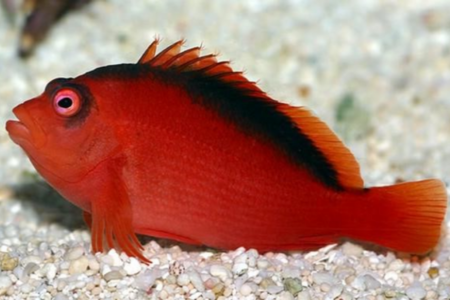
Flame Hawkfish
Neocirrhites armatus
- Temperature
- 24–27 °C
- Salinity
- 1.02 – 1.026 SG
- Min. tank size
- 110 L
- Lifespan
- 5-10 years
- Diet
- carnivore
- Care level
- easy
| Scientific classification | |
|---|---|
| Scientific Name: | Neocirrhites armatus |
| Family: | Cirrhitidae |
| Origin: | Pacific reefs |
| Care Characteristics | |
| Care Level: | easy |
| Diet: | carnivore |
| Max Size: | 9.00 cm |
| Water Type: | marine |
| Temp Group: | tropical |
| Reef Safe: | Reef Safe with Caution |
| Temperament: | semi aggressive |
| Min Group: | Can be kept alone |
| Varieties: | No cultivated strains — this is a wild-caught fish and the scarlet-and-black colouring is consistent across its range. Some variation exists in the extent of the black dorsal marking and the dark edging around the eye. The species is one of the more popular hawkfish in the hobby, and also one of the more expensive, since it is collected from a scattered Pacific range rather than farmed. The family Cirrhitidae contains several other aquarium species worth knowing. The longnose hawkfish, Oxycirrhites typus, is the most distinctive, with a red-checkered body and an extended snout. The falco or dwarf hawkfish, Cirrhitichthys falco, is smaller and cheaper. The arc-eye hawkfish, Paracirrhites arcatus, is common and hardy. All perch, all lack swim bladders, and all will eat ornamental shrimp. |
| Lifespan: | 5-10 years |
Quick Tips
- Bioload:Low
- Min Tank:110 L
- Substrate:Live rock and coral perches; sand
- Plant Safe:Yes
- Filtration:Moderate (reef conditions)
Flame Hawkfish (Neocirrhites armatus) is a species of fish in the family Cirrhitidae. It is native to Pacific reefs. The flame hawkfish is scarlet, black-eyed and utterly still — until it moves. It has no swim bladder, and it cannot hover. Instead it uses its robust pelvic fins as supports, perching on coral branches and rockwork like a bird on a wire, watching the tank, then darting at anything worth eating. The whole family behaves this way, and it is why they are called hawkfish. It reaches 9 cm and comes from the western Pacific, from Japan's Ryukyu Islands to the Pitcairns, on reef fronts exposed to tidal surge. In the wild it hides among live coral, favouring Stylophora and Pocillopora, and retreats deep into the branches when threatened.
Compatibility
- Temperament
- semi aggressive
- Keep in
- Can be kept alone
- Swims
- bottom
- Fin nipper
- No
- Delicate fins
- No
- Reef
- Reef Safe with Caution
Species similar to Flame Hawkfish
Matched on family, then category, then water type