Nobody buys these. They arrive — on a coral frag, on a plug, in the water a bag of livestock came in, or on a piece of live rock — and then one day there are nine of them where there was one. Aiptasia and Majano are the two pest anemones that turn up in almost every reef tank sooner or later, and between them they account for more quiet coral losses than any disease.
The single most useful thing on this page is this: work out which one you have before you spend any money. The biological controls for Aiptasia and Majano do not overlap at all. The nudibranch that reliably clears Aiptasia will starve to death beside a rock covered in Majano without touching one. Buying the wrong predator is the most common and most expensive mistake made with these animals, and it is entirely avoidable.
At a glance: identify before you treat
| Check | What it tells you |
|---|---|
| The column, first | Translucent and tall means Aiptasia; short, wide and opaque means Majano. This is the reliable feature |
| The colour | Brown or grey-brown is Aiptasia. Strong green, teal, orange or yellow points at Majano |
| Under actinic | Bright fluorescence points at Majano |
| Still unsure? | Photograph it under white light and ask somewhere people know what they are looking at |
The two need different treatments, and a fair amount of harmless — occasionally valuable — livestock gets killed by people who skipped this step.
Aiptasia: What You Are Looking At
Aiptasia is a small anemone with a translucent, glassy brown column and long, thin, tapering tentacles that it waves loosely in the current. A mature one might be 2-5 cm tall with a tentacle spread a little wider. Under white light it looks unremarkable and slightly dirty; the column is see-through enough that you can sometimes make out the gut through it, which is where the common name "glass anemone" comes from.
The taxonomy has moved. What almost every shop, forum post and product label still calls Aiptasia pallida is now Exaiptasia diaphana: the genus was split out of Aiptasia in 2014, and the International Commission on Zoological Nomenclature subsequently ruled that the epithet diaphana has priority over pallida. The hobby name is not going to change, and it does not need to — but if you go reading scientific papers about this animal, that is the name they will use.
It is worth knowing why those papers exist. Exaiptasia diaphana is one of the most important model organisms in coral biology. It hosts the same family of symbiotic algae that reef corals do, it grows fast, it reproduces readily in a lab, and it survives being experimented on — so a great deal of what is known about coral bleaching and cnidarian symbiosis was learned from the animal you are trying to kill. That is not an argument for keeping it. It is an explanation for why it is so good at living in your tank.
Why it spreads so fast
Aiptasia reproduces by pedal laceration. The base of the animal sheds small fragments of tissue, each of which crawls off and regenerates into a complete new anemone. It does this constantly, without needing a mate, and it does it faster when it is well fed.
This is the mechanism behind the single worst thing you can do about it, which the next section covers. It is also why an Aiptasia problem is never linear: one becomes three, three become twenty, and by the time it is obviously a problem it is a problem on every rock in the tank.
Majano: The Other One
Majano is Anemonia majano, and it is not a close relative of Aiptasia. It sits in Actiniidae — the same family as the bubble tip anemone — and it looks like it: a short, stout, opaque column with short, stubby, often bulbous-tipped tentacles radiating from a flat disc. Where Aiptasia is lanky and translucent, Majano is squat and solid.
It is also, frankly, attractive. Majano comes in green, teal, brown, orange and occasionally a striking yellow, and it fluoresces under actinic light. A single specimen on a rock looks like a miniature bubble tip and plenty of people leave it alone on purpose for exactly that reason. That decision is usually regretted within a year.
Majano is generally considered the more destructive of the two. It stings harder, it is tougher to kill, and it is far less vulnerable to biological control. It spreads more slowly than Aiptasia but it holds ground better, and an established Majano population is a harder problem than an established Aiptasia one.
Telling Them Apart
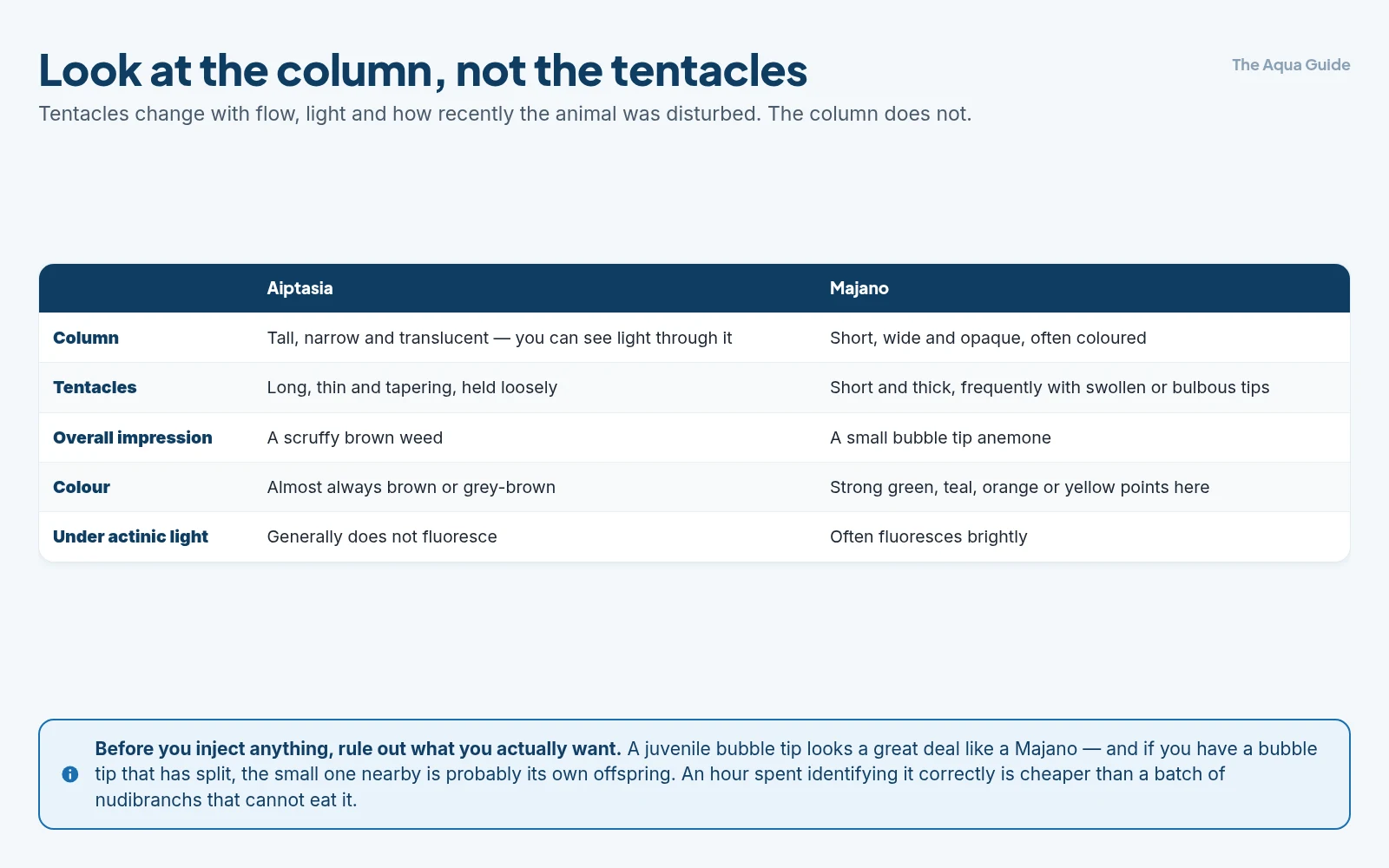
Look at the column first, not the tentacles. The tentacles change with flow, light and how recently the animal was disturbed; the column does not.
- Column: Aiptasia is tall, narrow and translucent — you can see light through it. Majano is short, wide and opaque, often coloured.
- Tentacles: Aiptasia has long, thin, tapering tentacles held loosely. Majano has short, thick tentacles, frequently with swollen or bulbous tips.
- Overall impression: Aiptasia looks like a scruffy brown weed. Majano looks like a small bubble tip anemone.
- Colour: Aiptasia is almost always brown or grey-brown. Strong green, teal, orange or yellow points at Majano.
- Under actinic light: Majano often fluoresces brightly. Aiptasia generally does not.
If you are still unsure, photograph it under white light and post it somewhere people know what they are looking at. An hour spent identifying it correctly is cheaper than a batch of nudibranchs that cannot eat it.
Things that are not pest anemones
People kill a fair amount of harmless and occasionally valuable livestock in pursuit of these two. Before you inject anything, rule out:
- A juvenile anemone you actually want. A baby bubble tip looks a great deal like a Majano. If you have a bubble tip in the tank and it has split, the small one nearby is probably its offspring.
- Feather duster and other tube worms. A fan of feeding radioles retracting into a tube is a worm, not an anemone, and it is harmless and beneficial.
- Hydroids. Much smaller, in colonies on stalks, often on glass and equipment. A genuine nuisance in some tanks but a different organism with different controls.
- Tube anemones. A Cerianthus has two distinct rings of long tentacles rising from a buried tube. It is not a true anemone and not a pest — though it does eat fish.
- Orange ball corallimorphs. Pseudocorynactis stays closed by day and opens after dark into tentacles with bright orange ball tips. Some people keep them deliberately. They also eat fish, so identifying one is worth doing either way.
What Does Not Work
This list matters more than the one after it, because most infestations are made worse by the first attempt to fix them.
Pulling, scraping or brushing them off
This is the big one. Aiptasia reproduces by shedding fragments of its own foot, and tearing one off rock leaves exactly those fragments behind. A scraped rock reliably carries more Aiptasia a month later than it did before you touched it. The same applies to Majano, which is also capable of regenerating from remnants of the base.
If you take nothing else from this page: do not pull them off. Every method below either kills the animal in place or removes the entire rock.
Siphoning them out
Same problem. A siphon strong enough to detach an anemone is strong enough to tear it, and the fragments go into the water column before they go up the tube. You may also simply relocate it: an intact Aiptasia sucked into a bucket and poured back into the sump will settle in the sump.
Starving them out with low nutrients
Both species photosynthesise, so they do not depend on the food you add. Cutting feeding and nutrients will slow their spread — sometimes noticeably — but it will not clear them, and a nutrient-stripped tank causes real problems for the corals you are trying to protect. Reduce overfeeding because overfeeding is bad practice, not because it is a treatment.
Blackouts and lights-out periods
A three-day blackout works on some nuisance algae. It does not work on these. They will simply feed heterotrophically and wait, and your corals will suffer more than they do.
Boiling or drying infested rock while it is still wet with tank water
Boiling live rock is a genuinely dangerous idea, but not because of these anemones — it is because rock carrying zoanthids or Palythoa can release palytoxin into steam, and that has put aquarists in hospital. If you are going to sterilise rock, dry it out completely outdoors first, do not heat it wet, and do not do it at all if there are any zoanthids on it.
What Works on Aiptasia
Berghia nudibranchs — the dependable answer
Berghia stephanieae is a small sea slug that eats Aiptasia and essentially nothing else. It is the closest thing to a reliable cure. A population will work through a tank methodically, including the Aiptasia in overflows, under rocks and inside plumbing that you cannot reach, and it leaves corals, fish and invertebrates alone.
Points worth knowing before you buy:
- The name is a mess. They are widely sold as Berghia verrucicornis, which is a different animal — the species in the trade is Berghia stephanieae, described in 2005 and originally placed in Aeolidiella. You are almost certainly getting the right slug under the wrong label.
- They are slow, then sudden. Expect to see very little for four to six weeks while they breed, then a rapid collapse in the Aiptasia population. Patience is part of the method.
- Buy enough. A handful in a large tank will work eventually but slowly. Most keepers use a starting population scaled to tank size and infestation, and more is genuinely faster.
- They are nocturnal and small. You will rarely see them. Absence of sightings is not evidence they died.
- Wrasses and other predators eat them. Many wrasses, hawkfish, some gobies and bristleworms will take them. In a tank with heavy slug predators the method is less likely to work, and that is worth assessing before buying.
- They starve when they win. Because they eat only Aiptasia, clearing the tank ends the food supply. That is the intended outcome, but if it sits badly with you, plan to pass survivors to another reefkeeper — there is usually demand.
Peppermint shrimp — inconsistent, and often the wrong shrimp
Peppermint shrimp are the most commonly recommended fix and the most commonly disappointing one. Two separate problems:
The species is frequently wrong. The shrimp with a real reputation for eating Aiptasia is Lysmata wurdemanni and its close relatives in the Atlantic complex. Shops sell several similar-looking shrimp under the same common name. Worse, camelback or hinge-beak shrimp (Rhynchocinetes) are sometimes sold as peppermints and they eat coral — a genuinely bad substitution. A peppermint shrimp has a straight rostrum and a slim body; a camelback has a distinctly humped back and an upward-hooked snout.
Individuals vary. Even correctly identified, some peppermints attack Aiptasia enthusiastically and others never touch it, and a few will sample zoanthids and LPS polyps instead. Buying several improves the odds that at least one is a willing worker. They also tend to prefer small Aiptasia and ignore large established ones, so they are better at holding a cleared tank than at clearing a bad infestation.
Fish that eat Aiptasia
- Copperband butterflyfish (Chelmon rostratus) will clear Aiptasia and is effective. It is also a demanding fish that often refuses food in a new tank, and it will pick at tube worms, clams and some LPS. Adding a difficult fish to solve a pest problem means committing to the fish for its whole life, not for the duration of the job.
- Bristletail filefish (Acreichthys tomentosus) eats Aiptasia and, unusually, also eats Majano. It is not reliably reef-safe — see the Majano section below.
- Berghia-safe alternative fish do not really exist. Anything with an appetite for a soft-bodied anemone generally has an appetite for soft-bodied corals, and that trade-off is the whole difficulty with the fish approach.
Injection — the manual method that actually works
Killing them in place, without detaching them, is the one manual approach that does not multiply the problem. Commercial pastes made for the job are the straightforward option; a thick kalkwasser (calcium hydroxide) slurry is the long-standing home-made equivalent.
- Turn off return pumps and wavemakers so the paste stays where you put it.
- Load a syringe with a blunt or curved tip. Approach slowly — a sudden movement makes the anemone retract and you will inject rock.
- Inject into the mouth, in the centre of the oral disc, and deliver enough to visibly fill and distend the animal. Surface-coating it does very little.
- Do a handful at a time, not the whole tank. Every dose adds alkalinity or a chemical load to the water.
- Restore flow after twenty to thirty minutes and run carbon afterwards.
- Expect survivors. Check the same spots in a week and re-treat.
Injection is the right tool for a handful of visible anemones, for cleaning a frag before it goes in, or for finishing off stragglers after a biological control has done the bulk. It is the wrong tool for a tank with two hundred of them on rock you cannot reach.
On the folk remedies: lemon juice and vinegar are frequently suggested and they do kill the animal, but they are less reliable at killing the base than a proper paste, and acid injected repeatedly into a reef tank is not free of consequences. There is no advantage over a purpose-made product.
Lasers, epoxy and removing the rock
- Lasers do work, and they reach into crevices an injection needle cannot. They are also expensive, require eye protection that is not optional, and are slow at scale. A sensible tool for a keeper who already owns one; a poor reason to buy one.
- Epoxy or superglue over the top sometimes smothers a single anemone in an awkward spot. It fails often enough that it is a second-choice method, and a survivor under a cap of epoxy is harder to treat next time.
- Taking the rock out is underrated. If the infestation is concentrated on one or two removable pieces, pulling them and either replacing them or curing them separately in a bucket for a few months is faster, cheaper and more certain than any in-tank treatment.
What Works on Majano
Here is the part that catches people out, and the reason identification comes first on this page.
Berghia nudibranchs will not eat Majano. Not reluctantly, not sometimes — they feed exclusively on Exaiptasia, and a batch introduced to a Majano-infested tank will starve beside them. Peppermint shrimp will not reliably eat Majano either; the occasional individual picks at a very small one, most ignore them entirely. Copperband butterflyfish generally ignore them too. Every standard Aiptasia control fails on this species.
The one predator with a real record
The bristletail filefish (Acreichthys tomentosus), sometimes sold as the matted or aiptasia filefish, is the only biological control with a dependable track record against Majano. It eats both pest anemones and will work through a heavy infestation.
It comes with a real caveat, which should be stated plainly: it is not reliably reef-safe. Individuals vary, and a proportion of them move on from pest anemones to zoanthids, soft corals, LPS polyps, clam mantles and ornamental shrimp. The honest way to use this fish is to decide in advance what you will do if it starts eating corals — a quarantine tank to move it to, or a keeper willing to take it — because "I will catch it if it misbehaves" is much harder in a reefed tank than it sounds.
Injection and physical removal
For most tanks, Majano is a manual job. The injection method described above works, with two adjustments: Majano's stouter body needs a larger dose to fill it, and it is tougher than Aiptasia — expect a higher survival rate and plan on re-treating the same animals more than once. Inject into the mouth, never scrape.
Because Majano spreads more slowly than Aiptasia, removing the affected rock is more often a realistic option. If a Majano population is still confined to one or two pieces, taking those out is the most certain fix available and worth doing before it becomes a whole-tank problem.
Choosing an Approach
Matched to what you actually have:
- A few Aiptasia, all reachable: inject them. Check again in a week and re-treat. Done.
- Aiptasia spreading across multiple rocks: Berghia. It is the method that reaches what you cannot see, and the four-to-six week wait is worth it.
- Aiptasia on one removable rock: take the rock out. Fastest and most certain.
- Aiptasia cleared, want it to stay clear: a couple of correctly identified peppermint shrimp are good insurance against new arrivals, even though they are poor at clearing an established population.
- A few Majano: inject, and expect to repeat. Do not buy Berghia.
- Majano across the tank: a bristletail filefish, with an exit plan for the fish, or a sustained injection campaign over several weeks. There is no easy answer here, which is why it is worth acting while there are still only a few.
- Both species present: Berghia for the Aiptasia, injection for the Majano. They do not conflict.
Prevention, Which Is Much Easier
Every infestation arrived from outside. The habits that prevent it are cheap and quick:
- Inspect every frag before it goes in — including the underside of the plug and the crevices in the glue. This is where most of them arrive, and a single juvenile is easy to miss and easy to kill on the plug.
- Never pour bag water into the tank. Fragments travel in water, not only on rock.
- Dip new corals. A standard coral dip is aimed at flatworms and nudibranchs rather than anemones, but the inspection that goes with dipping is what catches these.
- Quarantine, or at least hold frags on a bare-bottom rack for a few weeks where anything that appears is visible and removable before it reaches your rockwork.
- Look at the shop's display tank. If their systems are full of Aiptasia, anything you buy from them carries it. That is worth knowing without being a reason to avoid the shop — it is a reason to quarantine.
- Treat a new rock as guilty. Dry rock avoids the problem entirely; live rock is worth curing separately before it joins a display you care about.
A Note on Expectations
Aiptasia is eradicable. Berghia genuinely clear tanks, and a keeper who identifies the problem early and injects half a dozen anemones has solved it in an afternoon. Majano is harder, and a heavy established population in a fully reefed tank sometimes ends with the rock being replaced.
What decides which of those you are facing is almost always how quickly you acted, and whether the first thing you did was pull one off a rock. Identify it, kill it in place or remove the rock, and do not scrape.
Working out what you are looking at is half the job — the species dictionary covers the anemones, corallimorphs and corals these are most often confused with, including the ones worth keeping. If you are not certain from a photograph, ask in the community forum before you treat anything.