Sooner or later, every aquarium keeper sees a fish that doesn't look right. Maybe a few white spots have appeared. Maybe fins look torn or ragged. Maybe a fish is hiding when it should be active. The first time this happens, it can feel like an emergency. The good news is that most common aquarium diseases are recognizable, treatable, and preventable with a small toolkit of knowledge. This is the hub for everything fish-health. Each topic below opens into a more detailed guide, but by the end of this page you'll have the whole framework for keeping fish healthy and responding when they aren't.
What should I do first if my fish looks sick?
Test the water before anything else, then observe carefully and identify what you are actually seeing, because the same symptom can point to several different conditions needing different treatments. Almost every fish disease starts with stress — poor water quality, temperature swings, overcrowding or aggression — so the trigger matters as much as the illness.
At a glance: what you're probably looking at
| What you see | Most likely | Where to read |
|---|---|---|
| Tiny salt-like white dots | Ich (white spot) | The ich guide |
| Ragged, eroding or white-edged fins | Fin rot — usually bacterial, usually secondary | The fin rot guide |
| Fuzzy, cotton-like growth | A fungal infection, usually on a wound | The fungal infections guide |
| A fine gold or rust-coloured dusting | Velvet | The velvet and columnaris guide |
| Flat white or grey patches, spreading fast | Columnaris — bacterial, and urgent | The velvet and columnaris guide |
| Wasting, stringy white waste, a sunken belly | Internal parasites | The internal parasites guide |
If you are not sure which you are looking at, start with the treatment lookup rather than guessing — the same symptom can point to several conditions needing different treatments.
The Core Principle: Stress Causes Disease
Almost every fish disease starts with one underlying cause — stress. Healthy unstressed fish in clean water have strong immune systems that fight off most pathogens routinely; the pathogens that cause "diseases" are usually present in low numbers in any tank without making fish sick. What changes is the fish, not the pathogen.
When fish are stressed by poor water quality, temperature swings, overcrowding, aggression, poor nutrition, or sudden environmental changes, their immune defenses drop and the pathogens that were always there now have an opportunity. Disease outbreaks are almost always signs that something in the tank is wrong, not just bad luck.
This is why prevention matters so much: a well-maintained tank with proper conditions is the single most effective disease prevention strategy. The keepers who rarely see disease aren't lucky — their fish are rarely stressed enough to be vulnerable.
The Most Common Diseases You'll Meet
Ich, fin rot, fungus, velvet and internal parasites account for most of what a beginner sees, and each looks different enough to tell apart once you know what to look for. Each has its own page: ich, fin rot, fungal infections, velvet and columnaris and internal parasites. If you are not sure which you are looking at, start with the treatment lookup.
The First Response Framework
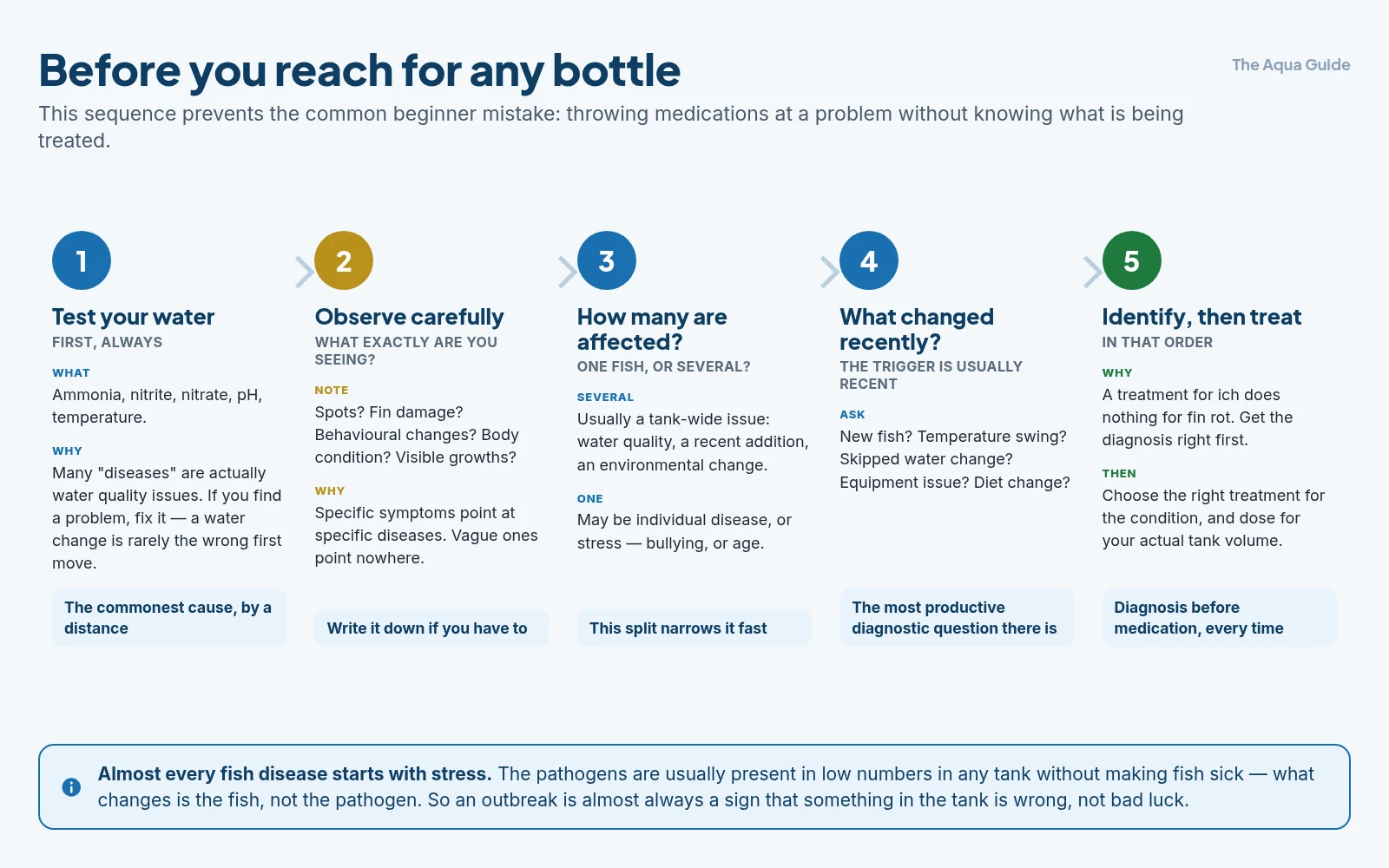
When you notice any fish looking off, work through this framework before doing anything specific:
1. Test your water. Ammonia, nitrite, nitrate, pH, temperature. Many "diseases" are actually water quality issues. If you find a problem, fix it — a water change is rarely the wrong first move.
2. Observe carefully. What exactly are you seeing? Spots? Fin damage? Behavioral changes? Body condition issues? Visible growths? Note the symptoms specifically — they point at specific diseases.
3. Check whether multiple fish are affected. Multi-fish symptoms usually point to tank-wide issues (water quality, recent additions, environmental change). Single-fish symptoms may be individual disease or stress.
4. Ask "what changed recently?" New fish? Temperature swing? Skipped water change? Equipment issue? Diet change? The recent change is often the trigger.
5. Identify the likely disease before treating. A treatment for ich doesn't work on fin rot. Get the diagnosis right first.
6. Choose the right treatment for the diagnosed condition — and dose appropriately for your tank size.
This sequence prevents the common beginner mistake of immediately throwing medications at every problem without knowing what you're treating.
The Treatment Toolkit
Which medication, at what dose, and what not to combine it with is a subject of its own — aquarium medications: when to use what covers the categories and the interactions, including which ones will take your filter down with the pathogen.
Prevention: The Real Game
Nearly everything here is prevented by three habits: quarantine new arrivals (quarantine: why and how), keep the water right (water quality), and notice trouble early (healthy vs stressed fish).
When to Treat in the Display Tank vs. Hospital Tank
Treating the display tank medicates every fish, the plants and the filter bacteria along with the patient. Setting up and using a hospital tank covers when that trade is worth avoiding and how to run one.
When to Accept the Outcome
Hard truth: not every sick fish can be saved. Some diseases are fast-acting and lethal; some fish are too far gone when symptoms become visible; some treatments fail despite proper application. Doing your best — proper diagnosis, appropriate treatment, supportive conditions — gives the best chance, but not every case ends well.
When a fish is clearly suffering with no realistic chance of recovery (severe dropsy not responding to treatment, irreparable injury, advanced age decline), humane euthanasia is a legitimate option that many experienced keepers eventually face. The clove oil method is the standard accepted approach (a topic for advanced reference). Don't feel like you failed; sometimes the kindest thing is ending suffering.
The Bottom Line
Fish disease is almost always tied to stress — and stress comes from poor water quality, environmental swings, overcrowding, aggression, or other underlying problems. The most common conditions (ich, fin rot, fungus, velvet, columnaris, internal parasites, dropsy, swim bladder issues) are individually recognizable and treatable when caught early. The first response is always: test water, observe carefully, identify what you're seeing, and treat the right condition. Prevention through quarantine, stable water quality, modest stocking, good feeding, and daily observation is far more effective than any treatment protocol. Build the toolkit — water changes, salt, heat for ich, specific medications, a hospital tank for serious cases — and you'll handle 90% of beginner disease situations confidently. The detailed guides in this section take each piece further.
Related guides
- Common aquarium diseases: treatment lookup
- How to spot a healthy vs stressed fish
- Ich (white spot): identification and treatment
- Fin rot: causes, recognition and recovery
- Fungal infections: cotton-like growth
- Velvet, columnaris and other bacterial issues
- Quarantine: why and how
- Setting up and using a hospital tank
Got questions about your specific setup? Drop them in our Community Forum — we love helping new fishkeepers get started right.
Each condition, and each step
This page is the first response. Identification and treatment for each condition live on their own pages.
- Disease treatment lookup — the index — start here if unsure
- Ich (white spot) — the most common, and the most treatable
- Fin rot — causes, recognition and recovery
- Fungal infections — cotton-like growth and treatment
- Velvet, columnaris and bacterial issues — the fast-moving ones
- Internal parasites — signs that are easy to miss
- Medications: when to use what — categories, doses and interactions
- Quarantine — the habit that prevents most of this
- Hospital tank — treating without dosing the display tank
- Healthy vs stressed fish — noticing trouble before it is disease
- Water quality — the cause behind most outbreaks