You notice white, fuzzy, cotton-like patches growing on one of your fish — maybe on the mouth, the body, or where a fin was damaged. This is most likely a fungal infection, the third common aquarium disease after ich and fin rot. The good news: fungal infections are usually slow-progressing, easy to identify, and respond well to treatment. Here's how to recognize them, what causes them, and the standard treatment protocol.
What is the white fuzzy growth on my fish?
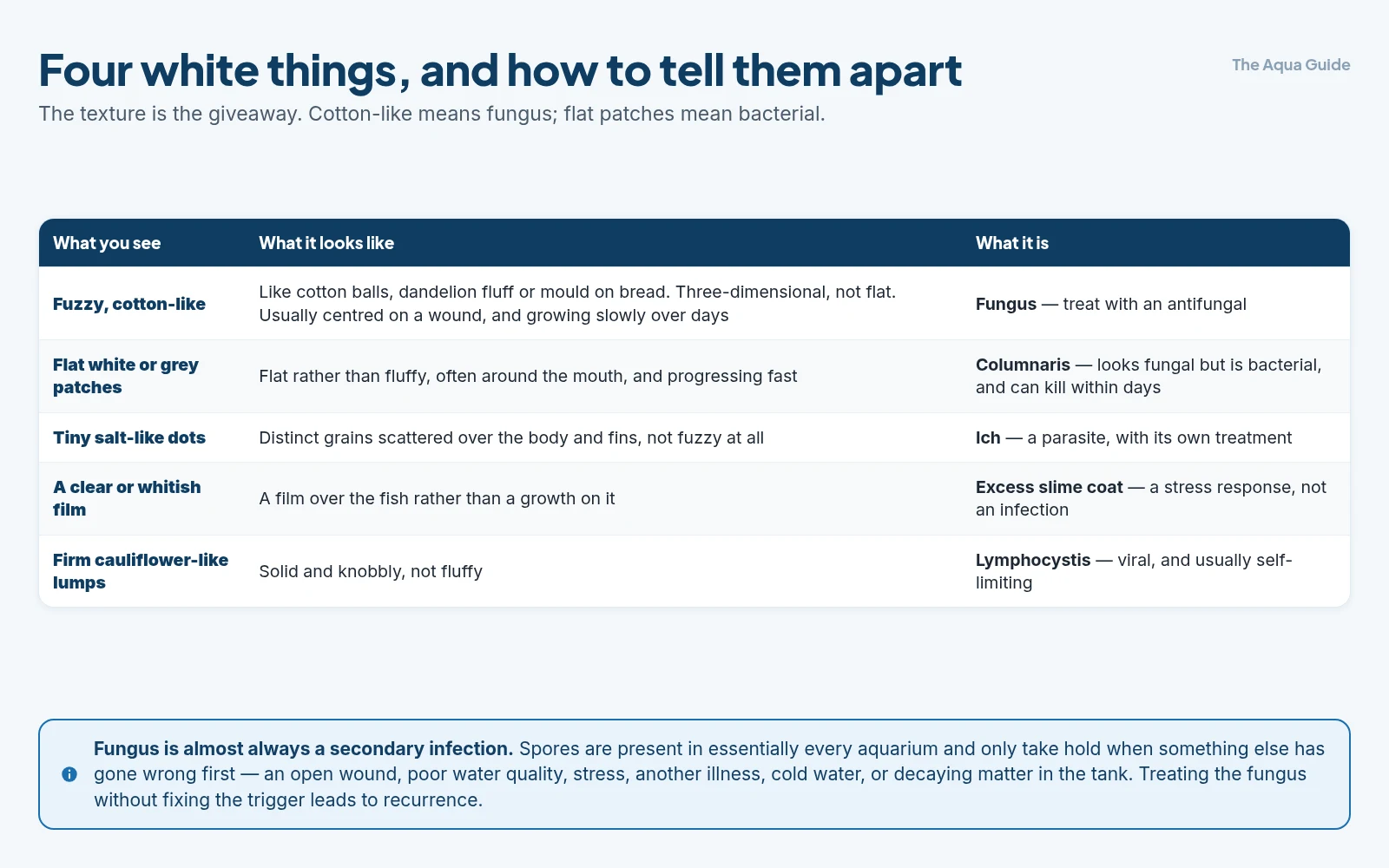
Fuzzy, cotton-like white or grey patches are almost always a fungal infection, usually centered on a wound or damaged fin. The three-dimensional fuzzy texture is what separates it from columnaris, which forms flat patches and kills far faster, and from ich, which appears as distinct salt-grain spots.
At a glance: the first five minutes
| Step | What you're doing |
|---|---|
| 1. Test your water | Ammonia, nitrite, nitrate, pH, temperature. Issues here often contribute |
| 2. Look for the cause | Is there a wound? Has the fish been bullied, netted or stressed? Has the heater failed? Find the trigger |
| 3. Do a 30% water change | Clean water alone helps |
| 4. Assess severity | A small isolated patch means gentle measures in the display tank. Multiple sites or rapid spread means a hospital tank and stronger medication |
| 5. Begin treatment | Based on that severity, not on the first product to hand |
Most mild cases resolve within a week on aquarium salt plus improved water quality — around 1 tsp per gallon, dissolved before adding. Skip the salt entirely if you have scaleless fish, plants, shrimp, or species that don't tolerate it.
What Fungal Infections Look Like
True fungal infections (most commonly Saprolegnia or related water molds) appear as:
- White or grey fuzzy, cotton-like growths on the body, fins, or mouth
- Cottony texture when viewed closely — fuzzy and dimensional, not flat
- Localized patches rather than full-body coverage (early on)
- Often centered on damaged tissue — wounds, fin damage, or stressed areas
- Slow growth over days, gradually expanding outward
The fluffy texture is the giveaway. If the white growth looks like cotton balls, dandelion fluff, or mold on bread, you're almost certainly looking at fungus.
Compared to other white conditions:
- Ich = tiny salt-like dots, not fuzzy
- Columnaris = flat white/grey patches, often around mouth, faster-progressing — looks fungal but isn't
- Excess slime coat = clear or whitish film over the fish, not fuzzy growth
- Lymphocystis = cauliflower-like firm lumps, not fluffy
The texture matters: cotton-like = fungus; flat patches = bacterial (likely columnaris).
Where Fungal Infections Appear
Common sites:
- Wounds and injuries — fungus colonizes broken skin quickly
- Damaged fins — often appearing alongside fin rot
- Mouth area — especially in fish that have rubbed against surfaces or fought
- Eggs — fungal infection of fish eggs is extremely common and a key concern for breeders
- Dead or dying fish — fungus can also colonize already-dead fish in the tank
Fungal infections are sometimes called secondary infections because they usually require a pre-existing problem (injury, weakened fish, dead tissue) to take hold. Healthy unstressed fish in clean water rarely develop fungus.
What Causes It
Fungal spores are naturally present in essentially every aquarium — they're part of the normal ecosystem. They become an infection problem only when:
Fish has open wounds or damage. Cuts, scrapes, fin damage, or other tissue injuries are entry points.
Water quality is poor. Elevated ammonia and nitrite weaken protective slime coats and immune function. High nitrate over time has the same effect.
Fish are stressed. Overcrowding, aggression, temperature swings, recent shipping — anything that reduces immune defenses.
Concurrent disease. Fish fighting another illness often develop fungus as a secondary issue.
Cold water temperatures. Fungal infections are more common in tanks running cooler than the fish prefer.
Dirty conditions. Decaying organic matter in the tank (uneaten food, dead plant material, debris) elevates fungal spore counts.
Identifying the underlying trigger is essential. Treating the fungus without fixing what's allowing it to take hold leads to recurrence.
The First Response
When fungal patches appear:
1. Test your water. Ammonia, nitrite, nitrate, pH, temperature. Issues here often contribute.
2. Look for the cause. Is there a wound? Has the fish been bullied, netted, or stressed? Has the heater failed? Find the trigger.
3. Do a 30% water change. Clean water alone helps.
4. Assess severity. Small isolated patch = treat in display tank with gentle measures. Multiple sites or rapidly spreading = move to hospital tank with stronger medication.
5. Begin treatment based on severity.
Treatment for Mild Fungal Infections
For small, localized fungal patches on otherwise healthy fish:
Aquarium salt at moderate concentration (around 1 tsp per gallon dissolved before adding) is effective against most fungal infections in compatible tanks. Continue for a week or two. Skip if you have scaleless fish, plants, shrimp, or species that don't tolerate salt.
Improved water quality. Daily 25% water changes ensure clean conditions during recovery.
Stable temperature at the upper end of the fish's comfort range helps immune function.
Removal of any decaying matter in the tank — dead plant leaves, uneaten food, debris in corners.
Methylene blue is a traditional gentle antifungal that works well as a quick bath or short-term treatment. Often used for sensitive fish or egg fungus.
Most mild cases resolve within a week with salt + water quality improvement.
Treatment for Moderate to Severe Fungal Infections
When fungus is spreading or affecting multiple sites, more direct treatment helps:
Commercial antifungal medications:
- Pimafix / Melafix combinations — gentle plant-derived treatments, suitable for most tanks including planted
- Methylene blue — traditional, very gentle, good for sensitive fish
- Malachite green — strong antifungal, harsh on some fish (don't use with scaleless species or tetras at full strength)
- API Fungus Cure or similar — combination antifungal/antibacterial products
Treatment process:
- Remove activated carbon from the filter.
- Follow label dosing exactly for your tank volume.
- Treat for the full course — typically 5–7 days.
- Maintain heavy aeration during treatment.
- Daily water changes of 25% between doses help with severe cases.
- After treatment, large water change and replace carbon to remove residual medication.
Consider hospital tank treatment for severe cases — protects healthy tankmates from medication and lets you focus care on the sick fish.
Special Case: Fungus on Fish Eggs
Egg fungus is a major concern for breeders. Saprolegnia readily colonizes both unfertilized eggs (which it eats) and any nearby fertilized eggs.
Prevention and treatment:
- Remove unfertilized eggs (typically white and opaque) promptly — they're the fungal entry point
- Use methylene blue in breeding tanks at low concentrations — gentle, antifungal, doesn't harm developing eggs
- Good water flow through the egg area helps prevent fungal colonization
- Snails or shrimp in breeding tanks can eat fungal-infected eggs before fungus spreads
Many breeders routinely add a few drops of methylene blue to all egg-rearing setups as preventive measure.
What NOT to Do
A few common mistakes:
Don't ignore small patches hoping they'll go away on their own. Fungus spreads. Treat early.
Don't use excessive salt — at high concentrations, salt can harm fish. Follow recommended doses for your species.
Don't mix multiple medications without research. Some combinations are dangerous (e.g., copper-based ich treatments + certain antibacterials can stress fish heavily).
Don't treat without diagnosis — what looks like fungus might be columnaris (bacterial), which needs different treatment. The texture test (fuzzy vs. flat) helps; when in doubt, treat with broad-spectrum products like salt + mild antibacterial + antifungal.
Don't expect overnight cures — even with proper treatment, fungus takes 5–10 days to clear.
Recovery
Successful treatment shows:
- Fungal patches stop spreading within 2–3 days
- Patches shrink and disappear over the next several days
- Damaged underlying tissue starts healing (scale regrowth, fin regeneration)
- Fish behavior normalizes — feeding, activity, color all improve
Full recovery, especially with tissue damage, takes weeks. Be patient and maintain excellent care through the recovery period.
Distinguishing Fungus from Columnaris
This distinction matters because columnaris is bacterial and faster-acting — treatments differ. Quick comparison:
| Feature | Fungus | Columnaris |
|---|---|---|
| Texture | Fluffy, cottony, 3D | Flat patches, sometimes pale grey/white |
| Location | Often on wounds | Often around mouth/head ("mouth fungus" despite being bacterial) |
| Speed | Slow days | Fast, can kill within days |
| Color | White or off-white | White, grey, or yellowish |
| Treatment | Antifungal | Antibacterial (often needs antibiotics) |
If white growth appears around the mouth or progresses very quickly, suspect columnaris and treat with antibacterials (often kanamycin or furan-2). True fungus is slower and more localized.
Preventing Fungal Infections
Strong prevention is straightforward:
Maintain excellent water quality. Clean stable water means fewer fungal spores active and stronger fish immunity.
Prevent injuries. Compatible tankmates, gentle handling, no sharp décor.
Treat injuries promptly. A small wound treated with mild antifungal (like a salt dip or methylene blue) prevents fungal colonization.
Stable warm temperatures. Most fungal infections occur in cooler conditions; keeping tropical fish at proper temperatures helps.
Quarantine new arrivals. Fish from stores often arrive with minor damage or stress; quarantine catches developing fungus.
Remove dead/decaying matter promptly. Fungus thrives on decay; clean tanks have fewer active spores.
The Bottom Line
Fungal infections appear as fuzzy, cotton-like white or grey growths on fish — usually centered on wounds, damaged fins, or stressed areas — and almost always develop secondary to an underlying issue (injury, poor water quality, stress, or other disease). The fuzzy 3D texture distinguishes fungus from flat bacterial patches (columnaris) and from spots (ich). Mild cases respond well to aquarium salt + water quality improvement; moderate-severe cases need commercial antifungal medications. The cardinal rule is to identify and fix the underlying trigger alongside treating the fungus, or it returns. Methylene blue is the standard gentle treatment, particularly important for breeding tanks with fish eggs. Prevent fungal infections through clean water, compatible stocking, prompt wound care, stable temperatures, and quarantine — and recognize them early so treatment stays simple.
Related guides
- Velvet, columnaris and other bacterial issues
- Ich (white spot): identification and treatment
- Fin rot: causes, recognition and recovery
- Setting up and using a hospital tank
- Aquarium medications: when to use what
- Common aquarium diseases: treatment lookup
- How to spot a healthy vs stressed fish
- Setting up a breeding tank
Got questions about your specific setup? Drop them in our Community Forum — we love helping new fishkeepers get started right.