The fish-medication aisle is overwhelming. Dozens of products, dramatic packaging, broad claims, and not much guidance on what actually treats what. The good news: most aquarium medications fall into a small number of categories, each useful for specific conditions. Knowing which is which prevents wasted treatment and stressed fish. Here's the practical guide.
Which aquarium medication should I use?
That depends entirely on the diagnosis, and getting the diagnosis first is the step most often skipped: white growths could be ich, fungus or columnaris, and each needs a different medication. Whatever you use, remove carbon from the filter before dosing, dose to the actual water volume, keep aeration high and finish the full course.
The Core Principle: Diagnosis First
Before any medication, you need to know what you're treating. This sounds obvious but is the most common beginner mistake — buying a "fish disease cure" without identifying which disease.
The same fish symptom can have different causes needing different treatments:
- White growths might be ich (parasitic), fungus (fungal), or columnaris (bacterial) — three different medications
- Ragged fins might be bacterial fin rot, mechanical damage, or fin-nipping — different responses
- Lethargy might be water quality, parasites, bacterial infection, or just temperature — different fixes
Treating without diagnosis often:
- Wastes the medication
- Stresses healthy fish unnecessarily
- Disrupts beneficial bacteria
- May actually harm the affected fish if it's the wrong treatment
The discipline of identifying the problem before treating is foundational. Refer to the disease-specific guides (ich, fin rot, fungus, columnaris, internal parasites) for diagnostic patterns.
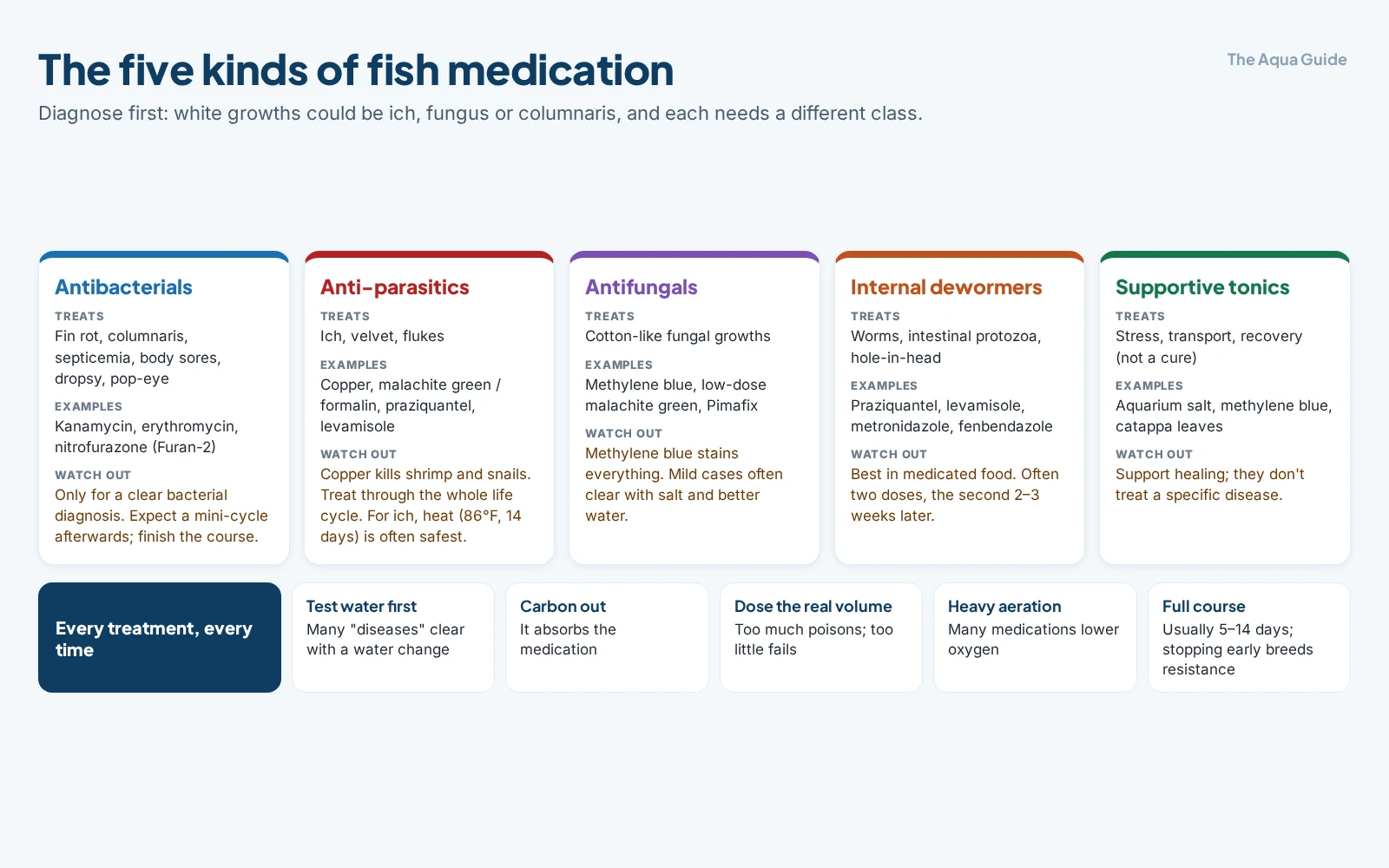
At a glance: the six categories
| Category | What it treats |
|---|---|
| 1. Antibacterials (antibiotics) | Bacterial infections — fin rot, columnaris, septicemia. Kanamycin, erythromycin, nitrofurazone |
| 2. Anti-parasitics | External parasites — ich, velvet, flukes |
| 3. Antifungals | True fungal growth, and fungus on eggs |
| 4. Anti-worm (internal) | Internal parasites, usually delivered in medicated food rather than in the water |
| 5. Stress reducers and tonics | Supportive rather than curative |
| 6. "Cure-all" products | Approach carefully — a product that treats everything is rarely the right treatment for what you actually have |
Remove activated carbon before dosing anything — it absorbs the medication. Antibiotics also harm your beneficial bacteria, so treat in a hospital tank where you can, never dose prophylactically, and always complete the full course.
The Medication Categories
Most aquarium medications fit into one of these categories:
1. Antibacterials (Antibiotics)
For bacterial infections — fin rot, columnaris, septicemia, body sores, dropsy, pop-eye.
Common products:
- Kanamycin — broad-spectrum, often the first-choice antibiotic for serious bacterial infections
- Erythromycin (Maracyn) — effective against gram-positive bacteria
- Nitrofurazone / Furan-2 — broad-spectrum, gentle on fish
- API General Cure — combination product (parasites + bacteria)
- API Fin & Body Cure — combination antibacterial for fin/body issues
Cautions:
- Remove activated carbon before treating — it absorbs medication
- Harm beneficial bacteria in the filter — expect a mini-cycle after antibiotic use
- Don't use prophylactically — overuse contributes to antibiotic resistance
- Complete the full course — stopping early breeds resistant bacteria
Use antibiotics when bacterial infection is clearly diagnosed and the fish is showing serious symptoms. Don't use for ich, fungus, or parasites — wrong drug class.
2. Anti-Parasitics
For parasitic diseases — ich, velvet, flukes.
Common products:
- Copper-based (CopperSafe, etc.) — effective for ich and velvet; LETHAL to invertebrates
- Malachite green / formalin combinations (Quick Cure, etc.) — classic ich treatment, can stain silicone
- Praziquantel — for flukes and tapeworms
- Levamisole — for nematodes and camallanus worms
Cautions:
- Copper is toxic to inverts — never use in shrimp/snail tanks
- Malachite green is harsh on scaleless fish (catfish, tetras at full strength)
- Some parasiticides are also hard on plants
- Treat for full lifecycle — many parasites have stages immune to medication; must treat through complete lifecycle
For ich specifically, heat treatment (raising to 86°F for 14 days) is often the safest first choice instead of medications — no chemicals, works on most community tanks.
3. Antifungals
For fungal infections — cotton-like growths.
Common products:
- Methylene blue — traditional, gentle, also used for egg fungus
- Malachite green at lower doses — antifungal
- Pimafix (Melaleuca-based) — plant-derived, gentle
- API Fungus Cure — broad antifungal/antibacterial combination
Cautions:
- Methylene blue stains everything — silicone, plants, hands
- Pimafix is mild — good for sensitive tanks but may not be strong enough for advanced cases
For most fungal infections, salt + improved water quality handles mild cases without needing dedicated antifungal medication. Antifungals come in for moderate to severe cases.
4. Anti-Parasitic / Anti-Worm (Internal)
For internal parasites — worms, intestinal protozoa.
Common products:
- Praziquantel — flatworms, tapeworms, some flukes
- Levamisole — nematodes, camallanus worms
- Metronidazole (Flagyl) — hexamita, intestinal protozoa, hole-in-head
- API General Cure — combination (praziquantel + metronidazole)
- Fenbendazole — broad-spectrum worm treatment
Cautions:
- Best delivered via medicated food (mixed into food and fed) — gets directly to the gut where parasites live
- Two-dose protocol often needed — first dose kills adults, second dose 2–3 weeks later catches new hatchlings
- Levamisole is hard to find in commercial fish products in some regions; vet-grade may be needed
5. Stress Reducers / Tonics
For supporting fish during stress, transport, or recovery — not curative but supportive.
Common products:
- Aquarium salt — broad supportive use; antibacterial mild antifungal at moderate doses
- Methylene blue — also used as a gentle stress reducer and oxygen-substitute for transport
- Stress Coat / Slime Coat products — claim to enhance fish slime production
- Indian almond leaves (catappa) — natural tannin source that has mild antibacterial/antifungal properties
These don't treat specific diseases but support fish health and recovery. Salt in particular is one of the most useful general tools (with the species/tolerance caveats).
6. "Cure-All" Products to Approach Carefully
Some products are marketed as broad-spectrum "fish disease cures" or "ick removers" without specifying what they treat or how. A few:
Combination products like API General Cure (clearly identified contents — praziquantel + metronidazole) — useful and effective.
Mystery "fix" products — without clear active ingredients, hard to evaluate. Some work; some are mostly placebo. Read labels carefully and check active ingredients.
Herbal/plant-extract products (Pimafix, Melafix) — mild antibacterial/antifungal properties from melaleuca/cajeput oils. Safe and gentle, but not as strong as dedicated medications. Useful for mild conditions.
When buying, prefer products with clearly labeled active ingredients so you know what you're actually dosing.
The Application Process
For most aquarium medications, the standard process:
1. Confirm diagnosis before starting.
2. Prepare the tank:
- Remove activated carbon from the filter
- Do a water change before starting (cleaner baseline)
- Note the tank volume accurately (overdosing = poison; underdosing = ineffective)
3. Dose according to label for your tank volume. Many medications come in tablet or capsule form designed for specific gallon counts.
4. Treat for the full duration specified — usually 5–14 days depending on the medication.
5. Maintain heavy aeration — many medications reduce dissolved oxygen.
6. Daily water changes of 25% between doses can help with severe cases (re-dose medication after water changes).
7. After treatment, replace carbon, do a large water change, and let the tank stabilize.
8. Observe for improvement and watch for negative effects on sensitive species.
What NOT to Mix
A few medication combinations to avoid:
Don't mix copper-based ich medications with most antibiotics — combined stress on fish.
Don't combine high-dose malachite green with antibiotics — significant fish stress.
Don't use formalin with high temperatures — formalin's toxicity increases at higher temperatures.
Don't combine multiple antibiotics without research — some are incompatible, and the combined load on fish is hard.
Don't dose a second medication immediately after another — let the first clear (carbon, water changes) before starting another treatment.
When in doubt, consult a knowledgeable source before mixing.
What Each Common Disease Needs
Each condition has its own identification and its own treatment, and getting the identification right is most of the work. The disease treatment lookup is the index; the individual conditions are listed at the end of this page.
When to Skip Medication Entirely
A great many problems are water quality wearing a costume, and medicating them makes things worse by damaging the filter as well. Test first — water quality — and if the fish is simply stressed rather than ill, healthy vs stressed fish is the distinction to make before reaching for a bottle.
Storing Medications
Most aquarium medications:
- Store cool and dry — bathroom cabinets are bad; cool dark cupboards are good
- Check expiration dates — most medications lose potency over time
- Discard products that look or smell off — discolored liquids, separated suspensions, off odors
- Keep away from children/pets — many fish medications are toxic to mammals at higher doses
A small organized "fish medicine cabinet" with the essentials is worth maintaining: aquarium salt, methylene blue, kanamycin or furan-2, praziquantel or API General Cure, and metronidazole covers most common situations.
When to Use What
A simple decision tree for a new symptom:
1. Test water first. Many "diseases" disappear with a water change.
2. Identify the visual/behavioral pattern. Spots? Fuzz? Patches? Behavioral only?
3. Match to disease type. Refer to the specific disease guides.
4. Choose the appropriate medication class. Don't use ich medication for fin rot, or antibacterials for parasites.
5. Treat in hospital tank if appropriate — protects display tank, focuses care.
6. Complete the full course. Stopping early breeds resistance and fails to clear infections.
7. Restore normal conditions after treatment — water changes, carbon, observation period.
The Bottom Line
Aquarium medications fall into clear categories — antibacterials, anti-parasitics, antifungals, anti-worm, and supportive tonics — each appropriate for specific conditions. Effective treatment depends on correctly identifying what you're treating; the same symptoms can need different medications, and treating without diagnosis often wastes effort and stresses fish. Build a small toolkit: aquarium salt, methylene blue, kanamycin or furan-2 for bacterial, API General Cure or metronidazole for internal parasites, and that handles most common situations. Always remove carbon before treating, dose accurately, maintain heavy aeration, complete the full treatment course, and follow up with water changes and observation. Sometimes the right answer is no medication at all — water quality alone resolves many issues. The combination of accurate diagnosis, appropriate medication choice, and proper application is what separates effective treatment from frustrating trial-and-error.
Got questions about your specific setup? Drop them in our Community Forum — we love helping new fishkeepers get started right.
The individual conditions
Identification comes first, and each condition below has its own page covering recognition and treatment.
- Disease treatment lookup — the index of conditions and treatments
- The beginner's guide to fish disease — where to start if you are not sure
- Ich (white spot) — identification and treatment
- Fin rot — causes, recognition and recovery
- Fungal infections — cotton-like growth and how to treat it
- Velvet, columnaris and bacterial issues — the ones that move fast
- Internal parasites — signs and treatment
- Quarantine — the step that prevents most of this
- Hospital tank — treating without medicating the display tank
- Healthy vs stressed fish — telling illness from stress
Related guides
- Common aquarium diseases: treatment lookup
- The beginner's guide to fish disease
- Setting up and using a hospital tank
- Quarantine: why and how
- Ich (white spot): identification and treatment
- Fin rot: causes, recognition and recovery
- Fungal infections: cotton-like growth
- How to spot a healthy vs stressed fish