Unlike the visible problems of ich, fin rot, or fungus, internal parasites work invisibly — and that's what makes them harder to recognize. A fish can host parasites for weeks or months before symptoms become obvious, by which point the infestation is well-established. The good news: internal parasites have recognizable indirect signs, and effective treatments exist for the most common types. Here's how to spot them and what to do.
How do I know if my fish has internal parasites?
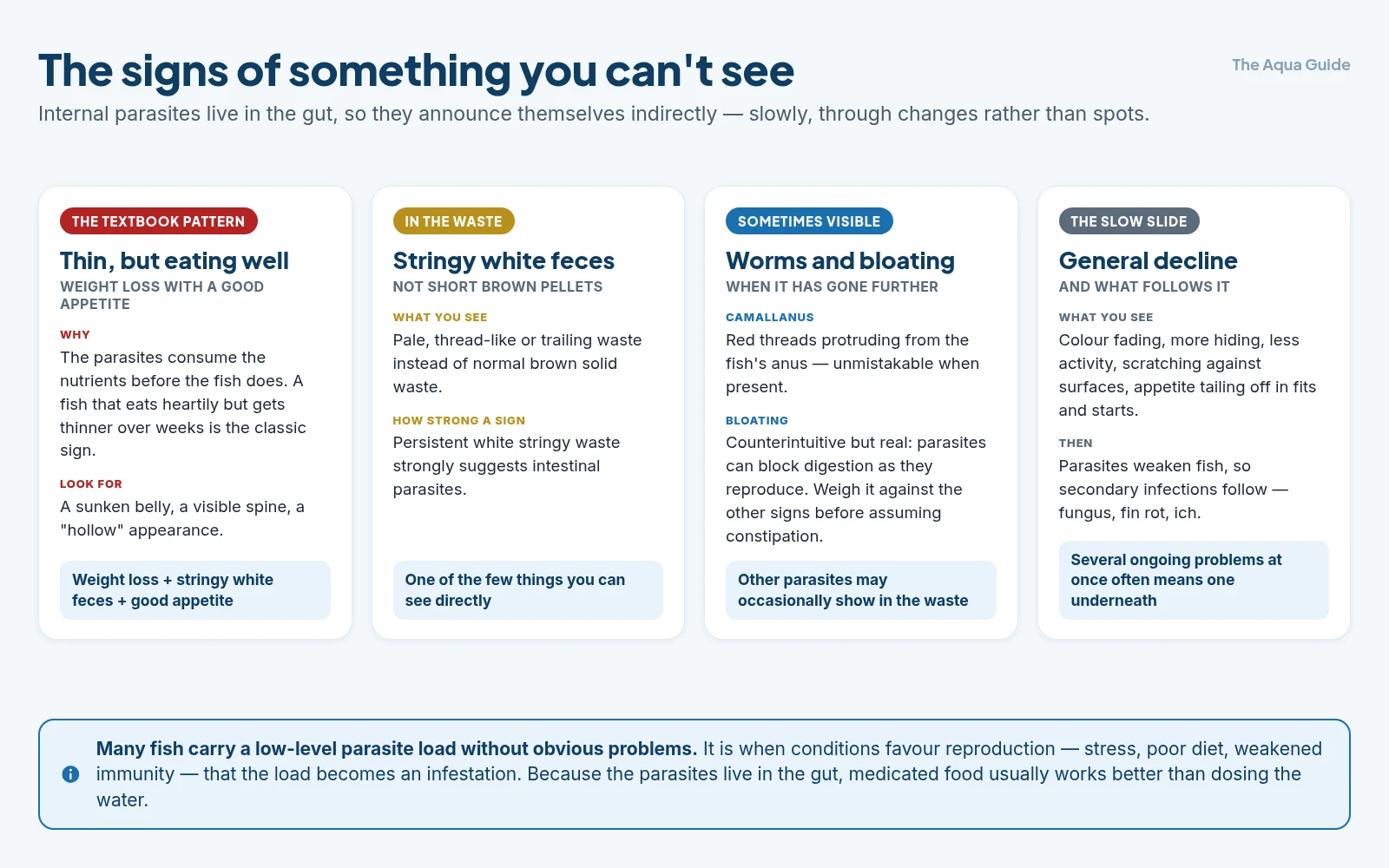
The classic pattern is weight loss despite eating normally, stringy white feces and sometimes bloating; red camallanus worms protruding from the anus make it obvious when they are present. Because the parasites live in the gut, medicated food usually works better than dosing the water, and the medication depends on the parasite type.
At a glance: what might be in there
| Parasite | What it is |
|---|---|
| Camallanus worms | Small red worms, visible protruding from the anal area — the one case where you see the parasite itself |
| Hexamita / Spironucleus | Protozoan parasites in the intestines, associated with hole-in-head disease |
| Tapeworms | Long flat worms in the intestines |
| Nematodes (roundworms) | Various species, in the gut |
| Flukes | Flatworms that can live externally on gills or skin, and also internally |
Most aquarium diseases announce themselves visually. These live inside the fish, so their effects appear slowly, through behavioural and physical change rather than dramatic symptoms — which is why a fish can host them for weeks or months before anything looks obviously wrong.
Why Internal Parasites Are Trickier
Most aquarium diseases announce themselves visually — you see spots, fuzz, or fin damage. Internal parasites live inside the fish, often in the digestive tract, and their effects appear slowly through behavioral and physical changes rather than dramatic visible symptoms.
Common kinds in aquarium fish include:
- Camallanus worms — small red worms visible protruding from the anal area
- Hexamita / Spironucleus — protozoan parasites in the intestines, associated with hole-in-head disease
- Tapeworms — long flat worms in the intestines
- Nematodes (roundworms) — various species in the gut
- Flukes — flatworms that can live on gills or skin externally and also internally
Many fish carry low-level parasite loads without obvious problems. It's when conditions favor parasite reproduction — stress, poor diet, weakened immunity — that infestations become severe enough to cause symptoms.
The Signs to Watch For
Indirect symptoms that suggest internal parasites:
Weight loss despite eating normally — the parasites consume nutrients before the fish does. A fish that eats heartily but gets thinner over weeks is a classic sign. Watch for sunken belly, visible spine, or "hollow" appearance.
Stringy white feces — pale, thread-like, or trailing waste rather than the normal short brown pellets. Healthy fish have brown solid waste; persistently white stringy waste strongly suggests intestinal parasites.
Bloated abdomen — counterintuitive but real: parasites can cause bloating as they reproduce and block digestion. Distinguish from constipation (which has different causes) by considering other signs.
Refusal to eat over time — gradual loss of appetite, sometimes alternating with brief eating periods.
Visible worms in the most obvious cases — camallanus worms appear as red threads protruding from the fish's anus. Other parasites may occasionally be visible in waste.
General decline — color fading, increased hiding, reduced activity, scratching against surfaces.
Concurrent issues — parasites weaken fish, making them prone to secondary infections (fungus, fin rot, ich). A fish with multiple ongoing problems often has underlying parasite issues.
The combination of weight loss + stringy white feces + good appetite is the textbook intestinal parasite pattern.
Where Parasites Come From
Internal parasites are typically introduced through:
New fish. Wild-caught fish often carry parasites; even captive-bred fish can carry low loads. This is the main route into aquariums.
Live foods. Live brine shrimp, blackworms, tubifex, and similar can carry parasites. Frozen versions are safer.
Plants. Especially wild-collected or pond-source plants may harbor parasite cysts.
Other tanks via shared equipment — nets, siphons, hands transferred between tanks without disinfection.
Quarantine of new fish (and ideally new plants) is the primary prevention tool.
Diagnosis Challenges
Honest acknowledgment: diagnosing specific parasites without a microscope is hard. You're usually working from symptom patterns rather than confirmed species identification.
Practical approach:
If you see worms (red worms from anus = camallanus; tiny visible worms in feces = various) — diagnose specifically and treat accordingly.
If you see the combination of weight loss + stringy white feces + good appetite — assume intestinal parasites generally and treat with broad-spectrum antiparasitic medication.
If you see Hexamita-style symptoms (alongside hole-in-head disease, often in cichlids) — treat with metronidazole specifically.
If you can't identify but suspect parasites — broad-spectrum treatment is reasonable, though don't medicate without genuine suspicion.
Treatment by Parasite Type
Camallanus Worms
Recognizable as red thread-like worms visible from the fish's anus. Common in livebearers.
Treatment:
- Levamisole is the standard treatment — most effective option
- Fenbendazole also works
- Treatment process: dose according to label, repeat in 2–3 weeks (kills adult worms but not eggs; second dose catches new hatches)
- Improve water quality during treatment
Levamisole-based products are sold for aquariums or can be sourced from veterinary suppliers (fish-medication grade). Follow specific product instructions carefully.
Hexamita / Spironucleus / Hole-in-Head
Protozoan parasites in the intestines, often associated with HITH in cichlids.
Treatment:
- Metronidazole is the standard — sold as fish medication or sometimes used from human/vet sources
- Treatment process: typically 5–7 days at recommended dose, sometimes administered through medicated food
- Improve diet — varied vitamin-rich foods support recovery
- Improve water quality — chronic poor conditions are a risk factor
Metronidazole is the antibiotic-class workhorse for various internal protozoan issues.
Tapeworms and Other Intestinal Worms
Long flat worms (tapeworms) or various roundworms in the intestines.
Treatment:
- Praziquantel — broad-spectrum, effective against most flatworms and tapeworms
- Levamisole — for nematodes (roundworms)
- Combination products like API General Cure (which contains praziquantel + metronidazole) handle multiple parasite types
API General Cure is a popular broad-spectrum option that addresses several common parasites simultaneously.
Skin and Gill Flukes (External-Internal Hybrid)
Tiny flukes living on gills or skin, often causing flashing, gasping, mucus excess.
Treatment:
- Praziquantel is effective
- Formalin baths in severe cases (with caution — strong treatment)
General Treatment Approach
For suspected internal parasites without specific identification:
1. Confirm symptoms are consistent. Don't medicate based on a single ambiguous sign. The combination pattern (weight loss + white feces + intact appetite, or visible worms) gives confidence.
2. Use a broad-spectrum antiparasitic. Products like API General Cure (praziquantel + metronidazole) cover multiple common parasite types.
3. Treat in hospital tank if possible. Concentrates the medication and protects healthy tankmates from unnecessary exposure.
4. Follow the full treatment course — usually 5–7 days for the initial dose, sometimes with a second dose 2–3 weeks later to catch newly-hatched parasites.
5. Improve diet quality during recovery. Varied, high-quality, vitamin-rich foods help fish rebuild condition. Many keepers use medicated food (medication mixed with food) for direct intestinal delivery.
6. Address water quality and stress. Healthy fish in clean water resist parasites; sick fish in poor conditions stay sick.
Medicated Food: The Best Delivery for Internal Parasites
For intestinal parasites, getting medication INTO the fish matters more than diluting it through tank water. Medicated food is often more effective than water dosing.
Preparation:
- Mix recommended dose of medication (metronidazole, levamisole, praziquantel) with a small amount of warm water
- Soak fish food in the medicated water for 15–30 minutes
- Feed the medicated food in normal small portions
- Repeat daily for the treatment course (typically 5–7 days)
Several commercial pre-made medicated foods are also available — convenient when treating cichlids or other fish that take pelleted food readily.
Special Considerations
Pregnant livebearers — some treatments are hard on fry/embryos. Research before treating pregnant fish.
Invertebrates and plants — many parasite medications harm shrimp, snails, and some plants. Hospital tank treatment is safer for mixed setups.
Sensitive species — some tetras, certain catfish, scaleless fish — may not tolerate full-strength medications. Check tolerance.
Concurrent infections — fish with parasites often have secondary issues (fungus, fin rot). Treat the parasites primarily but be prepared to address secondary infections as the fish recovers.
Recovery and Aftercare
After successful treatment:
- Appetite improves within days
- Stringy white feces returns to normal brown as the gut clears
- Weight gain over weeks as nutrients are absorbed normally
- Color and energy return
- Full recovery typically takes 4–8 weeks for severely affected fish
Important: continue to feed varied high-quality food for weeks after treatment to rebuild condition. Recovered fish often need extra feeding focus during recovery.
Preventing Internal Parasites
The big prevention measures:
Quarantine all new fish for 2–4 weeks, ideally with prophylactic deworming for any wild-caught or imported fish. Some keepers treat all new arrivals with API General Cure as a preventive measure during quarantine.
Avoid live foods from questionable sources. Stick to frozen alternatives, or use only known-clean live food sources.
Quarantine new plants too. A bleach dip or extended quarantine catches plant-hitchhiker parasites.
Maintain stable healthy conditions. Strong fish immune systems suppress low-level parasite populations effectively.
Observe carefully and regularly. Catching white stringy feces early lets you treat before significant damage.
When to Suspect Parasites
A useful mental flag: if you have a fish that's eating but losing weight over weeks, or a fish with chronically white stringy waste, or a fish that's never quite right despite good water quality — internal parasites are a leading suspect. Many "mystery decline" cases are actually undiagnosed internal parasites.
The Bottom Line
Internal parasites are the invisible disease — typically diagnosed through indirect signs rather than dramatic visible symptoms. The classic pattern is weight loss despite eating normally, stringy white feces, and possibly bloating; visible parasites (camallanus worms protruding from the anus) make diagnosis easier. Treatment depends on the parasite type: levamisole or fenbendazole for nematodes/camallanus, metronidazole for hexamita and similar protozoa, praziquantel for tapeworms and flukes, or broad-spectrum products like API General Cure for unidentified cases. Medicated food delivers medication directly to the intestinal parasites and is often more effective than water dosing. Treatment courses are 5–7 days, sometimes with a second dose weeks later to catch new hatchings. Prevent introduction through quarantine of new fish, careful sourcing of live foods, plant quarantine, and stable healthy tank conditions that keep fish immune systems strong. Spot the indirect signs early, treat appropriately, and most parasite issues resolve fully.
Related guides
- Common aquarium diseases: treatment lookup
- The beginner's guide to fish disease
- Aquarium medications: when to use what
- Setting up and using a hospital tank
- Quarantine: why and how
- How to spot a healthy vs stressed fish
- Choosing the right food: flakes, pellets, frozen, live
- Velvet, columnaris and other bacterial issues
Got questions about your specific setup? Drop them in our Community Forum — we love helping new fishkeepers get started right.