Quarantine is the habit that separates beginners from intermediate hobbyists, and the one most beginners skip — until the first time they introduce a disease into an established tank and watch fish they've kept for months get sick. A simple quarantine tank, used for a couple of weeks before any new fish joins your main display, prevents this almost entirely. Here's why quarantine matters, how to set one up cheaply, and what to actually do during those two weeks.
Do I need to quarantine new fish?
It is the single most effective way to keep disease out of an established tank: 2–4 weeks in a separate 10–20 gallon setup with a sponge filter, heater, minimal decor and a lid, observing daily and treating anything that appears in isolation. Even a well-run shop cannot catch every parasite in a fish that looks healthy in its tank.
Why Quarantine Matters
Every fish you bring home is a potential disease carrier. Fish stores cycle thousands of fish through their systems, often from many sources, and even well-run stores can't catch every parasite or bacterial issue in a fish that looks healthy in their tank. New fish are also stressed from transport, which suppresses their immune systems and makes hidden infections flare up. The result: a fish that looked fine at the store can develop visible disease three days after going into your community tank — and by then, the parasites or bacteria have spread to everyone else.
A quarantine tank is a separate, simpler tank where new fish stay for 2–4 weeks. During that time, any diseases they're carrying have time to manifest, you can treat them in isolation, and your main community is protected. If the new fish stays healthy through quarantine, you can confidently move it to the display tank. If it gets sick, you treat it without exposing everyone else to medication, stress, and pathogens.
The math is brutal but simple: setting up a small quarantine tank costs roughly the price of one nice fish. Losing your entire community to a disease introduced by an un-quarantined new fish costs vastly more in money, time, and heartbreak. Quarantine is one of the highest-return habits in the hobby.
What a Quarantine Tank Looks Like
The good news: a quarantine tank doesn't need to be fancy. Most experienced keepers run small, simple, bare-bones setups specifically for this purpose.
Tank size: 10–20 gallons is plenty for almost any quarantine. Smaller for tiny fish, larger if you regularly quarantine bigger species. It doesn't need to look pretty.
Filtration: a small sponge filter is ideal — gentle, cycled-bacteria-friendly, and won't trap fish during medication-induced stress. (Sponge filters need an air pump to run.)
Heater: match the temperature your fish are used to. A small heater appropriate for the tank volume is fine.
Lighting: minimal — a basic light or even ambient room light works. You're not displaying these fish, just observing them.
Décor: keep it sparse but provide a few simple hiding places — a piece of PVC pipe, a plastic plant, an artificial cave. Stressed fish need shelter, but elaborate décor makes catching them and treating them harder.
Substrate: none, or a thin layer. Bare-bottom tanks are easier to clean and easier to spot waste in. Some keepers prefer no substrate at all in quarantine.
Lid: important. Stressed new fish often jump.
That's the whole setup — under $100 for most beginner-scale quarantine tanks, easy to store and easy to fire up when needed.
At a glance: keeping it cycled, two ways
| Always-cycled | Borrowed filter | |
|---|---|---|
| How it works | The tank runs permanently, with the sponge filter holding bacteria | The tank sits empty. A day or two before a new fish arrives, you move a seasoned sponge from your main tank into it |
| What it costs you | You must feed the bacteria — a hardy "guinea pig" fish, a tiny pinch of food, or periodic ammonia dosing | Daily small water changes during quarantine, since the seeded filter may not be at full capacity |
| The advantage | Ready immediately when a fish arrives | No permanent cycle to maintain |
| The catch | Ongoing upkeep | You have to plan ahead |
Beginners often start with the borrowed filter, since it is lower maintenance. As you keep more fish, an always-running quarantine becomes more practical.
Keeping the Quarantine Tank Cycled (or Not)
There are two approaches, both valid:
Approach 1 — Always-cycled quarantine. Keep the quarantine tank running permanently with the sponge filter holding bacteria. This means the tank is always ready, but you need to feed the bacteria — either with a permanent low-stocking "guinea pig" fish (some keepers use a hardy minnow), with a tiny pinch of food, or with periodic ammonia dosing (fishless cycling maintenance). The advantage: when a new fish arrives, the tank is ready immediately.
Approach 2 — Borrowed-filter quarantine. Keep the tank empty between uses. When a new fish is coming, move one of your seasoned filter sponges (or media) from your main tank to the quarantine tank a day or two ahead. This seeds the quarantine with bacteria. Top up with daily small water changes during quarantine to keep ammonia in check, since the seeded filter may not have grown to full capacity. The advantage: no need to maintain a permanent cycle; the disadvantage: you have to plan ahead.
Beginners often start with the borrowed-filter approach since it's lower-maintenance. As you keep more fish, an always-running quarantine becomes more practical.
The Quarantine Process Step by Step
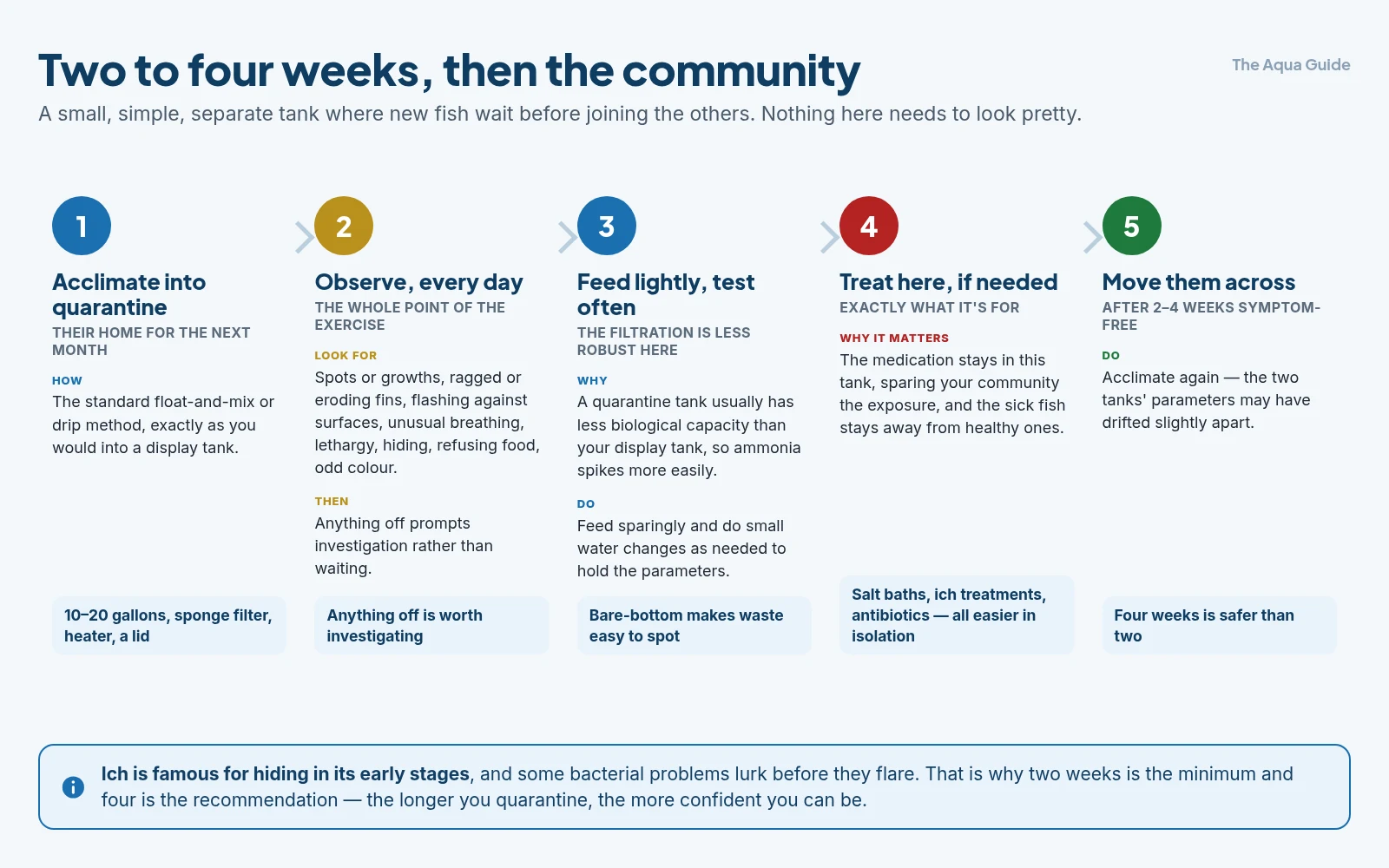
1. Acclimate the new fish to the quarantine tank using the standard float-and-mix or drip method (covered separately). Treat the quarantine tank as their new home for the next 2–4 weeks.
2. Observe carefully for the full quarantine period. Watch every day for: spots or growths on the body (ich, fungus, bacterial infection), ragged or eroding fins (fin rot, septicemia), flashing or scratching against surfaces (parasites or irritation), unusual breathing patterns (gill flukes, ammonia stress), lethargy, hiding, refusing food, or unusual coloration. Anything off prompts investigation.
3. Feed lightly and watch water. Quarantine tanks often have less robust biological filtration than display tanks, so feed sparingly to avoid ammonia spikes. Test water frequently; do small water changes as needed to keep parameters good.
4. Treat if needed. If disease appears, treat in the quarantine tank — that's exactly what it's for. Common treatments for common issues: salt baths for many bacterial/parasitic problems, dedicated medications for ich, antibiotics for bacterial infections. The key benefit: medications stay in the quarantine tank, sparing your community from medication exposure, and the sick fish stays isolated from healthy ones.
5. After 2–4 weeks symptom-free, move to the display tank. Acclimate the fish again to your main tank's water (parameters may have drifted slightly between the two tanks). They're now ready to join your community.
How Long Should Quarantine Be?
The standard recommendation is 2–4 weeks minimum, with 4 weeks being safer. Some diseases have life cycles that don't fully manifest in 2 weeks — ich is famous for hiding in early stages, and certain bacterial issues can lurk before flaring. The longer you quarantine, the more confident you can be.
Some keepers do "prophylactic treatment" during quarantine — treating with a broad-spectrum medication even without visible symptoms, on the assumption that something is probably hiding. This is more aggressive than necessary for beginners and risks unnecessary stress, but for valuable fish or for fish from less-reliable sources, it's a real practice.
The Beginner Reality
For a true beginner with a single tank, running a separate quarantine setup may not be realistic — and that's okay. Two practical alternatives:
Source carefully. If you can't quarantine, become extra picky about where you buy. Healthy stores with healthy tanks reduce (though never eliminate) the risk. Observe fish in the seller's tank carefully before buying.
Watch your community closely after every addition. Without quarantine, your display tank is your quarantine — for everyone. Test frequently, watch fish closely for the first few weeks after any new addition, and be prepared to treat or rearrange if a problem appears.
As you become more invested in the hobby, a quarantine tank becomes an obvious next step. Many experienced keepers say their only regret is not setting one up sooner.
The Bottom Line
A quarantine tank — a small, simple, separate setup where new fish stay for 2–4 weeks before joining your community — is the single most effective way to prevent disease outbreaks in your main tank. Set one up with a 10–20 gallon tank, a sponge filter, a heater, minimal décor, and a lid; keep it cycled either permanently or by borrowing media from your main tank ahead of new arrivals. During quarantine, observe daily for signs of disease, feed lightly, test water frequently, and treat any problems in isolation. After 2–4 weeks symptom-free, move the new fish to your display tank. For beginners without space for a quarantine setup, source carefully and watch your tank closely after any new addition. As your hobby grows, quarantine becomes one of those habits you can't believe you ever lived without.
Related guides
- Setting up and using a hospital tank
- How to acclimate new fish properly
- How to spot a healthy vs stressed fish
- Common aquarium diseases: treatment lookup
- Ich (white spot): identification and treatment
- Aquarium medications: when to use what
- The beginner's guide to fish disease
- Adding fish in batches: how slow is slow enough?
Got questions about your specific setup? Drop them in our Community Forum — we love helping new fishkeepers get started right.