If you've spent any time researching aquarium fish, you've seen the advice "keep them in groups of 6 or more" attached to seemingly half of all community species. Why? What's actually going on with these groups, and what changes if you keep too few? Here's the difference between schooling and shoaling, why proper group sizes matter, and the practical numbers that make schooling fish actually thrive in your tank.
How many fish do I need in a school?
Six of the same species is the minimum and 8–10 or more is better, for most tetras, rasboras, danios, barbs, corydoras, loaches and otocinclus. Too small a group produces chronic stress, hiding, weakened immunity and early death — and fish recognize their own species, so three of one and three of a similar-looking other do not combine into a school.
At a glance: the same number, two very different tanks
| A balanced community | The tempting alternative |
|---|---|
| 8 neon tetras — one schooling species, properly grouped | 3 neons, 2 cardinals, 2 black skirt tetras |
| 6 corydoras — one bottom-dwelling group, properly sized | 2 cories |
| 4–5 platies for the upper-mid zone | 2 guppies, 1 platy |
| Optionally one dwarf or honey gourami as a centrepiece | 1 betta, 1 pleco |
| About 19 fish, every group meeting its needs | 14 fish, none of them in a real group, none thriving |
Same ballpark number, vastly worse outcome. One species at 8+ is far better than three species at 3 each.
Schooling vs. Shoaling: A Quick Distinction
The two words get used interchangeably, but they describe slightly different behaviors.
Shoaling is the broader term — fish living and moving as a loose social group for safety, foraging, and social structure. A shoal is fish hanging out together with some general coherence, not necessarily synchronized.
Schooling is the tighter version — fish moving as a coordinated unit, often turning and accelerating in unison. A school is the picture-perfect synchronized swimming of, say, a tight group of tetras flowing through a tank as one organism.
In practice, most aquarium fish referred to as "schoolers" are actually shoaling fish that occasionally form tight schools when stressed or when something catches their attention. The terms have blurred together in the hobby, and the practical implication is the same: these are social fish that need to be in groups. That's what really matters.
Why Group Size Matters
Schooling and shoaling species evolved to live in groups for very practical reasons. Safety in numbers — a predator has trouble singling out one fish in a moving school. Social structure — these fish are hard-wired to interpret the behavior of other group members; the presence of others tells them when to feed, when to flee, when it's safe to come out. Confidence — fish in groups explore openly; the same fish alone hides.
When you keep a schooling species in too small a group (one, two, or even three or four), you're depriving the fish of its evolved social structure. The consequences are concrete and observable:
Chronic stress. The fish remains in a state of mild alarm because the group it relies on isn't there. Long-term stress weakens the immune system and shortens lifespan.
Persistent hiding. Under-grouped schoolers spend their time hidden in plants or behind décor rather than swimming openly — defeating the entire point of having them.
Reduced feeding. Stressed fish eat less, grow slower, and lose condition.
Aggression toward other species. Counterintuitively, a stressed schooler may direct its anxiety outward, becoming nippy or aggressive toward tankmates. The "fin-nipping tiger barb" stereotype is largely tiger barbs kept in inadequate groups — properly schooled, they're far less of a problem.
Premature death. Fish kept in inadequate groups often die earlier than they should, with no obvious cause. Chronic stress is just hard on them.
So the "6 of each species" advice isn't aesthetic — it's a real biological requirement for fish that need group living.
Practical Group Sizes
The standard recommendations:
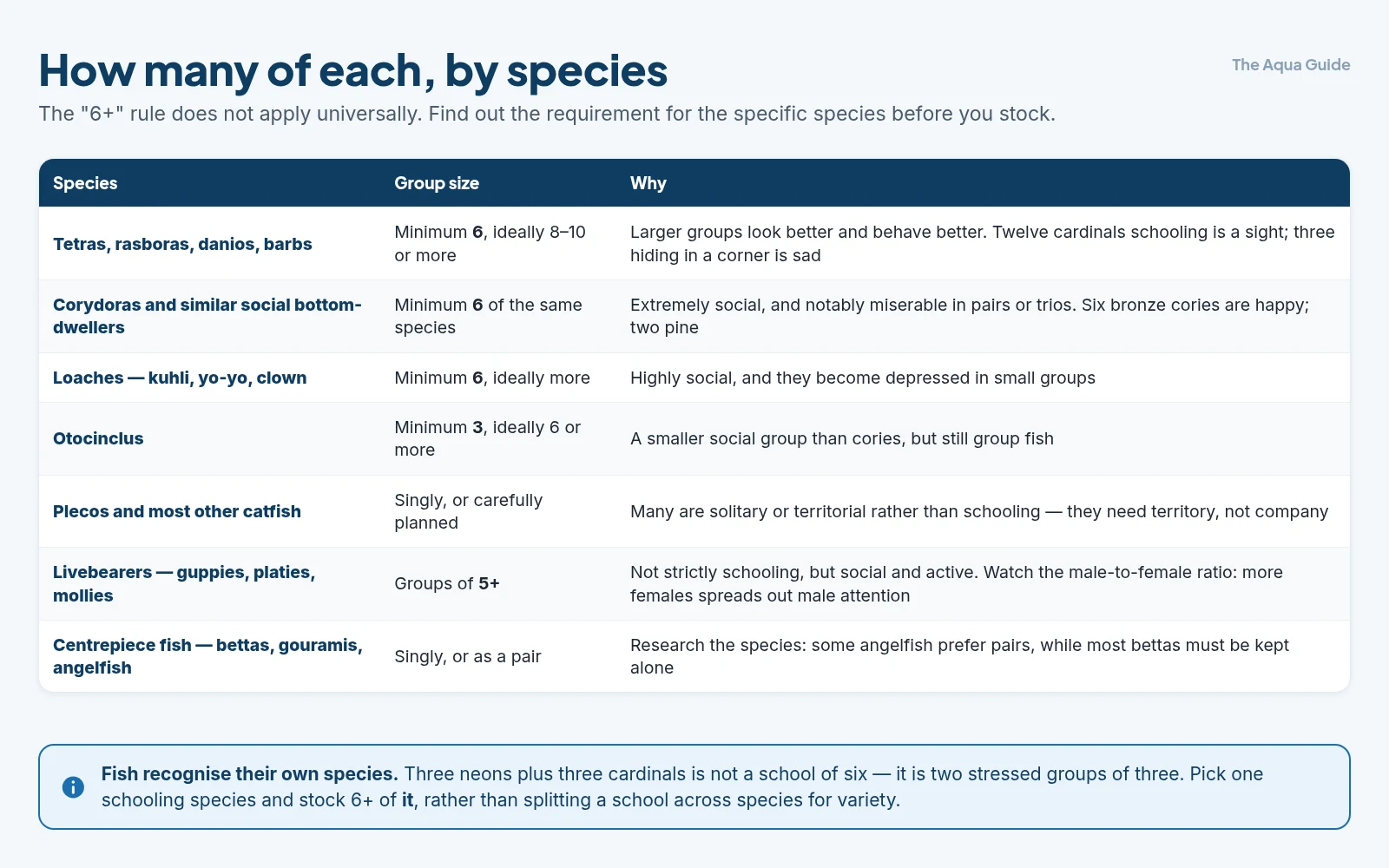
Schooling fish (tetras, rasboras, danios, barbs, most small community schoolers): Minimum 6, ideally 8–10 or more. Larger groups look better and behave better. Twelve cardinal tetras schooling together in a planted tank is a sight; three lonely cardinals hiding in a corner is sad.
Corydoras catfish and similar social bottom-dwellers: Minimum 6 of the same species. Cories are extremely social and notably miserable in pairs or trios. A group of six bronze cories is happy; two bronze cories pine.
Loaches (kuhli, yo-yo, clown, etc.): Minimum 6, ideally more. Loaches are highly social and become depressed in small groups.
Otocinclus catfish: Minimum 3, ideally 6 or more. Smaller social group than cories but still group fish.
Plecos and most catfish (other than cories/otos): Many plecos are solitary or territorial, not schooling — keep singly or in carefully-planned multi-pleco setups with enough territory.
Livebearers (guppies, platies, mollies): Not strictly schooling, but social and active. Groups of 5+ work well; pay attention to male/female ratios (more females than males to spread out male attention).
Centerpiece fish (bettas, gouramis, angelfish, etc.): Often kept singly or as a pair, not as a school. Always research the specific species — some angelfish for instance prefer pairs, while most bettas must be kept alone.
The key principle: find out the requirement for the specific species before stocking. Group needs vary, and the "6+" rule doesn't apply universally.
How Many of Each Species, in Practice?
Combining group needs with stocking planning, a typical community might look like this:
- One schooling species, properly grouped: 8 neon tetras (or 8 ember tetras, or 8 harlequin rasboras — pick one schooler, do it properly)
- One bottom-dwelling group, properly sized: 6 corydoras
- A few livebearers for the upper-mid zone: 4–5 platies
- Optionally a centerpiece: a single dwarf gourami or honey gourami
That's around 19 fish in a balanced setup, with every group meeting its needs. Compare to a tempting-but-wrong alternative: 3 neons, 2 cardinals, 2 black skirt tetras, 2 cories, 2 guppies, 1 platy, 1 betta, 1 pleco = 14 stressed fish, none of them in a real group, none of them thriving. Same number, vastly worse outcome.
When to Add More to Existing Schools
If you find yourself with an under-grouped schooling species (you bought 3 to "see how they do"), the right move is add more of the same species to get to the proper group size, not to replace them with a different species. Six tetras of one type beats three each of two types; consolidate and add until you have a real school.
When buying additions, add them as close together as possible so the school doesn't have to repeatedly reform — ideally as one batch (within the constraints of bacterial batching, covered separately).
A Note on Mixing Species in "Mixed Schools"
A common mistake: thinking that 3 neons + 3 cardinals = "6 tetras schooling together." It doesn't work that way. Schooling fish recognize their own species as schoolmates; other species, even similar-looking ones, don't count. Mixed-species "schools" rarely form cohesively; you get two separate small groups of stressed fish.
The right approach is to pick one schooling species and stock 6+ of it, rather than splitting your school across species for variety. If you want two schoolers, do two species at 6+ each — which means more tank space.
The exception: a few species genuinely will school together (some closely-related rasboras, for example), but this is unusual and species-specific. Default to "one species per school, 6+ per school."
What "Bigger Is Better" Looks Like
For most schooling species, the difference between 6 and 12 is real and visible. With 6, you have a small school that holds together loosely. With 12+, you have what looks like an actual natural school — tight formation, synchronized movements, confident exploration of the tank. The fish are notably calmer, eat better, color up more, and look like the photos on the fish-keeping forums that inspired you in the first place.
If your tank can handle it (per stocking math, not just enthusiasm), going to 10–15 of a schooling species rather than 6 is one of the most aesthetically and biologically rewarding upgrades you can make.
The Bottom Line
Schooling and shoaling species need to be in proper groups — minimum 6 of the same species, ideally 8–10 or more — because they evolved for group living, and inadequate groups produce chronic stress, hiding, weakened immunity, aggression, and early death. The advice applies to most tetras, rasboras, danios, barbs, corydoras catfish, loaches, otocinclus, and many other community species; verify the specific requirement for any species you're considering. Plan your stocking with this in mind: one species at 8+ is far better than three species at 3 each. Don't try to "mix" species into combined schools — fish recognize their own kind, not similar-looking neighbors. Group your schoolers properly, balance them across water-column zones, and you'll have a community that actually behaves like a healthy community — confident, active, and the lively display you imagined when you started the hobby.
Related guides
- How many fish can my tank hold?
- Community tank compatibility: what gets along
- Adding fish in batches: how slow is slow enough?
- Beginner-friendly fish species
- The beginner's guide to choosing fish
- How to spot a healthy vs stressed fish
- Fish compatibility quick reference
- How to acclimate new fish properly
Got questions about your specific setup? Drop them in our Community Forum — we love helping new fishkeepers get started right.