The questions every fishkeeper asks: "Can I keep X with Y? Will they get along? Which one will be bullied?" This is the quick lookup for common fish compatibility — peaceful community, semi-aggressive setups, what works, what doesn't, and the gotchas to watch for.
At a glance: the three questions
| Ask | Why it decides the answer |
|---|---|
| Do they want the same water? | Soft acidic against hard alkaline is the commonest silent mismatch. Both fish are peaceful; one of them never thrives |
| Do they want the same temperature? | Goldfish are cold-water fish. No amount of good intentions makes them tropical tankmates |
| Does one fit in the other's mouth? | A peaceful large fish will still eat a neon tetra overnight. Size compatibility is not about temperament |
After those three, everything else is temperament and layer: fin-nippers away from long fins, and stocking spread across top, middle and bottom rather than piled into one.
The Compatibility Framework
Three factors drive most compatibility:
Temperament — peaceful, semi-aggressive, aggressive Size — fish 2x larger than another may eat or bully the smaller Water parameter overlap — species needing very different water can't share a tank
A general guideline: peaceful + similar size + overlapping parameters = compatible. Failures usually involve one of these three.
Temperament Categories
Peaceful Community Fish
These belong together in mixed community tanks:
- Tetras (neon, cardinal, ember, glowlight, rummynose, lemon, black skirt)
- Rasboras (harlequin, chili, ember, lambchop)
- Corydoras catfish (panda, bronze, peppered, sterbai, julii)
- Otocinclus catfish (peaceful bottom-feeders)
- Small barbs (cherry barb, gold barb — though some barb species are nippy)
- Danios (zebra, leopard, pearl) — fast swimmers can stress slower fish
- White cloud minnows
- Hatchetfish
- Mollies, platies, swordtails (with caveats about males harassing females)
- Guppies (males may harass females, multiple males may chase each other)
Semi-Aggressive Fish
Need careful tankmate selection:
- Angelfish — eat small fish (neons!), peaceful with similar-size tankmates
- Gouramis (dwarf, pearl, blue) — males can be territorial; pairs work, multiple males don't
- Rainbowfish — boisterous, peaceful but stress smaller delicate fish
- Tiger barbs — fin-nippers; school of 6+ helps but not fool-proof
- Apistogramma and other dwarf cichlids — territorial during breeding
- Rams (German blue rams) — peaceful most of the time, territorial when spawning
- Bettas — aggressive to other bettas (males), variable with other fish
Aggressive Fish
Need species-specific tanks or carefully matched aggressive tankmates:
- African cichlids (Lake Malawi/Tanganyika) — aggressive; their own kind only
- Oscars — large, predatory, eat smaller fish
- Larger cichlids (Jack Dempsey, convicts, severums, etc.) — aggressive
- Larger pufferfish — fin nippers, sometimes predatory
- Larger catfish (some shovel-noses) — predatory, eat small fish
Common Compatibility Combos
Classic Beginner Community (Peaceful)
A typical 20-30 gallon community:
| Fish | Number | Layer | Notes |
|---|---|---|---|
| Neon or cardinal tetras | 8-10 | Mid | Schooling |
| Corydoras catfish | 6 | Bottom | Schooling, peaceful |
| Otocinclus | 4-6 | All (glass) | Algae eaters |
| Mystery snail | 1-2 | Bottom/glass | Optional cleanup |
| Cherry shrimp | 10+ | Bottom/plants | If no fish-shrimp issues |
Why this works: All peaceful, similar size, similar parameters (74-78°F, pH 6.5-7.5), occupy different tank levels.
Slightly Larger Community
A 40-55 gallon mid-range community:
| Fish | Number | Layer | Notes |
|---|---|---|---|
| Rummynose tetras | 8-10 | Mid | Schooling |
| Angelfish | 2 (pair) | Mid-upper | Centerpiece |
| Corydoras sterbai | 6 | Bottom | Schooling |
| Otocinclus | 4-6 | Glass | Algae |
| Cherry barbs | 8 | All levels | Peaceful schooling |
Why this works: Angels are big enough that small tetras can fit but rummynose are too big to be eaten. Higher levels filled with mid-swimmers; bottom by cories.
Dwarf Gourami Community
For tanks 20-30 gallons:
| Fish | Number | Layer | Notes |
|---|---|---|---|
| Dwarf gourami (male) | 1 (only) | Upper | Centerpiece |
| Harlequin rasboras | 8 | Mid | Schooling |
| Pygmy corydoras | 6 | Bottom | Schooling |
| Otocinclus | 4 | Glass | Algae |
Why this works: One male gourami avoids territory issues; rasboras and cories share levels peacefully.
Soft Acidic Community (Wild South American)
For pH 5.5-6.5, soft water:
| Fish | Number | Layer |
|---|---|---|
| Cardinal tetras | 10-12 | Mid |
| Hatchetfish | 6 | Upper |
| Sterbai corydoras | 6 | Bottom |
| Otocinclus | 4 | Glass |
| Apistogramma (pair) | 2 | Mid |
Why this works: All wild Amazonian species comfortable in soft acidic water.
Hard Water Community (African Setup or Hard Tap)
For pH 7.5-8.5, GH 12+:
| Fish | Number | Layer |
|---|---|---|
| Livebearers (platies, mollies) | 6-8 | Mid-upper |
| Synodontis catfish | 1-2 | Bottom |
| Mystery snails | 2 | Bottom |
Why this works: Hard-water species thrive together in alkaline conditions.
Common Incompatible Combos
These look reasonable but don't work:
Angelfish + Neon Tetras
Classic mistake. Angels grow to 6 inches; neons are 1-1.5 inches. Adult angels eat adult neons. Use rummynose, lemon, or other 2-inch tetras instead.
Goldfish + Tropical Fish
Goldfish need cool water (65-75°F); tropical fish need 74-80°F. Different requirements; can't share a tank.
Multiple Male Bettas
Will fight to the death. One male only, OR a sorority of multiple females (separate consideration).
Bettas + Fin-Nippers (Tiger Barbs, Some Tetras)
Long-finned bettas attract nippy fish. Tiger barbs are notorious; some tetras (serpaes, black skirts) can nip too.
Tetras + African Cichlids
Different parameters (soft acidic vs hard alkaline). Cichlids will eat tetras.
Discus + Most Community Fish
Discus need 84°F and very clean parameters; most fish find this too warm and clean.
Plecos + Discus (Common Plecos)
Common plecos rasp on discus slime coat at night. Use bristlenose plecos instead.
Cichlids + Shrimp
Most cichlids hunt shrimp. Even smaller dwarf cichlids will eat baby shrimp.
Loaches + Snails
Many loaches (clown, yoyo, kuhli) eat snails. If you want snails, avoid these loaches.
Multiple Male Gouramis
Males fight for territory. One male per tank (10+ gallons) or only females.
Schooling Fish Requirements
Many species require groups to thrive:
| Species | Minimum School Size |
|---|---|
| Neon/cardinal tetras | 8 |
| Corydoras | 6 |
| Otocinclus | 4 |
| Rasboras | 6-8 |
| Danios | 6 |
| Hatchetfish | 6 |
| Rummynose tetras | 8-10 |
| Glass catfish | 5+ |
| Cory fry | 6+ |
Keeping less than minimum causes stress, hiding, and often early death.
Top, Middle, Bottom Layer Distribution
Healthy community tanks have fish at different levels:
Top swimmers: Hatchetfish, some danios, gouramis, bettas, killifish Middle swimmers: Most tetras, rasboras, angelfish, barbs, rainbowfish Bottom dwellers: Corydoras, otocinclus, plecos, loaches, kuhli loaches
Mix species from each level for active-looking tanks. Don't overcrowd one level.
Water Parameter Matching
Even peaceful species can't share a tank with mismatched parameters:
| Need | Compatible | Incompatible |
|---|---|---|
| Soft acidic (pH 5.5-6.8, GH 1-8) | Tetras, discus, apistogramma, rams, wild bettas | Livebearers (mollies), African cichlids |
| Mid range (pH 6.8-7.5, GH 5-15) | Most community fish — middle ground | Discus needs softer; Africans need harder |
| Hard alkaline (pH 7.5-8.5, GH 12+) | Livebearers, African cichlids, shell-dwellers | Soft-water tetras, discus |
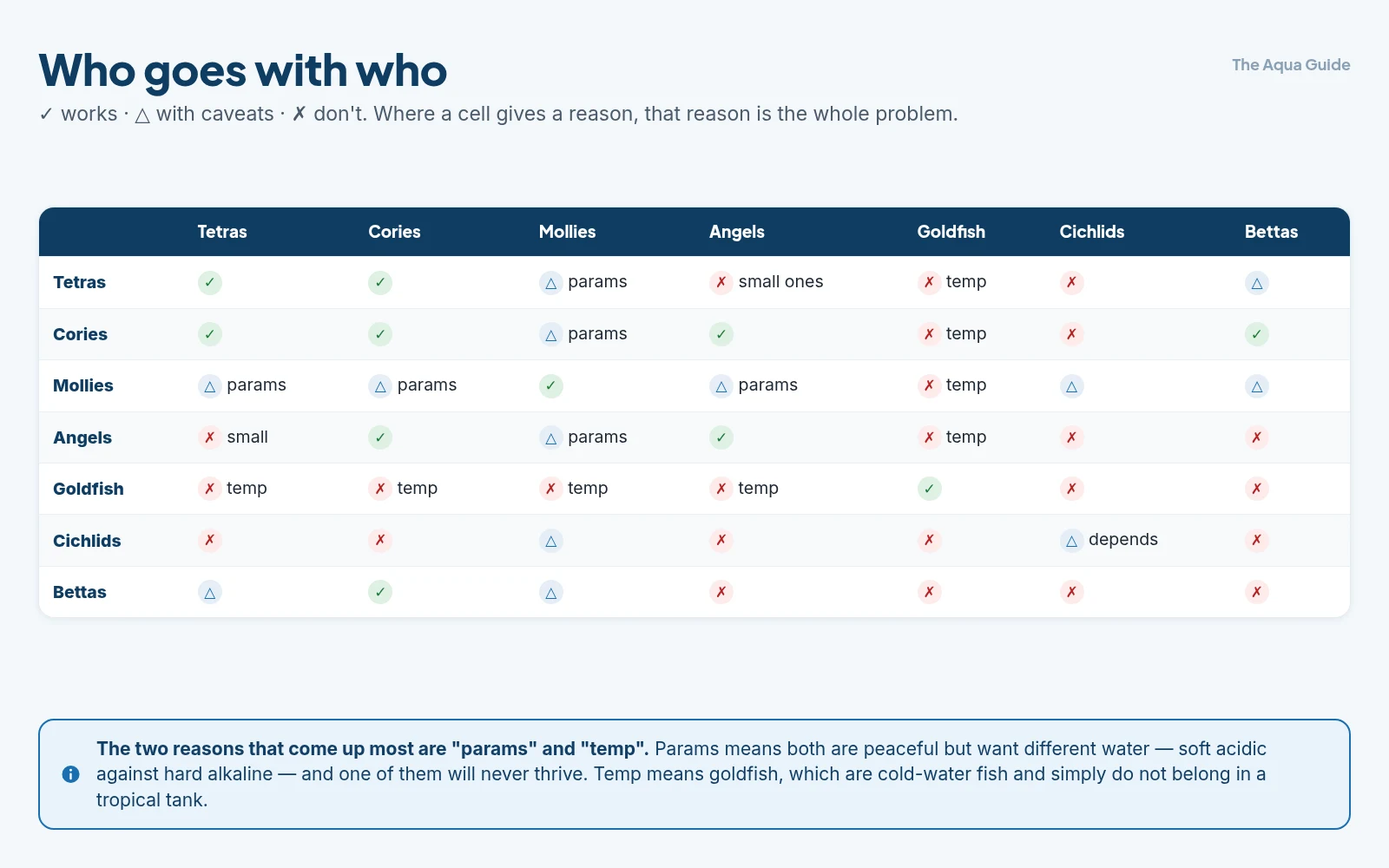
Quick Compatibility Matrix
A rough quick-reference for common fish:
| Tetras | Cories | Mollies | Angels | Goldfish | Cichlids | Bettas | |
|---|---|---|---|---|---|---|---|
| Tetras | ✓ | ✓ | △ params | ✗ small ones | ✗ temp | ✗ | △ |
| Cories | ✓ | ✓ | △ params | ✓ | ✗ temp | ✗ | ✓ |
| Mollies | △ params | △ params | ✓ | △ params | ✗ temp | △ | △ |
| Angels | ✗ small | ✓ | △ params | ✓ | ✗ temp | ✗ | ✗ |
| Goldfish | ✗ temp | ✗ temp | ✗ temp | ✗ temp | ✓ | ✗ | ✗ |
| Cichlids | ✗ | ✗ | △ | ✗ | ✗ | depends | ✗ |
| Bettas | △ | ✓ | △ | ✗ | ✗ | ✗ | ✗ |
✓ = compatible | △ = depends/risky | ✗ = incompatible
Stocking Density Rule of Thumb
A rough guideline:
1 inch of fish per gallon (adult length, not current size) for most community tanks.
Adjustments:
- Lower for messy fish (goldfish, large cichlids) — 0.5 inch per gallon
- Higher for tiny tetras (chili rasboras) — up to 1.5 inch per gallon
- Consider body shape — a 3-inch slim danio doesn't equal a 3-inch chunky goldfish
Better measure: Adequate filtration + stable water parameters + healthy behavior = appropriate stocking, regardless of rules.
Common Gotchas
"Community" doesn't always mean compatible. Pet stores sell "community" fish that won't actually live together.
Cute juveniles grow up. Cute angelfish that fit in a 10-gallon tank will become 6-inch adults needing 55+ gallons.
"Schooling fish" requires schools. Keeping a single tetra is cruel; it never thrives.
Tankmate compatibility shifts with age. Many cichlids are peaceful as juveniles, aggressive as adults.
Listed sizes are minimums. "Grows to 3 inches" often means 4-5 inches in some specimens. Plan for larger.
The Bottom Line
Fish compatibility depends on three factors: temperament (peaceful/semi-aggressive/aggressive), size (no major mismatches), and water parameter overlap. Classic beginner community: small tetras + corydoras + otocinclus in soft-medium water. Avoid: angels with neons, goldfish with tropicals, multiple male bettas, cichlids with shrimp, common plecos with discus. Schooling species need minimum numbers (6+ for most). Mix top/middle/bottom dwellers for active-looking tanks. The "1 inch per gallon" rule is rough — adequate filtration, stable parameters, and healthy behavior matter more. When in doubt, research the specific combination before buying — many "community" labels in stores are misleading. Compatibility is about more than just temperament; size and water parameter requirements matter equally.
Related guides
- Community tank compatibility: what gets along
- Schooling vs shoaling: how many of each species?
- How many fish can my tank hold?
- Beginner-friendly fish species
- The beginner's guide to choosing fish
- Understanding pH, KH and GH
- How to acclimate new fish properly
- Freshwater shrimp: cherry, amano and more
Got questions about your specific setup? Drop them in our Community Forum — we love helping new fishkeepers get started right.