Pre-built maintenance schedules you can adopt or adapt for your tank. Print them out, save to your phone, or build your own personal version. Consistent maintenance is the single biggest factor in keeping fish healthy long-term.
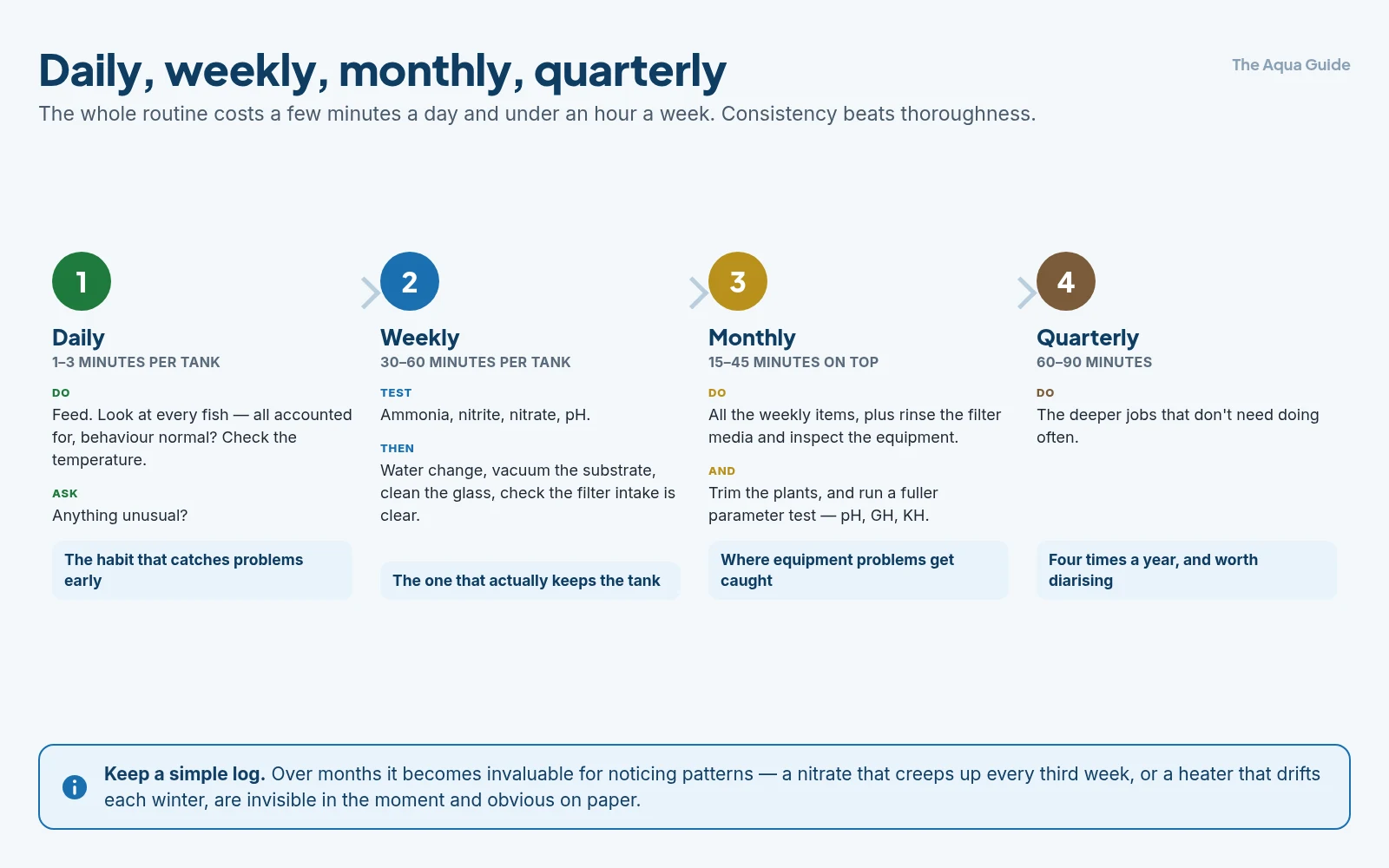
At a glance: what the routine costs
| How often | How long | What it buys |
|---|---|---|
| Daily | 1–3 minutes per tank | You notice a problem on day one instead of day ten |
| Weekly | 30–60 minutes per tank | Nitrate stays down, chemistry stays stable, and the glass stays clear |
| Monthly | 15–45 minutes on top | Filter flow restored, equipment checked before it fails |
| Quarterly | 60–90 minutes | The deeper jobs that do not need doing often |
Be realistic about what you will actually do consistently. A modest routine you keep beats an ambitious one you abandon — and better filters and heaters genuinely reduce how much monitoring you need.
The Universal Schedule (Most Tanks)
This works for typical 20-75 gallon community tanks, planted or unplanted.
Daily (1-2 minutes)
- ☐ Visual check — every fish accounted for and behaving normally?
- ☐ Temperature reading — within normal range?
- ☐ Equipment check — filter running, heater working?
- ☐ Feed fish (once or twice daily, only what they eat in 1-2 minutes)
- ☐ Note anything unusual
Weekly (30-45 minutes)
- ☐ Test water — ammonia, nitrite, nitrate at minimum (pH if unstable history)
- ☐ Water change — 25-30% partial change with dechlorinated, temperature-matched water
- ☐ Gravel vacuum — siphon substrate where you can (avoid plant roots)
- ☐ Clean glass — algae scraper on viewing panes
- ☐ Check filter intake — clear of debris
- ☐ Trim/prune plants if needed
- ☐ Dose fertilizers (if planted tank with dosing schedule)
- ☐ Top off any evaporation
Monthly (extra 15-30 minutes)
- ☐ Filter media check — rinse mechanical media in tank water (NOT tap)
- ☐ Replace mechanical filter media if torn or clogged beyond cleaning
- ☐ Deep cleaning of glass corners and equipment surfaces
- ☐ Check all equipment for wear (heater cord, filter seals, lights)
- ☐ Test broader parameter set: pH, GH, KH if measured
- ☐ Inspect all fish closely for any signs of disease or weight loss
- ☐ Empty/clean filter media bag if applicable
- ☐ Replace any depleted root tabs in planted tanks
Quarterly (60+ minutes)
- ☐ Replace chemical filter media (carbon, GFO, etc.) if used
- ☐ Deeper clean — scrub décor, hardscape if heavily algae-coated
- ☐ Inspect lighting fixtures, replace bulbs if degrading (LEDs usually last years)
- ☐ Re-organize stocking if needed
- ☐ Big substrate vacuum (front and accessible areas)
- ☐ Plant trimming/replanting major work
- ☐ Aquascape adjustment if desired
Annually (or as needed)
- ☐ Replace silicone seals if showing wear
- ☐ Replace LED lighting if degrading
- ☐ Replace heater if older than 3-4 years (failure risk increases)
- ☐ Replace filter impeller and worn parts
- ☐ Replace UV bulbs (if used) — usually annual
- ☐ Full equipment audit — what's working, what needs replacing
- ☐ Consider major rescape or refresh
Tank-Type Specific Schedules
High-Tech Planted Tank (CO2, Strong Light, EI Dosing)
More demanding maintenance:
Daily:
- Visual check
- Verify CO2 system functioning (drop checker color)
- Verify lights on schedule
- Feed fish
Three times per week (Mon/Wed/Fri):
- Dose macros (KNO3, KH2PO4)
Three times per week (Tue/Thu/Sat):
- Dose micros (CSM+B, iron)
Sunday (weekly):
- 50% water change (EI method)
- Trim fast-growing plants
- Clean glass
- Test parameters
Monthly:
- All standard monthly tasks
- Test CO2 levels (drop checker)
- Inspect diffuser (replace if clogged)
- Refill CO2 cylinder when low
Shrimp Tank (Cherry/Neocaridina)
Gentler maintenance:
Daily:
- Visual check (count visible shrimp)
- Verify temperature
- Feed sparingly (every other day, sometimes less)
Weekly:
- 10-15% water change (smaller and gentler than fish tanks)
- Slow drip new water in (1-2 hours for water change)
- Spot clean visible waste
- Check parameters (TDS especially)
Monthly:
- Inspect sponge filter (clean if needed in tank water)
- Add fresh Indian almond leaf if used
- Replace cuttlebone if depleted
- Add new shrimp food if running out
Quarterly:
- Deeper substrate touch-up
- Re-mineralize RO water for next changes
Notes: Less is more — shrimp tanks benefit from minimal disturbance.
Saltwater Reef Tank
Higher maintenance demands:
Daily:
- Visual check (corals, fish, equipment)
- Top off evaporation (RO water)
- Verify ATO (auto top-off) working
- Test salinity (refractometer)
Twice weekly:
- Feed fish
- Spot feed corals (if needed)
Weekly:
- 10-15% water change with new mixed saltwater (RO + salt mix)
- Test parameters: salinity, pH, KH, calcium, magnesium, nitrate, phosphate
- Clean glass
- Empty protein skimmer cup
- Top off auto-doser supplies
Monthly:
- Replace mechanical media (filter socks)
- Inspect powerheads, clean if needed
- Inspect protein skimmer fully
- Test all parameters including trace elements
- Calibrate test equipment
Quarterly:
- Replace chemical media (GFO, carbon)
- Trim macroalgae in refugium
- Deep clean equipment
Goldfish Tank
More frequent than tropical due to high bioload:
Daily:
- Visual check
- Feed (smaller meals 2-3 times daily)
- Skim surface for floating food
- Temperature check
Weekly (TWO times):
- 25-30% water change each time (twice per week, total 50-60% weekly)
- Vacuum substrate thoroughly
- Test parameters
- Clean filter intake
Monthly:
- Filter media cleaning/replacement
- Deep clean glass and décor
- Test all parameters
Notes: Goldfish produce twice the waste of tropical fish; double the water changes.
Cichlid Tank (Aggressive Africans)
Hardy fish but high bioload:
Daily:
- Visual check (watch for new aggression patterns)
- Feed
- Equipment check
Weekly:
- 25-30% water change
- Vacuum substrate (sand or pool filter sand)
- Test parameters (especially nitrate)
- Clean glass
Monthly:
- Filter media maintenance
- Test pH and KH (cichlids need stable high pH)
- Check for territorial damage (chewed décor, etc.)
- Inspect all fish for injuries
Newly Setup Tank (First 2 Months)
Extra attention during cycling:
Daily (first 2 weeks):
- Test ammonia, nitrite
- Watch fish closely
- Avoid feeding much
- Note water changes if needed
Daily (weeks 3-4 of cycle):
- Test ammonia, nitrite, nitrate
- 25% water change if ammonia >0.5 ppm
- Watch fish
Every other day (weeks 5-8):
- Test parameters
- Smaller water changes as cycle stabilizes
After cycling complete:
- Transition to standard weekly schedule
Building Your Personal Schedule
Adapt the templates to your situation:
Factors to Consider
Tank size: Smaller tanks need MORE frequent water changes (less buffer).
Stocking density: Heavily stocked tanks need more maintenance.
Plant load: Many plants help reduce maintenance burden but add their own demands (trimming, fertilization).
Equipment quality: Better filters/heaters reduce monitoring needs.
Your schedule: Be realistic about what you'll actually do consistently.
A Personal Schedule Template
DAILY: [date] [tank] [observations]
- Feed: yes/no/notes
- Visual: all fish accounted; behavior normal?
- Temp: ___°F
- Anything unusual?

WEEKLY: [date] [tank]
- Test results: NH3 ___, NO2 ___, NO3 ___, pH ___
- Water change: ___% with ___gallons
- Substrate vacuumed: yes/no
- Glass cleaned: yes/no
- Filter intake clear: yes/no
- Notes:

MONTHLY: [date] [tank]
- All weekly items
- Filter media rinsed: yes/no
- Equipment inspection: any concerns?
- Plant trimming done: yes/no
- Comprehensive parameter test: pH ___ GH ___ KH ___
- Notes:
Keep a simple log; over months it becomes invaluable for noticing patterns.
Time Investment Reality
Honest estimate of what proper maintenance takes:
| Frequency | Time Required |
|---|---|
| Daily (per tank) | 1-3 minutes |
| Weekly (per tank) | 30-60 minutes |
| Monthly extras | 15-45 minutes |
| Quarterly extras | 60-90 minutes |
A single tank: ~30-60 minutes per week total commitment. Multiple tanks: scale accordingly.
Don't underestimate. Many tank disasters happen when keepers think "I'll get to it next weekend" — and they don't.
The 1-2-3 Habit
A simple memory aid for the essentials:
1 minute daily: visual check, feed, temperature 20 minutes weekly: water change + test 30 minutes monthly: deeper inspection
If you only remember three things, remember these.
Setting Up Reminders
Tools to help:
Phone calendar: weekly reminder for water change day Wall calendar: check off tasks as completed Tank journal: track what you did and when App-based: several aquarium tracking apps exist Sticky notes: physical reminders near the tank
The goal: don't rely on memory alone.
When You Skip Maintenance
Honest realities:
Skip a day: Usually fine. Skip a week: Some buildup of nitrate; fish should be okay. Skip a month: Significant nitrate buildup; potential algae problems; fish stress increases. Skip multiple months: Cycle disruption possible; algae explosions; fish deaths.
For vacations, arrangements should be made for someone to feed and check fish, even if water changes wait.
The Bottom Line
Consistent maintenance is the single biggest factor in long-term aquarium success. A universal schedule for most tanks: daily (1-2 min: visual, feed, temp), weekly (30-45 min: water change, test, vacuum, clean glass), monthly (15-30 min extra: filter media, equipment check, deeper test), quarterly (60+ min: chemical media, deep clean, plant work), annually (equipment refresh as needed). Adapt for tank type: high-tech planted (frequent dosing, weekly 50% water change), shrimp (gentler smaller changes), saltwater (more demanding testing, weekly parameters), goldfish (twice as much), cycling tanks (daily testing). Build your personal schedule; track in a journal. The "1-2-3 habit": 1 min daily, 20 min weekly, 30 min monthly. Skipping maintenance compounds — better to do less work consistently than periodic catch-ups. Setting reminders helps. Time investment for a single tank: 30-60 minutes weekly total. Worth every minute.
Related guides
- The daily, weekly and monthly maintenance checklist
- The correct step-by-step water change
- How often should you do a water change — and how much?
- How to clean your filter without crashing the cycle
- How to spot a healthy vs stressed fish
- Water parameters cheat sheet
- How to use a liquid test kit (and why strips fail)
- Aquarium water quality: the complete guide