Here's a truth that takes most beginners far too long to learn: you are not really keeping fish. You are keeping water. Get the water right, and the fish almost take care of themselves. Get it wrong, and no amount of fancy food, beautiful plants, or expensive equipment will save them. Nearly every problem a beginner faces — sick fish, sudden deaths, endless algae, cloudy tanks — traces back to water quality. This guide is the map to understanding it.
Think of this as the hub. Each topic below is a doorway into a more detailed guide, but by the end of this page you'll understand how all the pieces fit together.
At a glance: what to measure, and what it means
| Reading | Target | If it's wrong |
|---|---|---|
| Ammonia | 0 ppm, always | Act now — water change, less food, check the cycle |
| Nitrite | 0 ppm, always | The same response. Both are actively toxic |
| Nitrate | Under about 20–40 ppm | More or larger water changes; nothing else removes it |
| pH | Steady, more than ideal | Check KH before reaching for any adjuster |
| KH | Enough to hold pH steady | A tank with no KH is a time bomb — pH can crash suddenly |
| GH | Matched to your fish | Choose different fish rather than fighting your water |
| Temperature | Steady, in the species' range | A failed heater is one of the commonest triggers of everything else |
Nearly every beginner problem traces back here — sick fish, sudden deaths, endless algae, cloudy tanks. Get the water right and the fish very nearly take care of themselves.
What "Water Quality" Actually Means
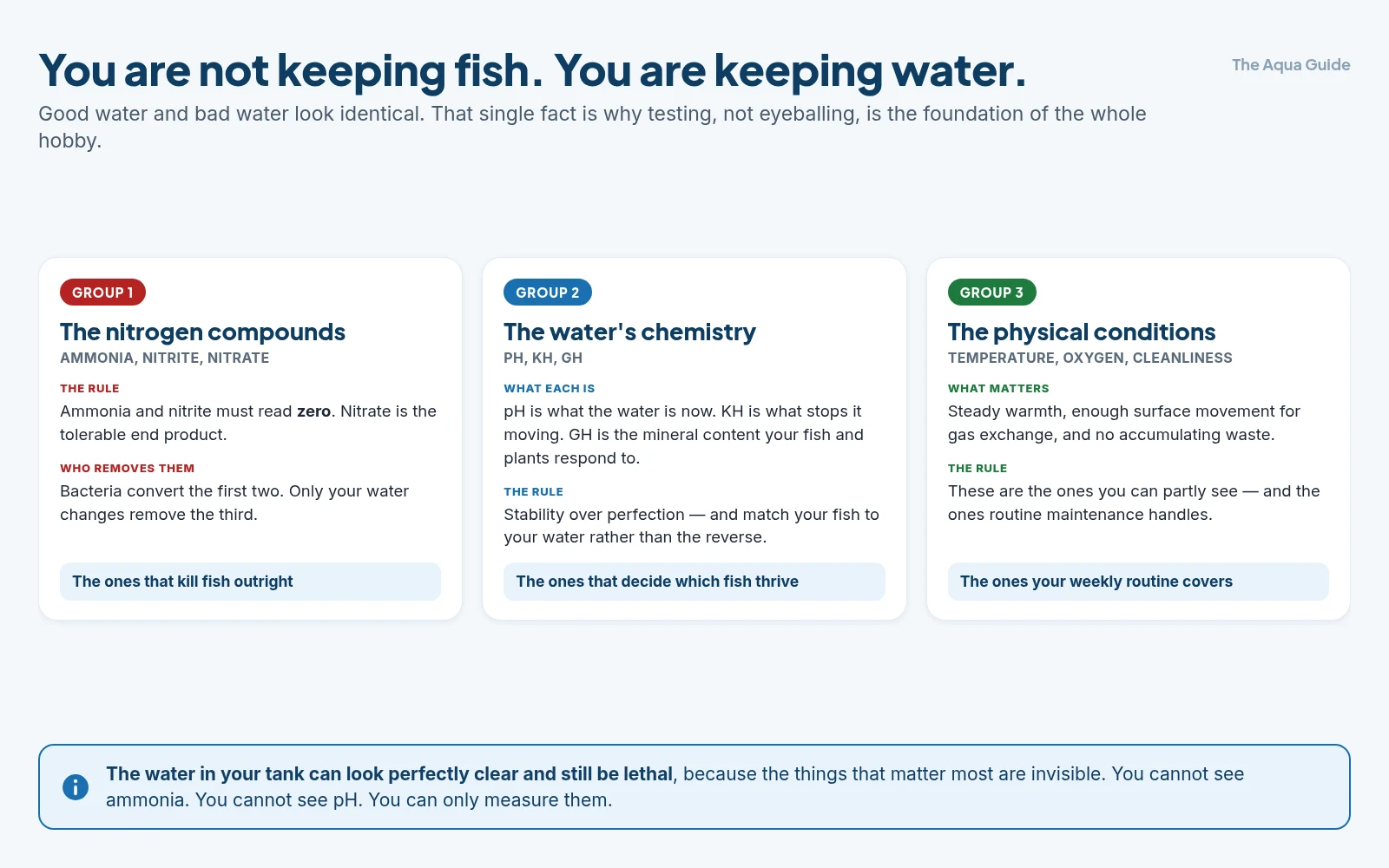
Water quality isn't one thing — it's a handful of measurable factors that together determine whether your water is a healthy environment or a slow poison. The water in your tank can look perfectly clear and still be lethal, because the things that matter most are invisible. You can't see ammonia. You can't see pH. You can only measure them. That single fact — that good and bad water look identical — is why testing, not eyeballing, is the foundation of the whole hobby.
The factors that make up water quality fall into a few groups: the nitrogen compounds (ammonia, nitrite, nitrate), the chemistry of the water itself (pH, and the hardness values KH and GH), and the physical conditions (temperature, oxygen, cleanliness). Let's walk through each.
The Nitrogen Compounds: Ammonia, Nitrite, Nitrate
Ammonia and nitrite must read zero; nitrate is the tolerable end product that water changes remove. How that chain is established is the nitrogen cycle, and the numbers you act on are in safe ammonia, nitrite and nitrate levels.
The Water's Chemistry: pH, KH, and GH
pH is what the water is now; KH is what stops it moving; GH is the mineral content your fish and plants actually respond to. pH, KH and GH explained covers how they relate, and tap, RO and remineralised water covers where yours comes from.
The Physical Conditions
Temperature, oxygen, and cleanliness round out the picture. Temperature needs to be stable and appropriate for your species — most tropical fish want the mid-to-high 70s°F, and sudden swings stress them and can harm your bacteria. Oxygen is easy to overlook but vital: fish and beneficial bacteria both need dissolved oxygen, which comes from surface movement and agitation. Cleanliness means keeping organic waste (uneaten food, detritus, decaying plants) from building up, since all of it eventually becomes ammonia and feeds algae.
How You Actually Manage Water Quality
Almost all of it is one habit performed properly and on schedule. How often and how much to change sets the interval, the correct step-by-step water change the method, and using a liquid test kit how to know where you stand.
When Something Goes Wrong
Water problems announce themselves visually before a test kit confirms them. Cloudy water, green water, yellow water and a bad smell each have distinct causes — see cloudy water, green water, yellow or orange water and smelly water.
The Bottom Line
You're keeping water, and the fish live in whatever you make. Water quality is the combination of the nitrogen compounds (keep ammonia and nitrite at zero, nitrate low), the water's chemistry (a stable pH, supported by adequate buffering), and the physical conditions (stable temperature, good oxygen, low waste). You manage all of it with four habits: test regularly, change water on schedule, avoid overstocking and overfeeding, and protect your bacteria. Master those, and you've mastered the thing that actually determines whether your tank thrives. Everything else in fishkeeping is built on this foundation.
Water quality, question by question
This page is the overview. Everything below answers one part of it properly.
- Safe ammonia, nitrite and nitrate levels — the numbers, and when to act on them
- pH, KH and GH explained — what each measures and which one to fix
- Water parameters cheat sheet — the whole set on one page
- Using a liquid test kit — and why strips mislead
- Water change frequency and volume — how much, how often, and why
- The correct water change — the method, step by step
- Tap, RO and remineralised water — choosing your source water
- RO/DI water — when it is worth the trouble
- When pH keeps crashing — the buffer problem behind it
- Cloudy water — what each kind of cloudiness means
- Green water — free-floating algae and how to clear it
- Smelly water — what the smell is telling you
- Yellow or orange water — tannins and the alternatives
Related guides
- What are safe ammonia, nitrite and nitrate levels?
- Understanding pH, KH and GH
- Water parameters cheat sheet
- How to use a liquid test kit (and why strips fail)
- How does the aquarium nitrogen cycle work?
- How often should you do a water change — and how much?
- Tap, RO and remineralised water explained
- Smelly aquarium water: causes and fixes