A pH crash is one of the more alarming water-quality problems, partly because it seems to come out of nowhere. Your pH was fine for weeks, and then suddenly it's plummeted — your fish are stressed, and you're scrambling. The good news is that a pH crash has a clear, well-understood cause, and once you understand it, both the fix and the prevention are straightforward. Let's break down why it happens and exactly what to do.
At a glance
| The cause | KH (carbonate hardness, the water's buffer) runs out, so nothing neutralises the acids a tank produces |
| Why it feels sudden | pH stays steady while KH is used up, then drops when KH hits zero |
| Most at risk | Soft water, infrequent water changes, heavy stocking or feeding, lots of driftwood, peat or botanicals |
| If it's happening now | Gentle partial water changes with dechlorinated, temperature-matched tap water; several modest ones beat one huge one |
| Prevention | Regular water changes, test KH as well as pH, crushed coral or aragonite if your tap water is soft |
| Avoid | "pH up" products: they change the number, not the missing buffer |
What a pH Crash Actually Is
A pH crash is a sudden, sharp drop in your water's pH, often into acidic territory (well below 7, sometimes alarmingly low). Because fish handle stable pH far better than changing pH, a rapid crash is genuinely dangerous — it stresses fish, can harm them directly, and at low enough pH it slows or stops your beneficial bacteria, putting your nitrogen cycle at risk too.
The key insight is that a pH crash is almost never random. It's the predictable result of one specific thing running out: your water's buffering capacity.
The Root Cause: Depleted KH (Buffering)
Here's the mechanism. Your water has a buffering capacity, measured as KH (carbonate hardness). KH acts like a bodyguard for your pH — it neutralizes the acids that constantly build up in a tank and holds your pH steady. Those acids come from normal tank processes: the nitrogen cycle itself produces acid, as does fish respiration, decaying organic matter, and (in planted or CO₂ tanks) other sources.
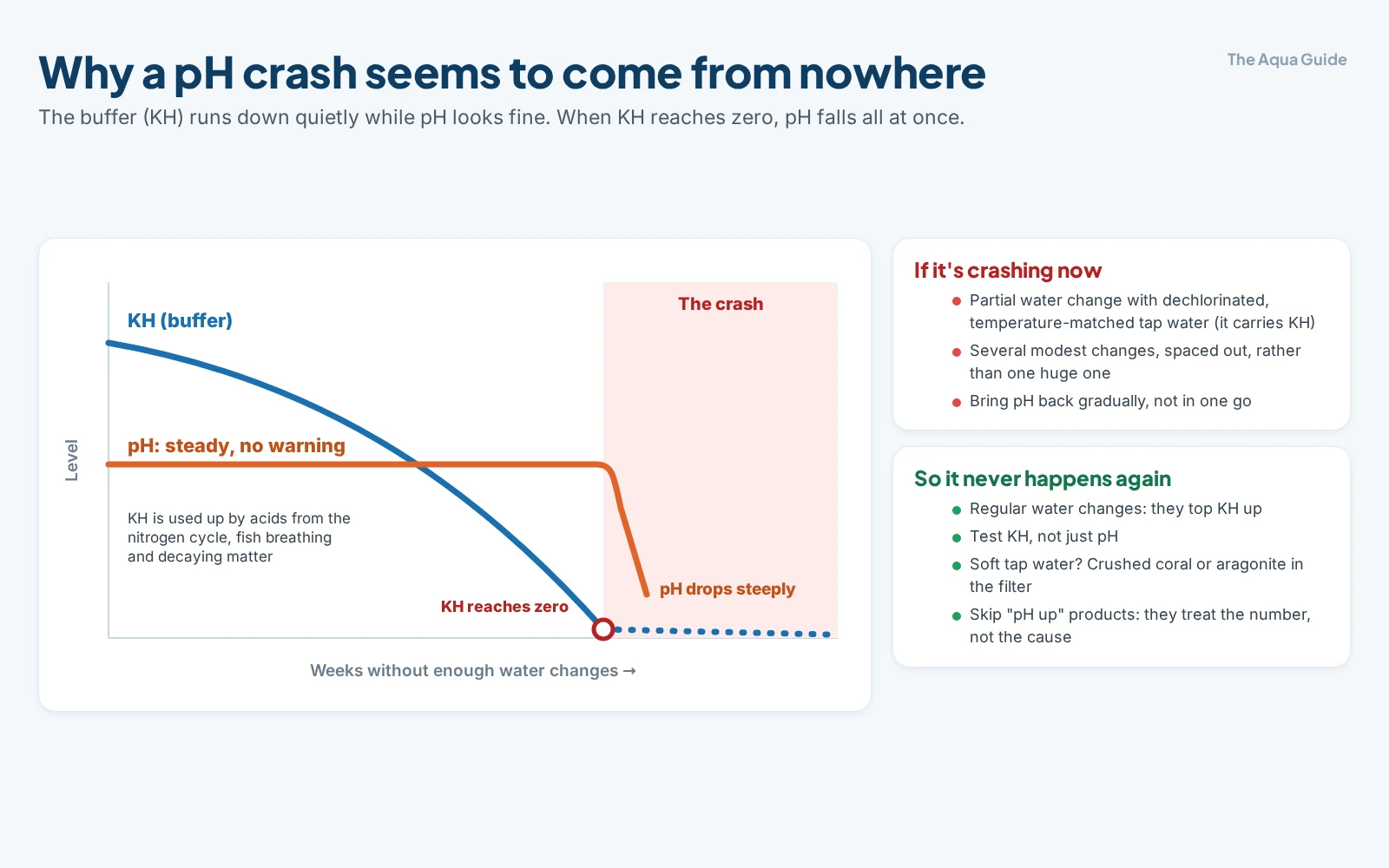
As long as you have KH, it absorbs those acids and your pH stays stable. But KH gets consumed in the process — it's used up over time. If you don't replenish it, it eventually runs low and then hits zero. And once KH is gone, there's nothing left to neutralize the incoming acids. At that point the accumulated acid drops your pH suddenly and steeply. That's the crash.
So a pH crash is really a KH depletion problem wearing a disguise. The pH is just the visible symptom; the missing buffer is the actual cause.
Why It Catches People Off Guard
The reason crashes feel sudden is that buffering masks the problem right up until it fails. While KH is being depleted, your pH stays reassuringly stable — everything looks fine. There's no gradual warning in the pH reading itself. Then the buffer runs out, and the pH falls off a cliff all at once. This is why people say their pH "suddenly" crashed: it was stable until the exact moment the buffer was exhausted. The only way to see it coming is to test KH, not just pH — KH is the early-warning gauge that pH alone won't give you.
Tanks Most at Risk
Some setups are far more prone to crashes. Soft-water tanks (naturally low KH) have less buffer to begin with, so they deplete faster. Tanks with infrequent water changes don't get their KH replenished, so it steadily runs down. Heavily-stocked or heavily-fed tanks produce more acid. Tanks with lots of driftwood, peat, or botanicals (which release tannins and acids) acidify faster. And neglected tanks generally — low maintenance plus any of the above — are the classic crash candidates.
What to Do Right Now (If You're Crashing)
If you're in an active crash, stabilize gently — and "gently" is the key word, because slamming the pH back up fast is its own shock.
Do a partial water change with fresh, dechlorinated, temperature-matched water that has some KH in it (most tap water does). This simultaneously dilutes the accumulated acid and adds buffering back. Don't try to swing the pH all the way back to "normal" in one go — a gradual recovery over a few changes is safer for the fish than a violent correction. If the crash is severe, several modest water changes spaced out beat one huge one. Then address the root cause below so it doesn't recur.
How to Prevent It for Good
Prevention is simple and reliable, and it comes down to keeping KH topped up:
Do regular water changes. This is the big one. Most tap water contains KH, so routine partial changes naturally replenish your buffer before it ever runs out. Consistent water changes alone prevent the vast majority of pH crashes — it's yet another reason the weekly habit matters so much.
Test KH, not just pH. Periodically check your KH so you can see depletion coming. If your KH is trending toward zero, that's your signal to act before the crash.
Add a buffer source if your water is naturally soft. If your tap water is very soft (low KH) and you keep finding KH near zero, you can add lasting buffering — crushed coral or aragonite in the filter slowly dissolves to maintain KH, or a commercial carbonate buffer does the same. This gives soft-water tanks the cushion they otherwise lack.
Don't overload the tank. Lighter stocking and sensible feeding mean less acid production and slower KH depletion.
Note what's not on this list: chasing pH with "pH up" chemical products. Those adjust the number directly without addressing the missing buffer, so the pH just drifts and crashes again — often worse. Fixing KH fixes the cause; chasing pH only treats the symptom and tends to create more instability.
The Bottom Line
A pH crash is a sudden, dangerous drop in pH caused by your water's buffer (KH) running out — once there's no carbonate left to neutralize the acids a tank naturally produces, the pH falls off a cliff. It feels sudden because buffering hides the problem until the moment it fails, which is why you should test KH, not just pH. To fix an active crash, do gentle partial water changes with buffered, temperature-matched water to dilute the acid and restore KH gradually. To prevent crashes for good, keep up with regular water changes (which replenish KH), watch your KH over time, and add a buffer source like crushed coral if your water is naturally soft. Treat the cause — the missing buffer — not just the symptom, and your pH will stay rock-steady.
Related guides
- Understanding pH, KH and GH
- How to use a liquid test kit
- How often should you do a water change, and how much?
- What are safe ammonia, nitrite and nitrate levels?
- What causes a nitrogen cycle crash?
- pH explained
- KH explained
Got questions about your specific setup? Drop them in our Community Forum — we love helping new fishkeepers get started right.