You did everything right. Your tank was cycled, ammonia and nitrite were holding at zero, your fish were thriving — and then suddenly the readings spike, the water turns cloudy, and your fish are in distress. This is a cycle crash: the sudden collapse of your beneficial bacteria colonies, and it's one of the most alarming things that can happen to an established tank. The good news is that crashes almost always have a specific, identifiable cause — and once you know the causes, they're largely preventable. Let's go through them.
At a glance: a crash in progress
| Do this now | Why |
|---|---|
| Partial water change, dechlorinated and temperature-matched | Dilutes the ammonia and nitrite while the colony is down |
| Reduce or pause feeding | Cuts the ammonia source the colony cannot keep up with |
| A conditioner that detoxifies ammonia | Buys your fish a safety window |
| Find which cause triggered it, and fix that | The colony will rebuild on its own; the trigger will repeat if it stays |
| Keep testing daily until both read zero | Your job is to keep the fish alive while it rebuilds |
Prevention is far easier than recovery, and a stable, well-maintained tank rarely crashes at all.
What a Crash Actually Is
A cycle "crash" means your beneficial bacteria have died off or been suppressed faster than they can recover. Because those bacteria are what keep ammonia and nitrite at zero, their collapse causes both toxins to spike rapidly — and a tank that was perfectly safe yesterday becomes dangerous overnight. Understanding why colonies die is the key to never letting it happen.
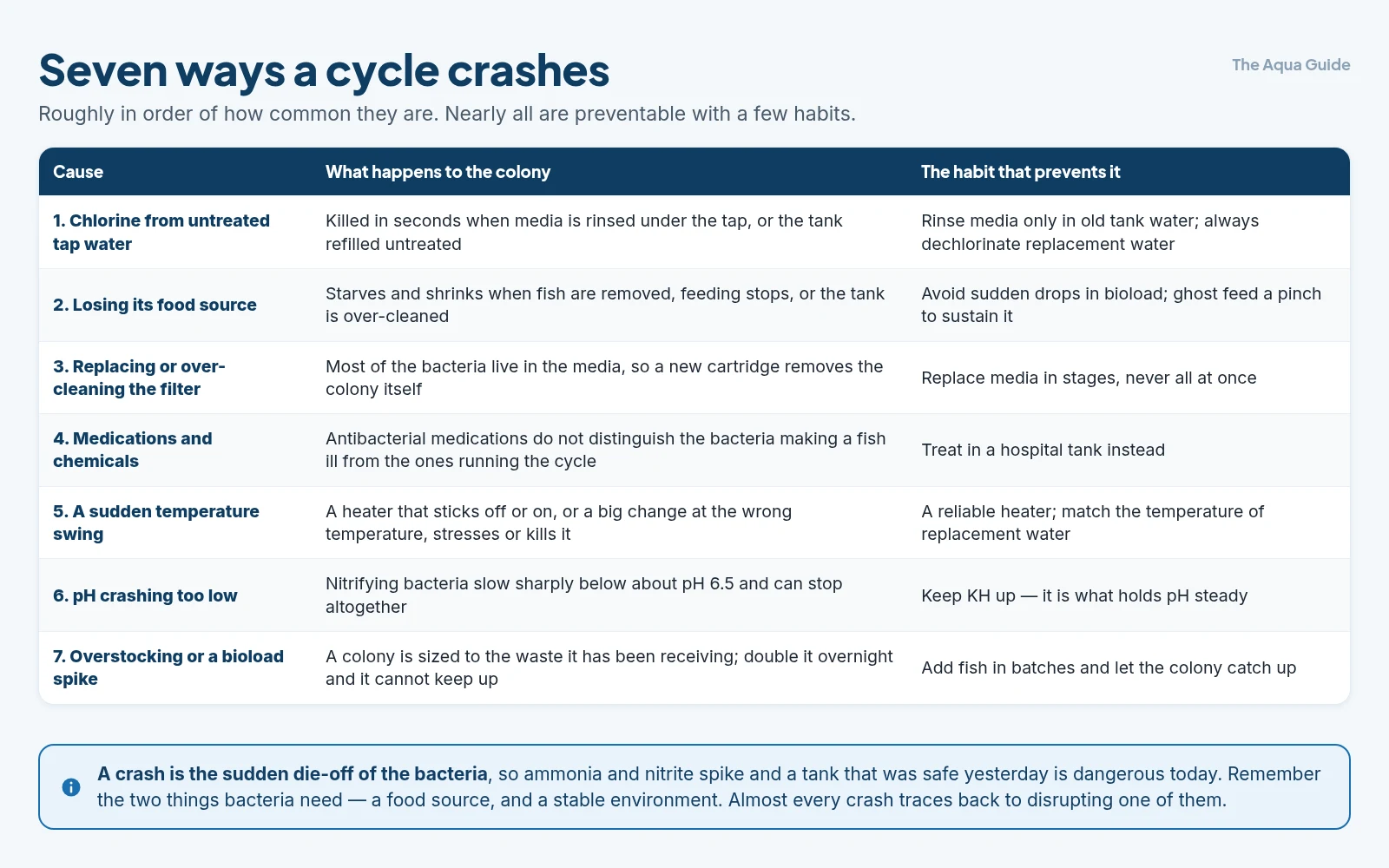
Remember the two things bacteria need: a food source (ammonia) and a stable, hospitable environment. Almost every crash traces back to disrupting one of those two things. Here are the culprits, roughly in order of how common they are.
1. Killing the Bacteria with Chlorine
This is the classic crash, and it's heartbreakingly common. Your beneficial bacteria live mostly in your filter media. If you rinse that media under the tap — chlorinated tap water — to "clean" it, the chlorine kills the colony in seconds. Same goes for refilling the tank or doing a large water change with untreated tap water.
The fix is simple and absolute: never let untreated tap water touch your filter media or your tank. Rinse filter media only in a bucket of old tank water, and always treat replacement water with a dechlorinator. This single habit prevents the most frequent cause of crashes.
2. Losing the Bacteria's Food Source
Bacteria need a steady supply of ammonia to stay alive. If that supply suddenly disappears, the colony starves and shrinks. This happens when you remove most or all of your fish at once, when you go on vacation and stop feeding for an extended period, or when you over-clean the tank and strip out all the organic matter. The colony, with nothing to eat, dies back — and then when you add fish or resume feeding, there aren't enough bacteria to handle the load, and ammonia spikes.
The fix: avoid sudden, drastic drops in your bioload. If you must empty a tank temporarily, keep it fed with a pinch of food (ghost feeding) to sustain the bacteria.
3. Replacing or Over-Cleaning the Filter
Most of the bacteria live in the filter media, not in the water, so replacing a cartridge or rinsing media under the tap removes the colony itself. Cleaning your filter without crashing the cycle covers what to rinse, in what, and how often.
4. Medications and Chemicals
Antibacterial medications do not distinguish between the bacteria making a fish ill and the ones running the cycle. Aquarium medications: when to use what sets out which classes affect the filter, and a hospital tank is how you avoid the question entirely.
5. A Sudden Temperature Swing
Beneficial bacteria are most active and stable within a normal tropical temperature range. A heater that fails (sticking off and letting the tank go cold, or sticking on and cooking it) can stress or kill the colony. Big, fast temperature changes — like a large water change with water at the wrong temperature — can do the same.
The fix: use a reliable heater, consider a backup or an alarm thermometer for valuable tanks, and always match the temperature of replacement water to your tank during water changes.
6. pH Crashing Too Low
Nitrifying bacteria slow sharply below about pH 6.5 and can stop altogether, and a tank whose KH has been exhausted loses its ability to hold pH steady at all. My pH keeps crashing deals with the cause, and pH, KH and GH explained covers why KH is what protects you.
7. Overstocking or a Sudden Bioload Spike
A colony is sized to the waste it has been receiving; double the bioload overnight and it cannot keep up until it grows. Adding fish in batches covers the safe rate, and how many fish can my tank hold the ceiling.
How to Respond to a Crash in Progress
If you're testing and seeing a sudden ammonia or nitrite spike on an established tank, act fast to protect your fish while the colony recovers. Do an immediate partial water change with dechlorinated, temperature-matched water to dilute the toxins. Reduce or pause feeding to cut the ammonia source. Use a water conditioner that detoxifies ammonia to buy your fish a safety window. Then identify which cause above triggered it, fix that root cause, and keep testing daily until ammonia and nitrite return to zero. The colony will rebuild — your job is to keep the fish alive while it does.
The Bottom Line
A nitrogen cycle crash is the sudden die-off of your beneficial bacteria, and it almost always comes down to one of a handful of causes: chlorine from untreated tap water, losing the bacteria's food source, replacing filter media all at once, bacteria-killing medications, temperature swings, a pH crash from depleted buffering, or a sudden bioload spike. Nearly all are preventable with a few habits — treat all tap water, never replace all filter media at once, stock and clean gradually, and keep up with water changes. Prevention is far easier than recovery, and a stable, well-maintained tank rarely crashes at all.
Related guides
- How to clean your filter without crashing the cycle
- What are safe ammonia, nitrite and nitrate levels?
- What is ghost feeding, and how does it help cycling?
- How does the aquarium nitrogen cycle work?
- Adding fish in batches: how slow is slow enough?
- How many fish can my tank hold?
- Setting up and using a hospital tank
- The nitrogen cycle, explained
Got questions about your specific setup? Drop them in our Community Forum — we love helping new fishkeepers get started right.
Each cause, in full
The seven causes above are summarised here so you can identify yours quickly. Each one is treated properly on its own page.
- Cleaning the filter safely — the single most common way a healthy cycle is destroyed
- Medications and the filter — which treatments kill nitrifying bacteria
- When pH keeps crashing — why it falls, and what holds it up
- pH, KH and GH explained — why KH is the buffer that protects the cycle
- Adding fish in batches — how fast a colony can grow to meet new stock
- How many fish can my tank hold — the bioload ceiling for your volume
- Overfeeding — the other direction — too much ammonia, not too little
- Restarting after a crash — getting the readings moving again
- Safe levels — what the readings should be once recovered