Walk into any aquarium store with a new tank and someone will hand you a bottle of "instant cycle" bacteria, promising you can add fish today. It's one of the most heavily marketed products in the hobby — and one of the most misunderstood. So do you actually need it? Does it work? And if you're going to buy a bottle, which ones are worth your money? Let's separate the marketing from the reality.
At a glance: getting value out of a bottle
| What to do | Why |
|---|---|
| Buy the freshest bottle, from a shop with good turnover | These are live cultures with a limited shelf life. A bottle sat on a warm shelf for a year may contain mostly dead bacteria |
| Store it cool, not frozen | Extreme heat or freezing during shipping or storage kills the culture |
| Dose by the instructions | Not by the "add fish today" claim on the front |
| Add it to a tank that already has an ammonia source and a running, dechlorinated filter | The bacteria need food and a home — filter media surface — to establish |
| Keep testing | Let the readings, not the label, say when it is safe: ammonia and nitrite at zero, nitrate present |
You'll get the most value from it if you are impatient, if you have no access to mature filter media, or if you are doing a fish-in cycle and want to shorten the danger window for your fish.
What Bottled Bacteria Actually Is
A bottle of nitrifying bacteria contains live cultures of the same beneficial bacteria your tank needs to grow on its own — the ones that convert ammonia to nitrite and nitrite to nitrate. The idea is simple: instead of waiting weeks for these bacteria to multiply naturally, you pour in a ready-made colony and give your cycle a massive head start.
In principle, this is sound. The bacteria are real, and adding an established colony genuinely can accelerate cycling. The problem isn't the concept — it's the gap between what the labels promise and what the products reliably deliver.
The "Instant Cycle" Myth
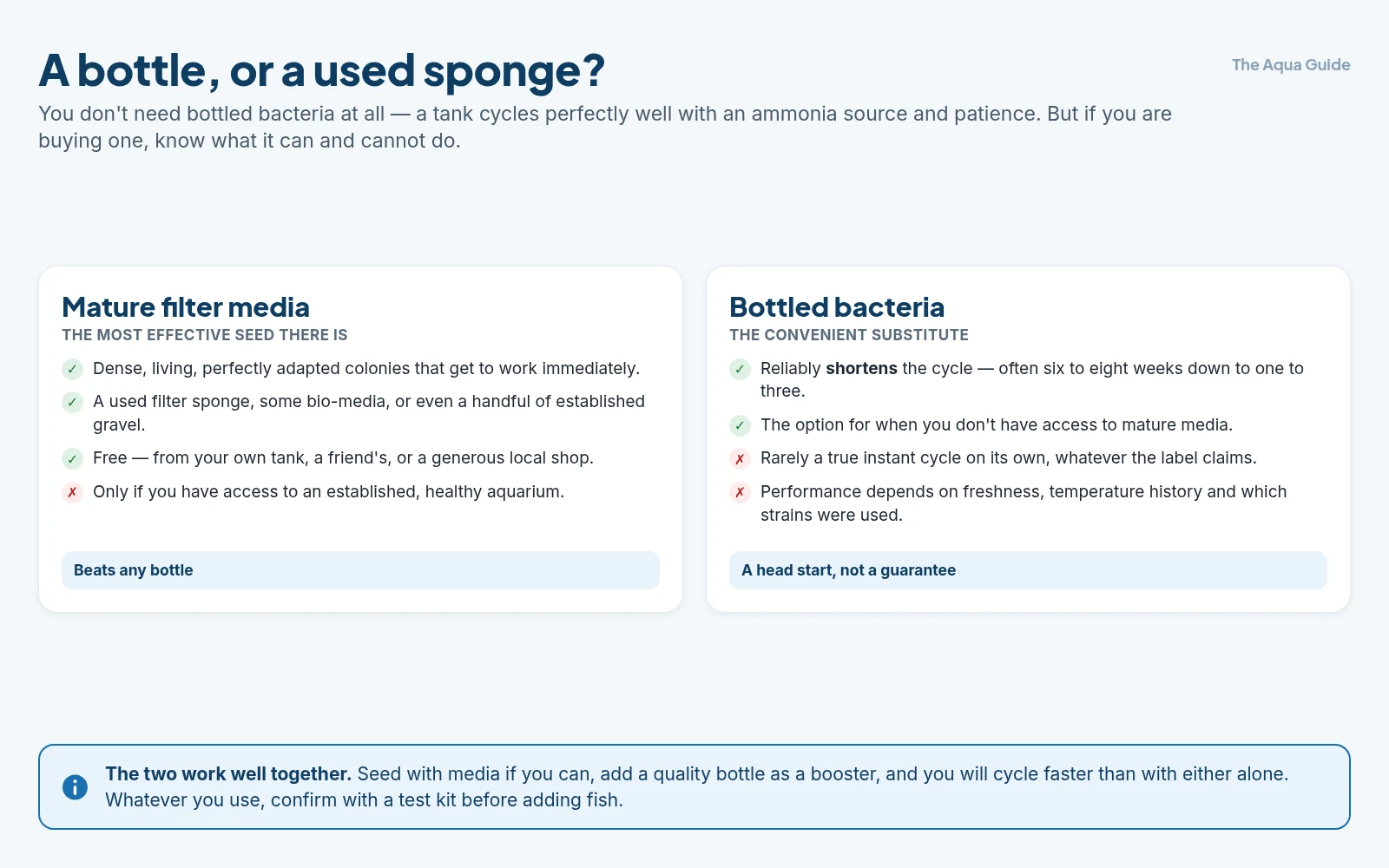
Almost every bottle claims you can add fish immediately, or within 24 hours. Treat that claim with heavy skepticism. In practice, bottled bacteria rarely produces a truly instant, safe-for-fish cycle on its own. What it reliably does is shorten the cycle — often cutting it from the typical six-to-eight weeks down to one to three weeks, depending on the product and conditions.
That's a real, worthwhile benefit. But it's not the same as "add fish today." If you take the label literally, dump in the bottle, and add a full stock of fish that afternoon, you're gambling with their lives — the colony usually isn't large or established enough yet to handle a full bioload. The responsible approach is to use bottled bacteria as an accelerant, then confirm with a test kit that ammonia and nitrite are holding at zero before trusting it with fish.
Why Results Vary So Much
Bottled bacteria is a living product, and that's the root of its inconsistency. A bottle is only as good as the bacteria still alive inside it, and several things affect that:
Freshness. These are live cultures with a limited shelf life. A bottle that's sat on a warm shelf for a year may contain mostly dead bacteria. Always check for a date and buy from a shop with good turnover.
Temperature history. Extreme heat or freezing during shipping or storage can kill the culture. A bottle that baked in a delivery truck won't perform.
The strains used. This is the big one. Some products historically used bacteria strains that aren't actually the dominant nitrifiers in aquariums, meaning they didn't establish well. The better modern products use strains far better matched to what actually colonizes a healthy tank — which is why brand choice genuinely matters.
What Actually Works Better Than a Bottle
Here's a truth the marketing won't tell you: the single most effective way to "seed" a new tank isn't a bottle at all — it's mature filter media from an established, healthy aquarium. A used filter sponge, some bio-media, or even a handful of established gravel carries dense, living, perfectly-adapted colonies that get to work immediately. If you have access to an established tank (yours or a friend's), or a generous local fish store, this beats any bottle.
Bottled bacteria is best thought of as the option for when you don't have access to mature media — a convenient, store-bought substitute. And the two work well together: seed with media if you can, add a quality bottle as a booster, and you'll cycle faster than with either alone.
So — Do You Need It?
Honestly, no, you don't need it. A tank will cycle perfectly well on its own with just an ammonia source and patience. Bottled bacteria is a convenience and an accelerant, not a requirement.
You'll get the most value from it if you're impatient and want to shave weeks off the wait, if you don't have access to mature filter media to seed with, or if you're doing a fish-in cycle and want to grow your colony faster to shorten the danger window for your fish. In those cases, a fresh bottle of a reputable product is money reasonably spent.
If you're happy to wait the natural three-to-eight weeks and you can get seeded media, you can skip the bottle entirely with no downside.
How to Use It Properly
If you do use it, get the most out of it: buy the freshest bottle you can from a high-turnover source, store it correctly (cool, not frozen) until use, and dose according to the instructions. Add it to a tank that already has an ammonia source and a running, dechlorinated filter — the bacteria need food (ammonia) and a home (filter media surface) to establish. Then, crucially, keep testing. Let the readings, not the label, tell you when it's safe for fish: ammonia and nitrite at zero, nitrate present.
The Bottom Line
You don't need bottled bacteria, but a fresh, reputable bottle can meaningfully speed up your cycle — typically cutting weeks off, not delivering a true "instant" cycle despite the claims. Its performance depends heavily on freshness, storage, and the strains used, so buy fresh from a busy shop. And remember that mature filter media from an established tank beats any bottle, and the two combined are best of all. Whatever you use, confirm readiness with a test kit before adding fish — the bottle is a head start, not a guarantee.
Related guides
- How to speed up the nitrogen cycle
- Fish-in vs fish-less cycling: which is right for you?
- What is ghost feeding, and how does it help cycling?
- How do I know if my tank is fully cycled?
- What are safe ammonia, nitrite and nitrate levels?
- How to use a liquid test kit (and why strips fail)
- How does the aquarium nitrogen cycle work?
- The nitrogen cycle, explained
Got questions about your specific setup? Drop them in our Community Forum — we love helping new fishkeepers get started right.