If you're new to fishkeeping, the "nitrogen cycle" is the one piece of science you genuinely have to understand. The good news: it's not complicated. Think of it as your tank's invisible cleanup crew — a natural process that takes the toxic waste your fish produce and converts it, step by step, into something far less harmful. Once you picture how it works, everything else about caring for a tank starts to make sense.
Here's the whole thing in one sentence: fish produce waste, that waste is poisonous, and a team of helpful bacteria turns the poison into something safe. Let's break that down.
How does the aquarium nitrogen cycle work?
Fish waste and uneaten food release ammonia, one colony of bacteria converts it to nitrite, and a second colony converts nitrite to nitrate. Ammonia and nitrite are toxic and must read zero; nitrate is far less harmful and is removed by water changes.
At a glance: the three chemicals
| Stage | What it is | Safe level | What deals with it |
|---|---|---|---|
| 1. Ammonia (NH₃) | The first waste product, from fish and from food and plant matter breaking down | Zero | The first crew of bacteria |
| 2. Nitrite (NO₂⁻) | What that first crew makes from the ammonia | Zero | The second crew of bacteria |
| 3. Nitrate (NO₃⁻) | What the second crew makes from the nitrite — the end of the chain | Low | You: water changes, and live plants |
Three rules that prevent most early disasters: don't overfeed, add fish slowly, and never rinse filter media under the tap — chlorine kills the bacteria living in it, undoing weeks of progress in seconds. Rinse it in a bucket of old tank water instead.
The Candy Analogy
The cycle involves three chemicals with intimidating names. To keep them straight, picture them as three colours of candy being passed down a line.
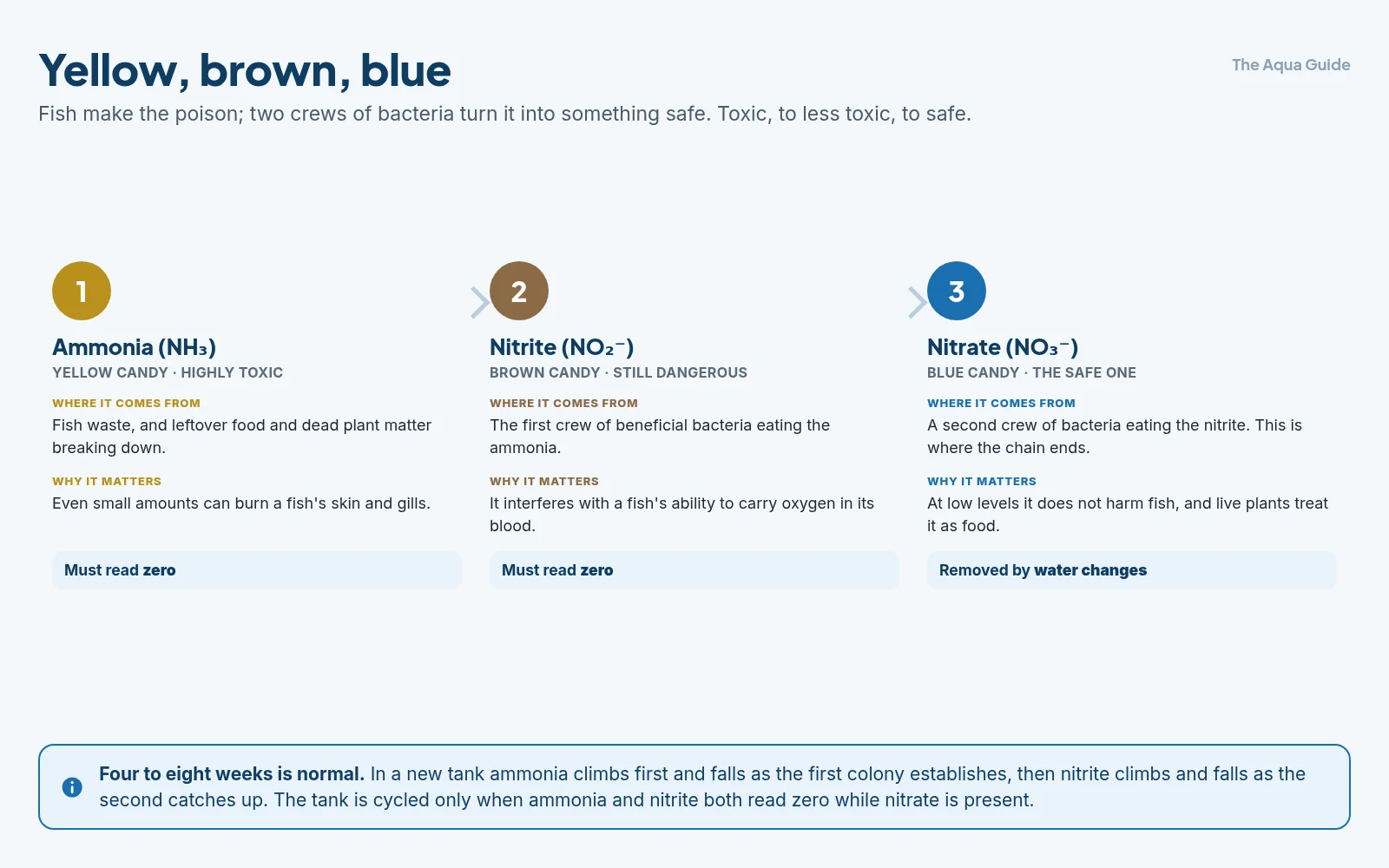
Yellow candy — Ammonia (NH₃). This is the first waste product, created when fish go to the bathroom and when leftover food and dead plant matter break down. Ammonia is highly toxic; even small amounts can burn a fish's skin and gills. This is the dangerous candy nobody wants sitting around.
Brown candy — Nitrite (NO₂⁻). The first crew of beneficial bacteria eats the ammonia and turns it into nitrite. That's progress, but it's not safe yet — nitrite is still dangerous, because it interferes with a fish's ability to carry oxygen in its blood. Less toxic than ammonia, but you still don't want it in the tank.
Blue candy — Nitrate (NO₃⁻). A second crew of bacteria eats the nitrite and converts it into nitrate. This is the safe candy. At low levels nitrate doesn't harm fish, and live plants actually treat it as food. This is where the chain ends.
So the flow is simple: yellow → brown → blue. Toxic, to less toxic, to safe.
How the Cycle Actually Operates
In a new tank the three readings arrive in order: ammonia climbs first, then falls as the first bacteria colony establishes; nitrite climbs next and falls as the second colony catches up; nitrate accumulates from then on and is what water changes remove. How you get there depends on whether you cycle with fish in the tank or without — fish-in vs fish-less cycling walks through both, and how to speed up the nitrogen cycle covers what genuinely shortens it.
How Long It Takes (and "New Tank Syndrome")
Four to eight weeks is normal, and the tank is only cycled when ammonia and nitrite both read zero while nitrate is present — how do I know if my tank is fully cycled sets out the test that confirms it. If the readings stall for weeks, that is its own problem with its own causes: see how to fix a stalled or stuck cycle.
Three Golden Rules for Beginners
Whatever else you do, protect your bacteria and don't overwhelm them. These three habits prevent the vast majority of early disasters.
Don't overfeed. Excess food rots and produces more ammonia than a young bacterial colony can keep up with. Feed small amounts, and when in doubt, feed less.
Add fish slowly. Dumping a crowd of fish into a new tank creates a mountain of waste overnight — far more than the bacteria can process. Add a few at a time and let the colony catch up before adding more.
Never rinse filter media under the tap. Tap water contains chlorine, and chlorine kills the beneficial bacteria living in your filter — undoing weeks of progress in seconds. When your filter needs cleaning, gently rinse the media in a bucket of old tank water instead.
The Bottom Line
The nitrogen cycle is really just nature recycling waste: fish make ammonia, one bacterial crew turns it into nitrite, a second crew turns that into nitrate, and you remove the nitrate with water changes or plants. Get this cycle established before you add fish, protect the bacteria once you have it, and the hardest part of fishkeeping is behind you. Everything else is maintenance.
Related guides
- What are safe ammonia, nitrite and nitrate levels?
- Fish-in vs fish-less cycling: which is right for you?
- How to speed up the nitrogen cycle
- How do I know if my tank is fully cycled?
- How to fix a stalled or stuck cycle
- What causes a nitrogen cycle crash?
- Do I need bottled bacteria, and which kinds work?
- The nitrogen cycle, explained
Got questions about your specific setup? Drop them in our Community Forum — we love helping new fishkeepers get started right.
The rest of cycling, in depth
This page is the map. Each question below is answered properly on its own page rather than summarised here.
- Fish-in vs fish-less cycling — which method suits your situation, and the trade-offs of each
- How to speed up the cycle — what actually shortens it, and what only appears to
- Do I need bottled bacteria? — which products contain live nitrifying bacteria and which do not
- Ghost feeding — how to supply ammonia in a tank with no fish in it
- Is my tank fully cycled? — the readings that confirm it, and the ones that mislead
- Fixing a stalled cycle — why readings stop moving, and how to restart them
- What causes a cycle crash — the seven ways an established cycle gets killed
- Safe ammonia, nitrite and nitrate levels — the numbers to act on
- Dechlorinators during cycling — which are safe with a developing colony
- Clarifiers during cycling — why they treat the symptom and not the cause
- How plants help — what live plants take up, and what they do not replace
- Cleaning the filter safely — where the bacteria live, and how not to remove them
- Adding fish in batches — how fast a cycled tank can absorb new stock