You've cycled your tank, planned your stocking, and you're ready to add fish — all of them, right? Almost certainly not. Adding too many fish too quickly is one of the most common ways beginners crash a freshly-cycled tank, even one that completed its cycle perfectly. Here's why slow batching matters, how to pace your additions, and what the right rhythm actually looks like.
How many fish can I add at once?
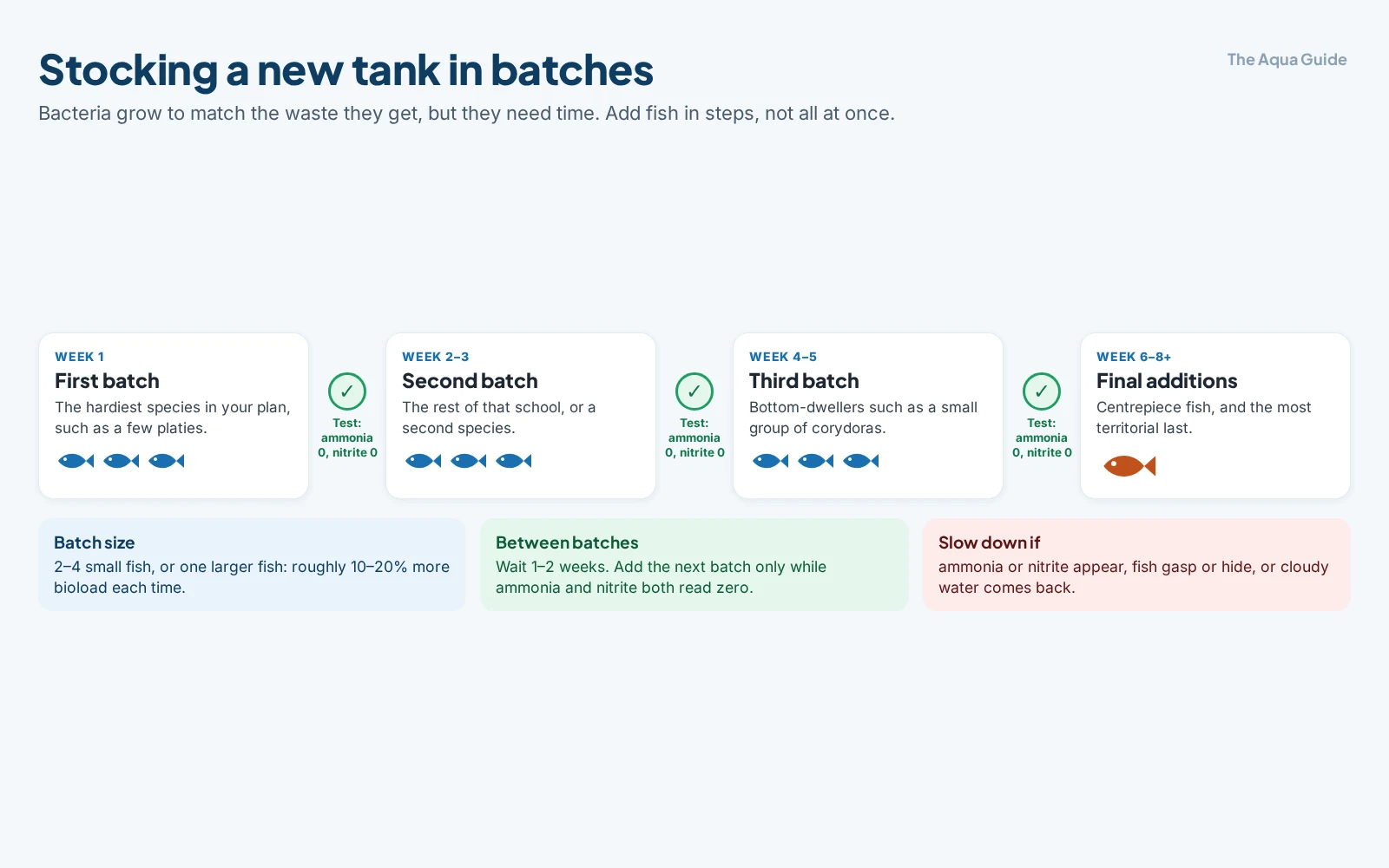
Add 2–4 at a time and wait 1–2 weeks between batches, testing ammonia and nitrite before each addition and only proceeding while both read zero. A cycled tank has only grown the bacteria its current bioload demands, so a full stocking on day one produces an ammonia spike even in a tank that cycled perfectly; populating a beginner community properly takes 6–10 weeks.
Why Even a Cycled Tank Can't Take Everyone at Once
This catches a lot of beginners off guard. You did everything right — added ammonia, watched it process, waited until nitrites zeroed out — and your tank is cycled. So why can't you stock it fully on day one?
The answer is that your bacteria colony has only grown to the size needed for the ammonia you fed it during cycling. If you cycled to a "moderate fish-load" ammonia level, your colony is sized for moderate fish, not a full stocking. Drop ten fish in at once and the colony suddenly faces several times the waste it's used to. The bacteria will eventually grow to handle it, but during the days it takes them to catch up, ammonia spikes — and your new fish bear the consequences.
This is sometimes called a "mini-cycle" — a temporary period where ammonia or nitrite appear because the bacteria haven't caught up to a sudden bioload change. It's avoidable by simply not changing the bioload suddenly.
The principle: your bacteria scale to match what you feed them, but they take time to scale. Add fish in batches and the bacteria grow gradually to match; add fish all at once and you create a gap where ammonia accumulates.
At a glance: the pacing
| The rule | |
|---|---|
| Batch size | 2–4 small fish at a time for a typical beginner community tank, or one larger fish |
| Between batches | Wait 1–2 weeks, testing along the way |
| What you're watching | That ammonia and nitrite stay at zero — proving the bacteria scaled up — and that the new fish settle in healthy |
| A school of six | Add three, wait, then add the rest |
| Time to full stocking | 6–10 weeks from a freshly cycled tank |
| If you see any reading | Wait longer before the next batch, and consider why the bacteria didn't keep up |
Six to ten weeks feels slow when you're excited. It is how to stock a tank without losing fish or stressing the system — and quarantine still applies on top of it.
The Basic Pacing Rule
The conservative, beginner-friendly pattern:
Add a small batch of fish, then wait 1–2 weeks before the next batch, testing water along the way.
"Small batch" depends on tank size and species, but a reasonable starting point is 2–4 small fish at a time for a typical beginner community tank, or one larger fish. For a school of 6 tetras intended as your first addition, you might add three at first, wait, then add three more.
During the wait, you're watching for two things: that ammonia and nitrite stay at zero (proving your bacteria scaled up to handle the new load), and that the new fish settle in healthy. If both are true after a week or two, you're ready for the next batch.
This pacing means a fully-stocked community tank takes 6–10 weeks to populate from a freshly-cycled state. That feels slow when you're excited — but it's how to do it without losing fish or stressing your system.
A Practical Stocking Sequence
A common sensible order for stocking a community tank:
Week 1: First small batch — the hardiest species in your plan, since they'll handle any small bumps best. Often this is a livebearer like a few platies, or the hardiest schooling fish in your community plan.
Wait 1–2 weeks, testing water. Ammonia and nitrite should stay at zero; if you see any reading, wait longer before the next batch and consider why your bacteria didn't keep up.
Week 2 or 3: Second small batch — continue with the rest of your schooling group, or add a second species.
Wait again.
Week 4 or 5: Third batch — bottom-dwellers like a small group of corydoras, or another mid-water schooling species.
Wait, observe, test.
Week 6–8+: Final additions — any centerpiece fish, additional species, or last members of schools.
The exact order isn't critical, but a few principles guide it: hardiest first, schoolers in their full group together (don't add 3 tetras, then 3 more weeks later — they're stressed during the wait), most aggressive or territorial last (so they can't claim turf before others are there), and any centerpiece fish toward the end.
How Many Fish Per Batch?
The rough mental rule: each batch should add roughly 10–20% to your current bioload, no more. So:
- An empty cycled tank gets a small first batch (a few small fish)
- A tank already holding 6 small fish can next add 1–2 more small fish or one medium fish
- A tank with significant fish already can add a few more proportionally
This is why early additions feel small and later ones can be slightly larger — you're adding the same proportion each time, not the same number.
For schooling species, you face a tradeoff: adding the full school at once is healthier for the fish (schoolers stress when in small groups) but harder on the bacteria. The usual compromise is to add the school in a couple of close-together batches — say 3 fish, wait a few days while testing, then 3 more — so the school isn't separated for long.
What to Test, and What to Look For
Between additions, your test kit is your best friend. Test for:
- Ammonia — should be zero. Any reading means bacteria haven't kept up; wait, do a water change, and slow your batching.
- Nitrite — should be zero. Any reading means the second bacterial group hasn't kept up; same response.
- Nitrate — should be present and slowly rising; reduce with water changes if it climbs above safe levels.
Test before any new batch — confirm ammonia and nitrite are at zero before adding more fish. If they're not, your tank can't yet handle the existing load, much less more. Wait, investigate, and address before continuing.
Signs You're Going Too Fast
A few warning signs that your batching pace is too aggressive:
- Any ammonia or nitrite appearing between batches
- Fish showing stress signs — heavy breathing, gasping, lethargy, hiding excessively — in the days after each addition
- Cloudy water reappearing (often a bacterial bloom catching up to the new bioload)
- Existing fish becoming sick after new additions (stress-triggered)
Any of these means slow down. Skip the next planned batch, do a water change, and let the system stabilize before continuing.
When You Can Be Slightly Faster
A few situations where you can stock a bit more aggressively:
- Heavily filtered tanks with substantial filter capacity have more bacterial reserve.
- Heavily planted tanks absorb ammonia directly through plant uptake, giving real buffer.
- Larger tanks dilute waste so even a relatively-large batch is a smaller proportional change.
But even in these cases, the principle of adding some fish then waiting and testing applies. The faster pace just means you can confidently add slightly more per batch — not that you can stock everything on day one.
A Reminder: Quarantine Still Applies
Throughout this batching process, the quarantine habit (covered separately) applies in parallel. Fish from a new source ideally spend 2–4 weeks in quarantine before joining your display, regardless of how the display's bacteria are scaling. The two practices work together: batching protects your bacteria, quarantine protects your community from disease. For beginners without quarantine capacity, source carefully and observe new arrivals closely.
The Bottom Line
Even a fully-cycled tank can't take a full stocking on day one — your beneficial bacteria have only grown to the size of the bioload they've been processing, and they need time to scale up when you add fish. Add fish in small batches of 2–4 at a time, wait 1–2 weeks between batches, and test ammonia and nitrite before each addition (they should stay at zero). Add the hardiest species first, then layer in the rest, with aggressive or territorial fish last. A fully-stocked beginner community tank takes 6–10 weeks to populate this way — feels slow, but it's how to do it without losing fish to ammonia spikes from a sudden bioload change. Combined with proper acclimation and (when possible) quarantine, slow batching is one of the most undramatic but most effective habits in successful fishkeeping.
Related guides
- How do I know if my tank is fully cycled?
- How many fish can my tank hold?
- How to acclimate new fish properly
- Quarantine: why and how
- Community tank compatibility
- What are safe ammonia, nitrite and nitrate levels?
Got questions about your specific setup? Drop them in our Community Forum — we love helping new fishkeepers get started right.