This is the question that separates a beginner who loses fish from one who doesn't. You've set up your tank, you've been waiting, and now you're staring at the water wondering: is it ready? The honest answer is that you can't tell by looking — a fully cycled tank and a deadly one can look identical. The only way to know is to test, and to know exactly what the test results should say.
Let's settle this completely, so you never have to guess.
How do I know if my tank is fully cycled?
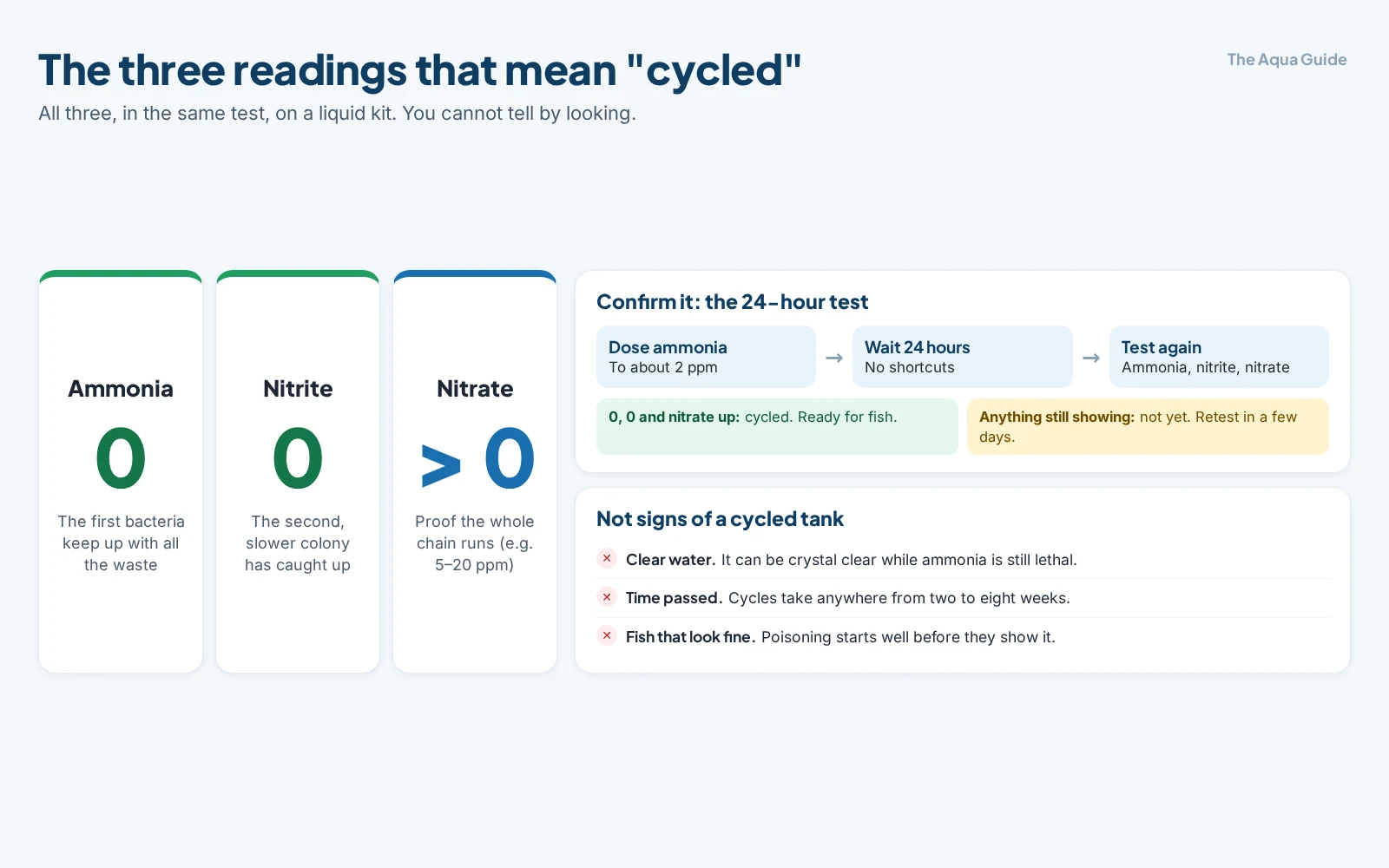
Your tank is cycled when a single water test shows ammonia at 0 ppm, nitrite at 0 ppm and some nitrate above zero, all at the same time. You cannot tell by looking — clear water says nothing about whether the bacteria have established.
The One Rule That Matters
A tank is fully cycled when a water test shows all three of the following at the same time:
Ammonia: 0 ppm. Nitrite: 0 ppm. Nitrate: present (some reading above zero).
That's it. That's the entire definition. If you remember nothing else from this article, remember those three numbers together. Ammonia zero, nitrite zero, nitrate showing — that combination, and only that combination, means your bacterial colonies are fully established and processing waste as fast as your fish produce it.
Why all three at once? Because each number tells you a different part of the story, and you need the whole story.
What Each Reading Is Telling You
Ammonia at zero means the first crew of beneficial bacteria has grown large enough to consume all the ammonia your tank produces. Ammonia is the most toxic waste in the tank, so this colony establishing itself is the first milestone.
Nitrite at zero means the second crew of bacteria — the one that eats the nitrite produced by the first crew — has also fully established. This colony always grows after the ammonia-eaters, because it needs nitrite to exist before it has anything to eat. This is why nitrite zeroing out is the milestone that takes longest.
Nitrate showing a reading is the proof that the whole chain is actually running. Nitrate is the end product — it's what's left after both bacterial crews have done their job. If your nitrate is reading something (say, 5–20 ppm) while ammonia and nitrite are both zero, that's the signature of a working cycle. No nitrate at all, with everything else at zero, usually means the cycle never really started — there was simply nothing to process.
So the three readings together describe a complete, functioning system: waste comes in (ammonia), gets converted (nitrite), and ends up as the relatively harmless byproduct (nitrate) that you'll remove with water changes.
At a glance: the 24-hour test
| Step | What you do |
|---|---|
| 1. Add ammonia | On a fishless cycle, dose pure ammonia up to around 2 ppm |
| 2. Wait 24 hours | That's the whole test — one full day |
| 3. Test again | Ammonia, nitrite and nitrate |
| 4. Read it | Both ammonia and nitrite at zero, with nitrate gone up, means you are fully cycled |
Reading zeros once isn't enough, because a tank can show momentary zeros and still not be ready. This test proves the bacteria can take a real dose and convert it completely within a single day — the difference between hoping your tank is ready and knowing it is.
The Definitive Test: The 24-Hour Ammonia Check
Reading zeros once isn't quite enough, because a tank can show momentary zeros and still not be ready. The gold-standard confirmation that experienced keepers use is simple, and it removes all doubt.
Add a source of ammonia to the tank — if you're doing a fishless cycle, this means dosing pure ammonia up to around 2 ppm. Wait 24 hours. Then test again.
If after 24 hours both ammonia and nitrite read zero, and your nitrate has gone up, your tank is fully cycled. You've just proven that your bacteria can take a real dose of ammonia and convert it completely to nitrate within a single day — which is exactly what they'll need to do once fish are living there. If ammonia or nitrite is still showing after 24 hours, the colonies aren't big enough yet. Wait a few more days and test again.
This 24-hour test is the difference between hoping your tank is ready and knowing it is.
What You Cannot Rely On
Several things feel like signs of a cycled tank but aren't. It's worth clearing these up, because beginners lose fish trusting them.
Clear water is not a sign. Cloudy water often clears up days before the cycle finishes, and a tank can be crystal clear while ammonia is still lethal. Clarity tells you nothing about your water chemistry. (If you're fighting cloudiness specifically, that's a separate issue covered in our cloudy-water guide.)
Time passed is not a sign. "It's been three weeks, so it must be done" is one of the most common fatal assumptions. Cycles vary enormously depending on temperature, whether you seeded the tank, and how much ammonia was available. Some finish in two weeks; some take eight. The calendar is a rough guide, never proof. Trust the test kit over the calendar, every time.
Healthy-looking fish are not a sign (if you're doing a fish-in cycle). Fish can be suffering from ammonia or nitrite poisoning well before they show obvious distress. By the time they're gasping or clamping their fins, real damage is already done.
Use a Liquid Test Kit, Not Strips
This matters enough to call out directly. Paper test strips are notoriously inaccurate, especially for the low-but-not-zero readings that matter most during cycling. A liquid drop-based test kit costs a little more but gives you readings you can actually trust. When you're making a life-or-death decision for your fish based on whether a number is truly zero, you want the accurate tool. Consider the liquid kit the single most important testing purchase you'll make.
A Quick Word on Fish-In Cycling
If you already have fish in the tank while it's cycling (which happens, often because a beginner didn't know to cycle first), the target is the same — ammonia and nitrite at zero — but your job until then is damage control. Keep both toxins as close to zero as possible with frequent partial water changes, feed sparingly, and be patient. The cycle will still complete; you're just protecting living fish while it does. Once you hit stable zeros on ammonia and nitrite with nitrate present, you've crossed the same finish line.
What Happens After You're Cycled
Reaching a cycled state isn't a "set it and forget it" moment — it's the start of ongoing care. Your bacteria are now established, but they stay alive only as long as they're fed (by fish waste) and protected (never rinse your filter media in tap water; chlorine kills them). And because nitrate keeps accumulating with nowhere to go, your regular water changes become the routine that keeps the whole system in balance.
But the hard part is genuinely behind you. A cycled tank is a stable tank. From here, fishkeeping becomes maintenance rather than crisis management.
The Bottom Line
You'll know your tank is fully cycled when a liquid test kit shows ammonia at zero, nitrite at zero, and nitrate present — confirmed by the 24-hour test, where a fresh dose of ammonia converts fully to nitrate within a day. Ignore clear water, ignore the calendar, and trust the numbers. When those three readings line up, your tank is ready for fish, and you've done the single hardest thing in the hobby correctly.
Related guides
- How the nitrogen cycle works: a beginner's guide
- How to fix a stalled or stuck cycle
- Fish-in vs fishless cycling
- What are safe ammonia, nitrite and nitrate levels?
- Adding fish in batches: how slow is slow enough?
- How to use a liquid test kit
- The nitrogen cycle, explained
Got questions about your specific setup? Drop them in our Community Forum — we love helping new fishkeepers get started right.