Few things test a beginner's patience like a cycle that just won't finish. The ammonia went up, maybe nitrite appeared — and then everything seems frozen. Weeks pass with no progress. Your nitrite won't drop, or your ammonia won't budge, and you start to wonder if your tank is broken. It isn't. A stalled cycle is almost always caused by one of a few specific, fixable problems. Here's how to diagnose what's wrong and get things moving again.
At a glance: the numbers while cycling
| What to check | Aim for | Stalls when |
|---|---|---|
| pH | 6.5 or above, with some KH | Below 6.5 it slows; below 6.0 it can stop |
| Ammonia | About 2 ppm, topped up as it drops | It runs out, or climbs to 5 ppm or more |
| Temperature | 27–29 °C (80–84 °F) | Room temperature or below |
| Tap water | Every drop dechlorinated | Untreated top-offs |
| Time | 3 to 8 weeks in total | No change at all for about two weeks |
First: Are You Sure It's Actually Stalled?
Before troubleshooting, rule out simple impatience. Cycling naturally takes three to eight weeks, and there are long stretches where nothing seems to happen — especially the nitrite phase, which is notoriously slow. The second bacterial colony (the nitrite-eaters) grows more slowly than the first, so a week or two of stubbornly high nitrite while ammonia reads zero is normal, not stalled. If you're only two or three weeks in, you may just need more patience.
A cycle is genuinely stalled when readings haven't changed at all for a prolonged period — say, two weeks with no movement in ammonia or nitrite despite a steady food source. If that's you, work through the causes below.
Cause 1: pH Too Low
This is the single most common reason for a stuck cycle, and the most overlooked. Nitrifying bacteria need a reasonable pH to function — when pH drops too low (often below 6.5, and especially below 6.0), the bacteria slow dramatically or stop working entirely. Cycling itself produces acids that consume your water's buffering capacity (KH), so a tank can gradually acidify until the cycle grinds to a halt.
How to check: test your pH and KH. If pH is very low or KH is near zero, this is likely your culprit.
The fix: raise and stabilize your pH by restoring buffering capacity. A partial water change with harder water helps, as does adding a source of carbonate hardness (crushed coral in the filter, or a commercial KH buffer). Bring pH back into a comfortable range and the dormant bacteria usually spring back to life within days.
Cause 2: Not Enough Ammonia (Starvation)
Bacteria can't grow without food. If your ammonia source ran out — the ghost-feeding food fully decayed, or you stopped dosing pure ammonia — the colonies have nothing to eat and growth stalls. Readings of zero ammonia and zero nitrite and zero nitrate often mean the cycle never had enough fuel to get going.
The fix: make sure you're maintaining a steady ammonia source throughout cycling. If dosing pure ammonia, keep topping it back up to around 2 ppm whenever it drops. If ghost feeding, keep adding small pinches of food regularly. Don't let the food source disappear mid-cycle.
Cause 3: Too Much Ammonia (Toxic to the Bacteria)
The opposite problem, and a sneaky one. While bacteria eat ammonia, extremely high concentrations actually inhibit them — paradoxically, dumping in too much ammonia (or way overfeeding a ghost-fed tank) can stall the very cycle you're trying to drive. Levels above roughly 5 ppm can suppress the colony.
The fix: if your ammonia reading is sky-high (5+ ppm), do a partial water change to dilute it back down into a workable range (around 1–2 ppm). Then maintain it there rather than overdosing.
Cause 4: Chlorine Sneaking In
If you've been topping off or doing water changes with untreated or under-treated tap water, chlorine may be quietly killing your developing bacteria as fast as they grow — keeping you stuck in place. This is easy to do by accident, especially with top-offs that people forget to treat.
The fix: dechlorinate every drop of tap water that goes into the tank, every time, including small top-offs. Make sure your conditioner is fresh and you're dosing enough for your water volume.
Cause 5: Temperature Too Low
Bacteria grow faster when warm. A tank sitting at room temperature (say, low 70s °F or below) will cycle far more slowly than one kept in the upper 70s to low 80s. Cold can make a cycle seem stalled when it's really just crawling.
The fix: raise the temperature into the upper range (around 27–29°C / 80–84°F) during cycling to speed bacterial growth. You can lower it back to your fish's preferred range once cycling completes.
Cause 6: No Oxygen / Poor Flow
Nitrifying bacteria are aerobic — they need oxygen to work. If your water is poorly oxygenated or your filter flow is weak, the bacteria can't function well, and the cycle drags.
The fix: make sure your filter is running properly and consider adding surface agitation or an airstone to boost oxygen, especially in a warm cycling tank (warmer water holds less oxygen, so the two issues can compound).
A Practical Troubleshooting Order
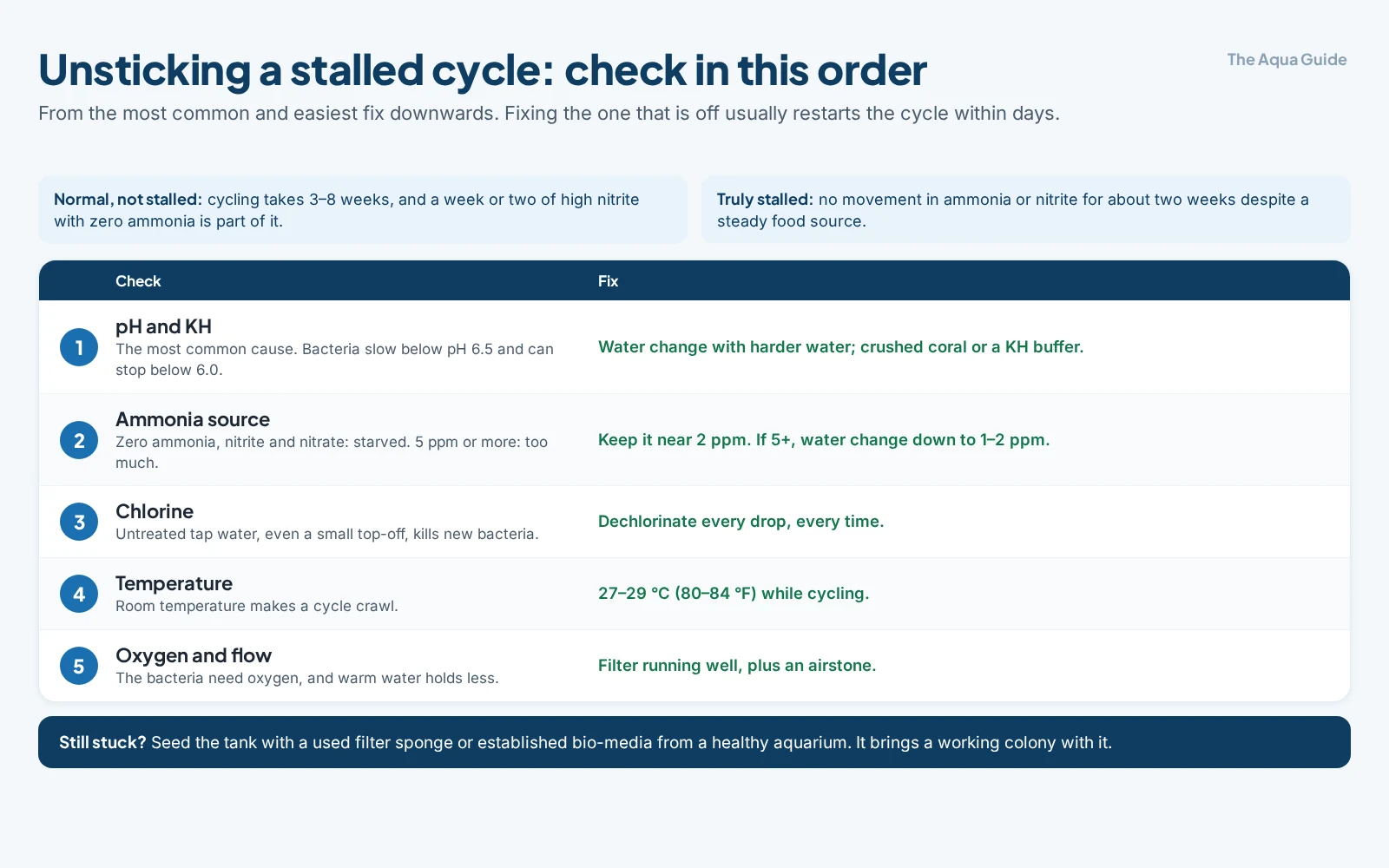
When a cycle is stuck, check in this order — it goes from most common and easiest to fix, downward:
First, test pH and KH (the top suspect). Then confirm you've got an appropriate, steady ammonia source — neither starved nor overdosed. Then verify you're dechlorinating all tap water. Then check your temperature is in the warm range. Finally, confirm good oxygenation and filter flow. Fixing whichever of these is off-target almost always restarts a stalled cycle within days.
When in Doubt, Seed It
If you've checked everything and you're still stuck — or you simply don't want to troubleshoot — the nuclear option that almost always works is to seed the tank with mature filter media from an established, healthy aquarium. Dropping in a used filter sponge or some established bio-media introduces a large, living, fully-functional colony that bypasses whatever was holding you back. A fresh bottle of quality bacteria can help too. Sometimes the fastest fix is simply to import the bacteria rather than coax the stubborn ones along.
The Bottom Line
A stalled cycle is almost never a broken tank — it's a fixable condition, usually caused by low pH (the most common), an ammonia source that's either run out or been overdosed, chlorine from untreated water, cold temperature, or poor oxygenation. Work through those in order, fix the one that's off, and the cycle typically resumes within days. And if you want to skip the detective work entirely, seeding with mature filter media from an established tank is the reliable reset button. Patience plus the right diagnosis will always get a cycle un-stuck.
Related guides
- How do I know if my tank is fully cycled?
- How the nitrogen cycle works: a beginner's guide
- How to speed up the nitrogen cycle
- What causes a nitrogen cycle crash?
- My pH keeps crashing: what do I do?
- What is ghost feeding?
- Do I need bottled bacteria?
- How to use a liquid test kit
Got questions about your specific setup? Drop them in our Community Forum — we love helping new fishkeepers get started right.