If you've been reading about fishless cycling, you've probably run into the term "ghost feeding" — and it sounds more mysterious than it is. There are no actual ghosts involved. Ghost feeding simply means feeding an empty tank: dropping fish food into water that has no fish in it yet. It sounds pointless, even a little absurd, but it's a genuinely useful technique for cycling a new aquarium. Here's what it is, why it works, and when to use it.
The Idea in One Sentence
Ghost feeding is adding fish food to a fishless tank so that the food rots and produces ammonia — giving your beneficial bacteria something to eat so they can grow, before any fish ever arrive.
That's the whole concept. To understand why anyone would do this, you have to remember what a cycle actually needs.
At a glance: ghost feeding, or dosing pure ammonia
| Ghost feeding | Dosing pure ammonia | |
|---|---|---|
| Control | Imprecise — you cannot control how much ammonia the rotting food produces | Precise — hit an exact target and know what the bacteria are handling |
| Cost | Free, using food you already have | A bottle of pure ammonia, not always easy to find without additives |
| Mess | Introduces organic gunk into the tank | Clean |
| Suits | A beginner who wants to get cycling without tracking down special products | Someone in a hurry, or who wants tight control |
Neither is better universally, and both grow exactly the same bacteria.
Why an Empty Tank Needs Feeding
A nitrogen cycle is really just the process of growing two colonies of beneficial bacteria — one that eats ammonia, and one that eats the nitrite the first colony produces. But bacteria, like anything alive, only grow when they have a food source. Their food is ammonia.
In a normal tank, fish provide that ammonia constantly through their waste. But in a brand-new fishless tank, there's no waste, no ammonia, and therefore nothing for the bacteria to eat — so they can't multiply. You're stuck: you can't safely add fish until the tank is cycled, but the tank can't cycle without an ammonia source.
Ghost feeding solves this. By adding fish food to the empty tank, you let it decay. As the food breaks down, it releases ammonia into the water — exactly the same ammonia fish would produce, just from rotting food instead of fish waste. The bacteria now have something to eat, they begin to multiply, and your cycle gets underway. By the time you add fish, the colonies are already established and waiting.
How to Ghost Feed, Step by Step
The method is straightforward, but the amount matters.
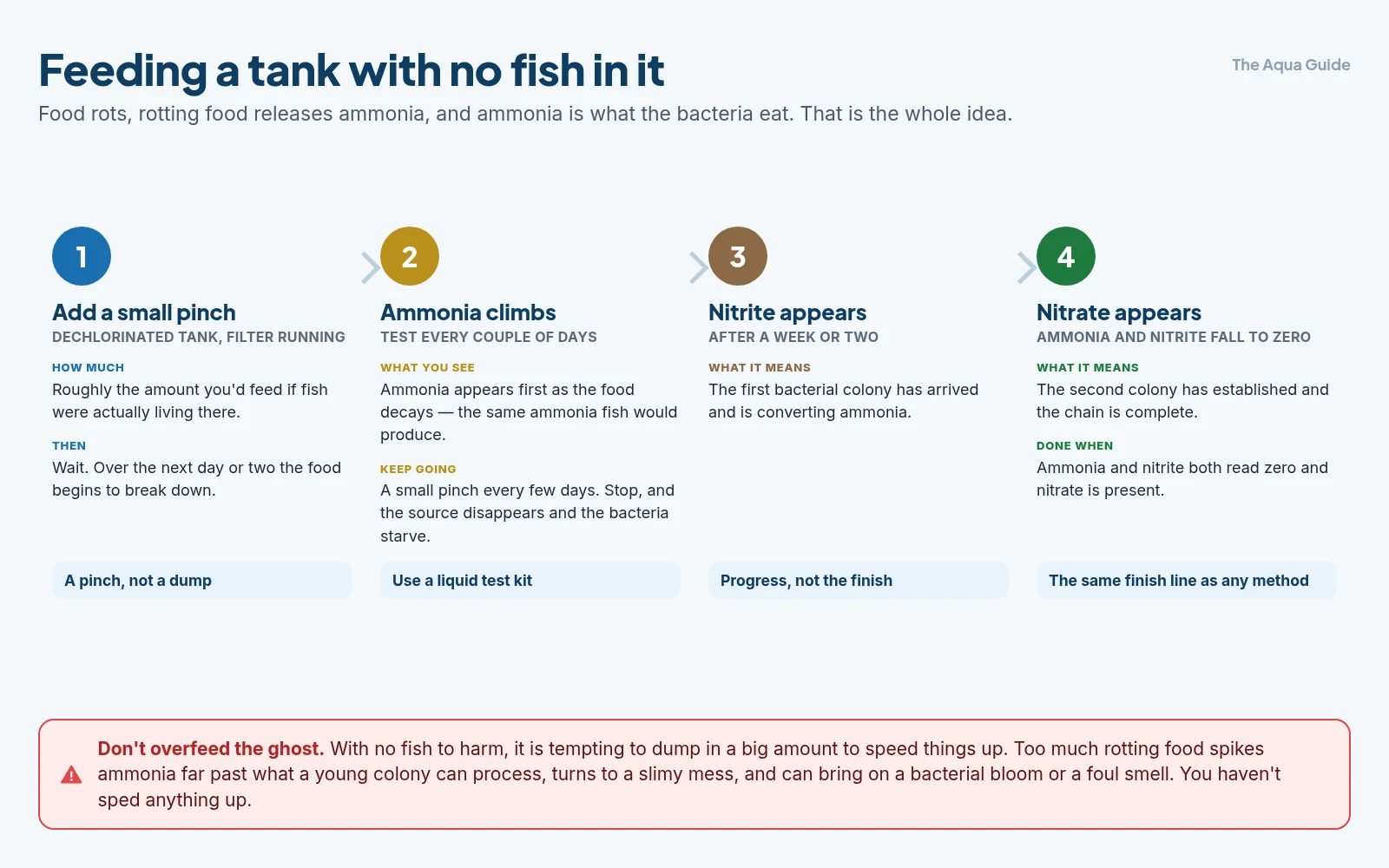
Start by adding a small pinch of fish food to your new, dechlorinated, filter-running tank — roughly the amount you'd feed if fish were actually living there. Then wait. Over the next day or two, the food will begin to break down and release ammonia.
Begin testing your water with a liquid test kit every couple of days. At first you'll see ammonia climb. After a week or two, you should see nitrite appear (the first bacterial colony has arrived and is converting ammonia). Later still, nitrate appears and ammonia/nitrite begin dropping toward zero (the second colony has established). Keep adding a small pinch every few days to keep feeding the growing colonies — if you stop, the ammonia source disappears and the bacteria starve.
The cycle is complete when ammonia and nitrite both read zero and nitrate is present — the same finish line as any other cycling method.
The Most Common Mistake: Overfeeding the Ghost
Here's where people go wrong. Because there are no fish to harm, beginners assume more food is better and dump in a big amount to "speed things up." This backfires.
Too much rotting food produces an enormous ammonia spike — far more than the young bacterial colony can process. The excess ammonia just sits in the water doing nothing useful, the food turns into a slimy mess, and the tank can develop a bacterial bloom (cloudy white water) or foul smell. You haven't sped anything up; you've just made a mess that the bacteria still have to slowly work through.
The rule is the same as feeding real fish: a small pinch, regularly, is far better than a big dump occasionally. You're trying to mimic the steady, modest ammonia output of a normal fish, not flood the tank.
Ghost Feeding vs. Bottled Ammonia
Ghost feeding is one of two common ways to supply ammonia for a fishless cycle. The other is dosing pure bottled ammonia directly. It's worth knowing the trade-off.
Dosing pure ammonia gives you precise control — you can hit an exact target (say 2 ppm) and know exactly how much ammonia your bacteria are handling. This makes it the more "scientific" method, and many experienced keepers prefer it.
Ghost feeding is messier and less precise — you can't control exactly how much ammonia the rotting food will produce, and it introduces organic gunk into the tank. But it's free, it uses food you already have, and it doesn't require buying a bottle of pure ammonia (which isn't always easy to find without additives). For a beginner who just wants to get cycling without tracking down special products, ghost feeding is a perfectly valid choice.
Neither is "better" universally — dosing is more controlled, ghost feeding is more convenient. Both grow the same bacteria.
When Ghost Feeding Makes the Most Sense
Ghost feeding shines in a few situations. It's ideal if you want a hands-off, low-cost fishless cycle and don't mind it taking the normal three to eight weeks. It's also useful for keeping a cycled-but-empty tank alive — for example, if you've got a quarantine tank or a spare tank running with no fish in it, a periodic pinch of food keeps the bacteria fed so the tank stays cycled and ready.
It's less ideal if you're in a hurry or want tight control, in which case dosed ammonia (often combined with seeded filter media) will serve you better.
The Bottom Line
Ghost feeding is simply feeding an empty tank so rotting food produces the ammonia your beneficial bacteria need to grow. It's a free, beginner-friendly way to run a fishless cycle — no fish are put at risk, and by the time you add them, the bacteria are established. The one rule that matters: feed small pinches regularly, never big dumps, because overfeeding the "ghost" creates an ammonia mess rather than a faster cycle. Test your water as you go, and you'll know the cycle is done when ammonia and nitrite hit zero with nitrate present.
Related guides
- Fish-in vs fish-less cycling: which is right for you?
- How to speed up the nitrogen cycle
- Do I need bottled bacteria, and which kinds work?
- Can I use chemical clarifiers during the cycle?
- How do I know if my tank is fully cycled?
- Quarantine: why and how
- How does the aquarium nitrogen cycle work?
- The nitrogen cycle, explained
Got questions about your specific setup? Drop them in our Community Forum — we love helping new fishkeepers get started right.