If there's one tool that separates fishkeepers who succeed from those who lose fish for mysterious reasons, it's a water test kit. Your water can look crystal clear and still be deadly — the things that harm fish are invisible, and the only way to see them is to test. But not all test kits are created equal, and the convenient option most beginners reach for first is often the one that lets them down. Let's cover why, and how to test properly.
At a glance: test strips vs a liquid kit
| Test strips | Liquid test kit | |
|---|---|---|
| Accuracy at low readings | Unreliable, and can read zero when there is a problem | Reliable, which is where it counts |
| Ammonia | Many strips don't test for it | Included in a master kit |
| Time per test | Seconds | A few minutes |
| Shelf life | Degrade quickly once opened | Reagent bottles last a long time |
| Consistency | Depends on lighting and your colour judgement | A defined volume and set drops each time |
How often to test: every few days while the tank is cycling, then weekly or every other week once it is established.
Why You Test At All
Quick reminder of the stakes: ammonia and nitrite are toxic to fish even at low levels, and both are completely invisible. A tank can read lethal while looking pristine. Testing is how you see the unseeable — it's the dashboard that tells you whether your water is safe, whether your tank is cycled, and whether a problem is brewing before your fish start dying. Skipping testing is flying blind, and blind flying is how beginners lose whole tanks without ever knowing why.
The Problem With Test Strips
Test strips are the little paper sticks you dip in the water and compare against a color chart. They're cheap, fast, and sold everywhere — which is exactly why beginners buy them. And for casual, rough checks they're not useless. But they have a serious weakness that matters enormously in this hobby: they're inaccurate, especially at the low readings that matter most.
The trouble is that the difference between "safe" and "dangerous" often lives in the low end of the scale. The gap between zero ammonia and a small but harmful amount is precisely where you need precision — and precisely where strips are least reliable. They can read zero when there's actually a problem, giving you false confidence while your fish suffer. Strips also degrade quickly once the bottle is opened and exposed to humidity, drift in accuracy as they age, and depend heavily on lighting and your own color judgment. Many also don't even test for ammonia, the single most important reading.
For a tool you're using to make life-or-death decisions for your fish, "fast and cheap but often wrong" is a bad trade.
Why Liquid Kits Win
A liquid test kit works differently. You add a measured amount of tank water to a small test tube, add a set number of drops of reagent, shake, wait, and compare the resulting color to a chart. It takes a few minutes instead of a few seconds — and that small extra effort buys you dramatically better accuracy.
Liquid kits read the low end reliably, which is exactly where it counts. They have a much longer usable life (the reagent bottles last a long time). And because they test a defined volume of water with defined reagents, the results are consistent and trustworthy. When your kit says ammonia is zero, you can actually believe it. For the core readings every fishkeeper needs — ammonia, nitrite, nitrate, and pH — a liquid master test kit is the standard tool, and it's worth considering the single most important testing purchase you'll make.
How to Use a Liquid Test Kit Properly
The method is simple, but a few details make the difference between an accurate reading and a misleading one.
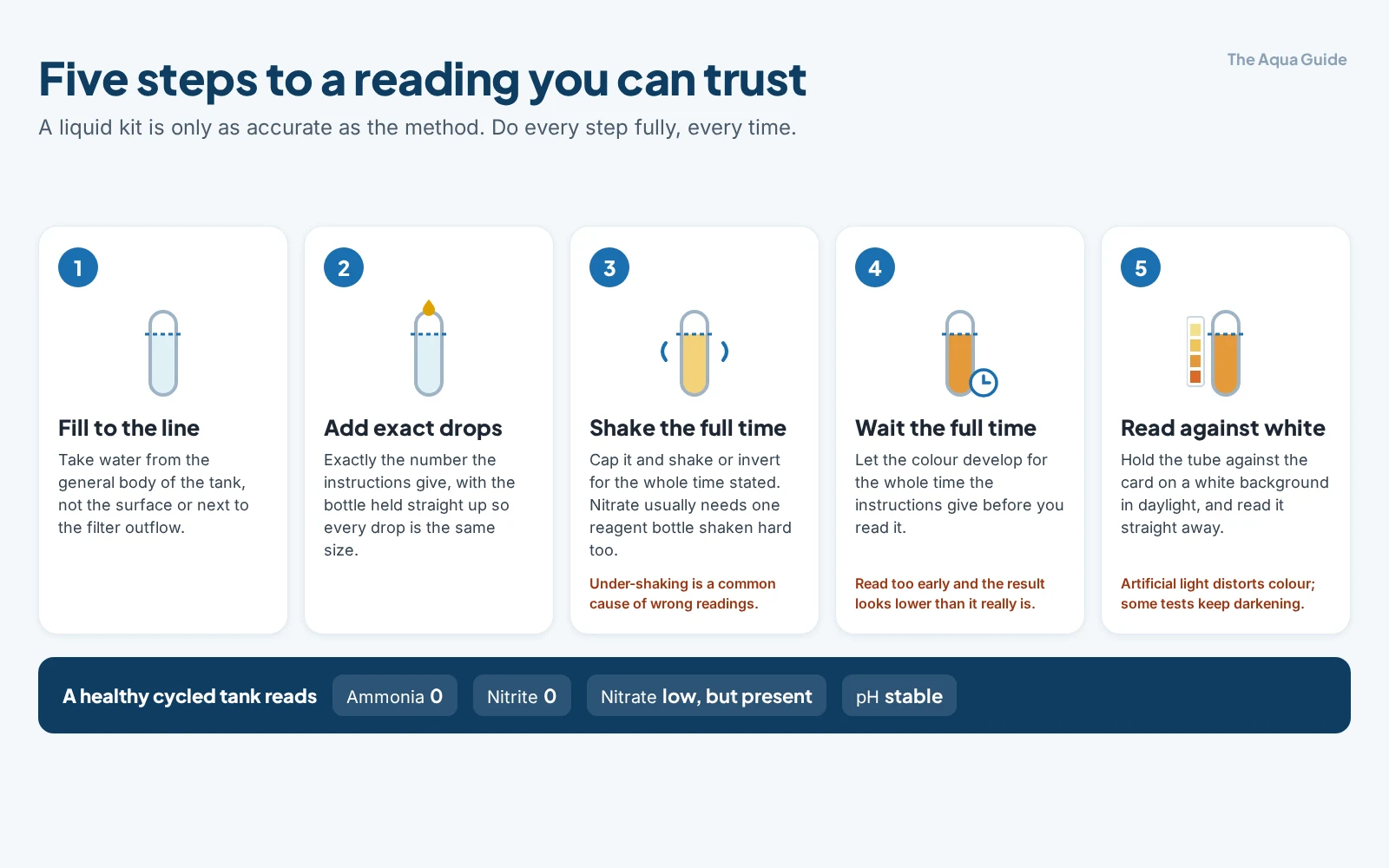
Start by filling the test tube to the marked line with water from your tank — not from the surface or right next to the filter outflow, but from the general body of the water. Add exactly the number of reagent drops the instructions specify, holding the bottle vertically so each drop is a consistent size. Cap the tube and shake or invert it for the full time the instructions state — under-shaking is a common cause of wrong readings, especially for nitrate, which often needs vigorous shaking of one reagent bottle and the tube.
Then wait the full development time before reading. This matters: read too early and the color hasn't fully formed; the result will look lower than reality. Once the time is up, compare the tube against the color card — ideally against a white background in natural daylight, since artificial light distorts colors. Read it promptly, because some tests continue to darken if left too long.
Rinse the tube thoroughly with tank or tap water between tests so leftover reagent doesn't contaminate the next reading, and you're done.
Reading the Results
The numbers you're looking for, in a healthy cycled tank: ammonia zero, nitrite zero, nitrate low (and present). For pH, you're looking less for a "perfect" number and more for stability over time. If ammonia or nitrite show anything above zero, that's your signal to act — water change, check your stocking and feeding, and investigate your cycle. (The full breakdown of what each safe level means has its own guide.)
A Few Habits That Help
Test on a routine, not just when something looks wrong — by the time a problem is visible, it's often advanced. During cycling, test every few days to track your progress. In an established tank, a weekly or biweekly check keeps you ahead of trouble. Keep a simple log of your readings; patterns over time tell you far more than any single test. And store your kit out of direct sunlight and extreme heat so the reagents stay accurate.
The Bottom Line
A test kit is non-negotiable, because the things that kill fish are invisible and only testing reveals them. Test strips are cheap and fast but unreliable exactly where it matters — at the low readings that separate safe water from dangerous water — and they often skip ammonia entirely. A liquid master test kit takes a few minutes longer but gives you accurate, trustworthy results for ammonia, nitrite, nitrate, and pH. Fill to the line, dose the drops precisely, shake fully, wait the full time, and read against white in daylight. Do that on a routine, and you'll catch problems while they're still fixable instead of discovering them through dead fish.
This is a sensitive area only in the sense that getting it wrong costs fish lives — so when in doubt, test more, not less.
Related guides
- What are safe ammonia, nitrite and nitrate levels?
- How do I know if my tank is fully cycled?
- How to fix a stalled or stuck cycle
- How often should you do a water change, and how much?
- My pH keeps crashing: what do I do?
- Understanding pH, KH and GH
- Fish tank water cloudy? What's wrong and how to fix it
- The nitrogen cycle, explained
Got questions about your specific setup? Drop them in our Community Forum — we love helping new fishkeepers get started right.