Most fishkeepers fill their tanks with tap water, treat it, and never think further — and for most fish, that's exactly right. But sooner or later you'll hear about RO water, remineralising, and treating tap water, and wonder whether you're missing something. Are you supposed to be using special water? When does it matter? Let's clear up the three main water sources, when each makes sense, and how to prepare them — without overcomplicating something that's usually simple.
At a glance: preparing each one
| Water | What to do | Then |
|---|---|---|
| Tap | Add dechlorinator for your volume | Match the temperature to the tank, and it is ready — this is your normal water-change routine |
| RO | Never use it pure for fish. Remineralise with a GH/KH product, or blend with tap water | Match the temperature. No dechlorinator is needed for true RO, but treat any tap water you blend in |
| Whichever you use | Match the temperature to the tank before it goes in | This is what avoids shocking your fish |
When is tap water not ideal? If it is extremely hard or soft and doesn't match the fish you want, if it carries unusual contaminants — rare, but worth checking your water report — or if you keep sensitive species or breed.
Tap Water — The Default (and Usually the Right Choice)
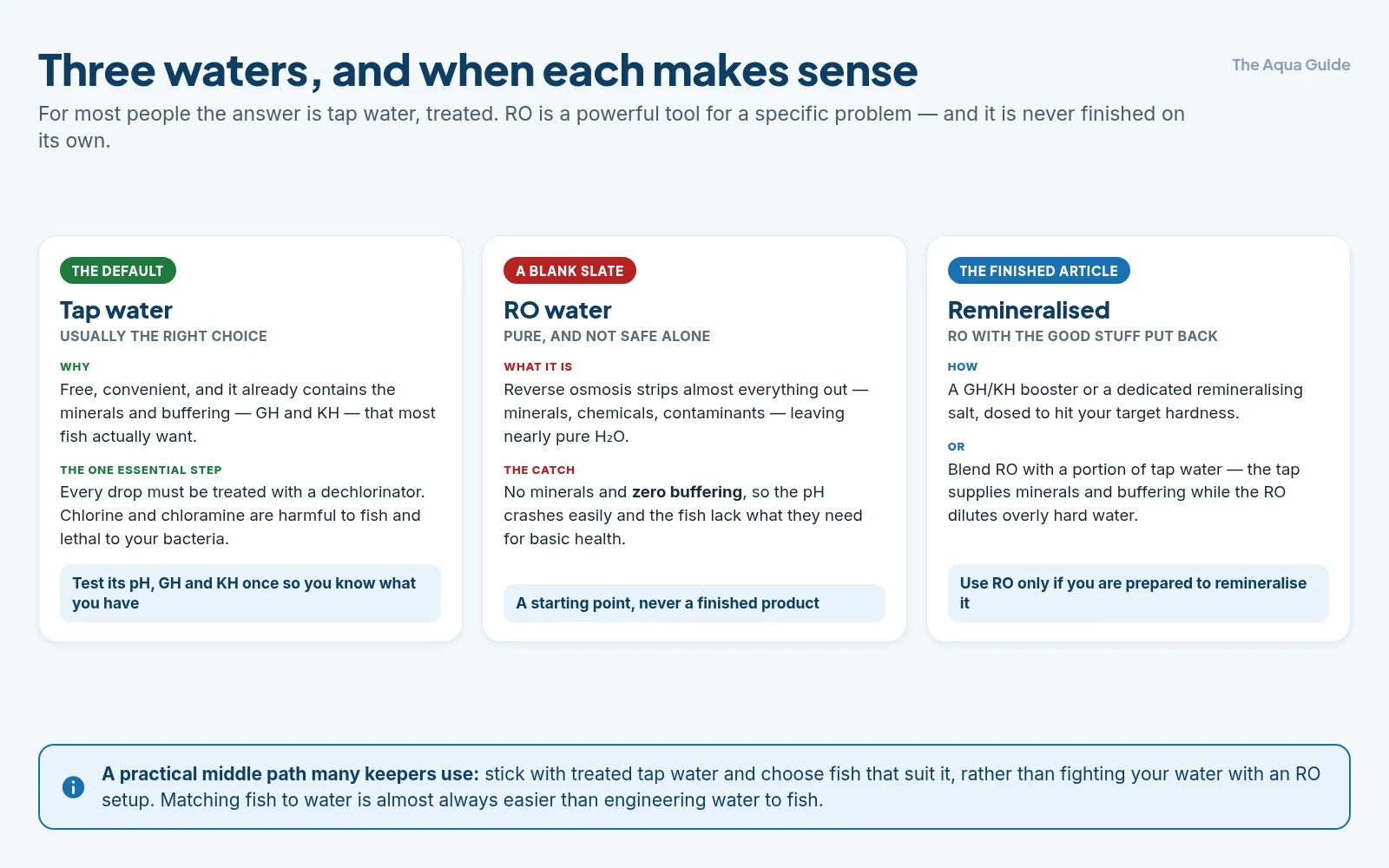
For the great majority of fishkeepers and fish, treated tap water is perfectly good. It's free, convenient, and contains the minerals and buffering (GH and KH) that most fish actually want. You don't need to overthink it.
The one essential step is treatment: tap water almost always contains chlorine or chloramine, added to make it safe for humans, but those chemicals are harmful to fish and lethal to your beneficial bacteria. So every drop of tap water that goes into your tank must be treated with a dechlorinator (water conditioner) first. Beyond that, the main thing worth doing once is testing your tap water's pH, GH, and KH so you know what you're working with — this tells you which fish naturally suit your water.
When is tap water not ideal? In a few cases: if your local tap water is extremely hard or extremely soft and doesn't match the fish you specifically want to keep; if it contains unusual contaminants (rare, but worth checking your water report); or if you're keeping sensitive species (certain wild-caught soft-water fish, sensitive shrimp, or breeding setups) that demand very specific, pure water. For the everyday community tank, though, treated tap water is the correct, recommended choice — don't let the existence of fancier options convince you that you need them.
RO Water — Pure, Blank-Slate Water
RO stands for reverse osmosis, a filtration process that strips almost everything out of water — minerals, chemicals, contaminants — leaving nearly pure H₂O. RO water (often produced by an RO unit at home, or bought from a fish store) is essentially a blank slate: very soft, very low in minerals, and free of chlorine and most contaminants.
The appeal of RO is control. Because it's pure and consistent, you can build exactly the water chemistry you want from scratch, regardless of what comes out of your tap. This matters for keepers whose tap water is unsuitable — for instance, someone with very hard tap water who wants to keep soft-water species, or a breeder who needs precise, repeatable parameters.
But here's the crucial catch: pure RO water is not safe to use on its own. Because it has almost no minerals and zero buffering (no GH, no KH), putting fish straight into pure RO water is dangerous — there's nothing to buffer the pH (so it crashes easily) and none of the minerals fish need for basic health. RO water is a starting point, not a finished product. This is where remineralising comes in.
Remineralising — Putting the Good Stuff Back
Remineralising means adding controlled amounts of minerals and buffering back into pure RO water to make it suitable for fish. Since RO stripped everything out, you add back exactly what you want: GH (for the calcium and magnesium fish need) and KH (for buffering and pH stability).
You do this with commercial remineralising products — typically a GH/KH booster or a dedicated remineralising salt — dosed to hit your target hardness. Some keepers mix RO water with a portion of tap water instead, using the tap water to supply minerals and buffering while the RO dilutes overly-hard tap to a gentler level. Either way, the goal is the same: take blank RO water and dial in the specific, stable chemistry your fish need.
The takeaway: RO and remineralising go together. Use RO only if you're prepared to remineralise it. Pure RO alone is for top-offs at most (and even then, with care), never as the sole water for fish.
Which Should You Use?
For most people, the honest answer is tap water, treated with dechlorinator. It's simpler, cheaper, and contains what fish want. Reach for RO + remineralising only when you have a specific reason: your tap water genuinely doesn't suit your chosen fish, you keep sensitive species with strict requirements, or you're breeding and need precise, repeatable parameters. RO is a powerful tool for those situations, but it adds cost, effort, and the absolute requirement to remineralise — so it's worth it only when you actually need that level of control.
A practical middle path many keepers use: stick with treated tap water, and choose fish that suit it, rather than fighting your water with an RO setup. Matching fish to water is almost always easier than engineering water to fish.
Preparing Each Type — Quick Reference
For everyday use, here's the short version:
Tap water: add dechlorinator for your volume, match temperature to the tank, and it's ready. (This is your normal water-change routine.)
RO water: never use it pure for fish — remineralise it first with a GH/KH product (or blend with tap water) to add minerals and buffering, then match temperature. No dechlorinator is needed for true RO since it's already chlorine-free, but treat any tap water you blend in.
Always: match temperature to the tank before adding water, whichever source you use, to avoid shocking your fish.
The Bottom Line
Treated tap water is the right choice for most fishkeepers and most fish — it's cheap, convenient, and naturally contains the minerals and buffering fish need; just always dechlorinate it. RO water is ultra-pure, giving you total control over chemistry, but it's a blank slate that's dangerous to use on its own because it has no minerals and no buffering — so it must be remineralised before it touches fish. Use RO + remineralising only when you have a specific need, like unsuitable tap water, sensitive species, or breeding. For everyone else, treated tap water and fish that suit it is the simpler, better path. Whatever you use, always match temperature before adding it to the tank.
Related guides
- Understanding pH, KH and GH
- RO/DI water: when and how to use it
- Can I use chemical dechlorinators during cycling?
- The correct step-by-step water change
- My pH keeps crashing — what do I do?
- How to use a liquid test kit (and why strips fail)
- Aquarium water quality: the complete guide
- The pH guide
Got questions about your specific setup? Drop them in our Community Forum — we love helping new fishkeepers get started right.