These three abbreviations confuse more beginners than almost anything else in fishkeeping. They sound like chemistry-class jargon, and the advice around them is often contradictory and intimidating. But the underlying ideas are genuinely simple, and once they click, a lot of mysterious fish problems start to make sense. Let's demystify pH, KH, and GH in plain language — what each one is, why it matters, and what you actually need to do about it.
At a glance: what you actually need to do
| Do | Why |
|---|---|
| Test your tap water's pH, KH and GH once | It tells you what kind of water you naturally have, and therefore which fish suit it |
| Choose fish that suit it, rather than fighting your water chemistry | Matching fish to water is far easier than engineering water to fish |
| Keep up with regular water changes | They naturally replenish KH and GH and keep everything stable |
| Keep an eye on KH over time | Especially in soft-water or heavily planted tanks — it is the value whose depletion causes sudden trouble |
| Resist chemical pH adjusters | Stable imperfect water beats constantly tweaked "ideal" water every time |
They interact. Higher KH generally supports a higher, more stable pH, while very low KH lets pH drift and crash. GH and KH often rise and fall together — but not always, which is why they are measured separately.
pH — How Acidic or Alkaline Your Water Is
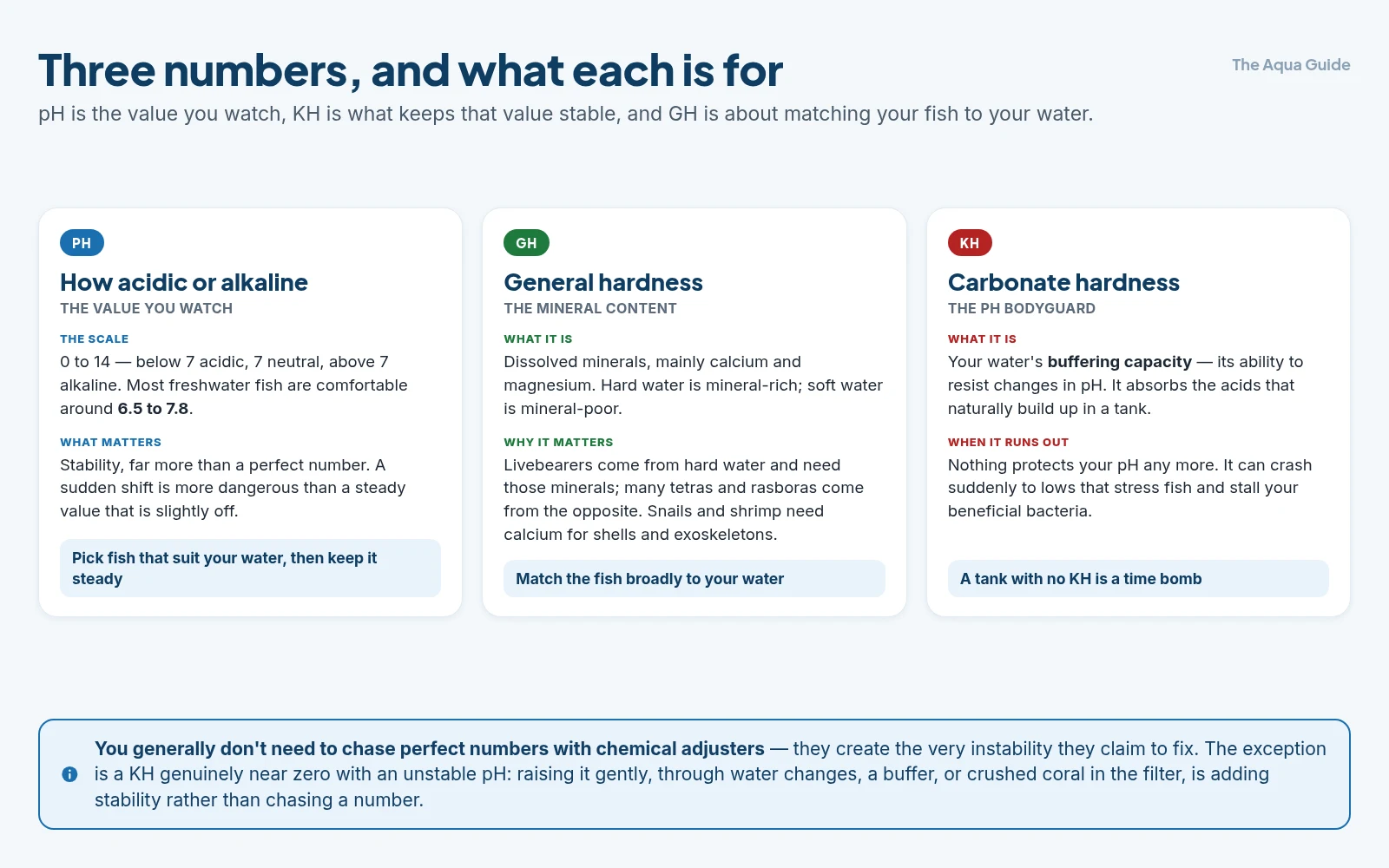
pH is the one most people have heard of. It's a scale from 0 to 14 that measures whether your water is acidic (below 7), neutral (7), or alkaline/basic (above 7). Most freshwater aquarium fish are comfortable somewhere in the range of about 6.5 to 7.8, though it varies by species.
Here's the single most important thing to understand about pH, and it's the opposite of what most beginners assume: stability matters more than hitting a perfect number. Fish are remarkably adaptable to a pH that isn't "ideal," as long as it's steady. What they handle badly is a pH that swings around — a sudden shift is far more stressful and dangerous than a stable value that's slightly off. So the goal isn't to chase a magic number; it's to keep your pH steady. This is why chasing "perfect" pH with chemical adjusters often does more harm than good — you create instability trying to fix a non-problem. Pick fish that suit your water's natural pH, keep it stable, and you've done the right thing.
GH — General Hardness (the "Mineral Content")
GH measures the amount of dissolved minerals in your water, mainly calcium and magnesium. This is what people mean by "hard water" versus "soft water." Hard water is mineral-rich (high GH); soft water is mineral-poor (low GH).
GH matters because fish evolved in particular water types and their bodies are built for them. Livebearers like guppies, mollies, and platies come from hard, mineral-rich water and genuinely need those minerals to stay healthy. Many tetras, rasboras, and other soft-water species come from the opposite — mineral-poor water — and do best there. Minerals also matter for snails and shrimp, which need calcium to build their shells and exoskeletons. You don't need to obsess over GH, but matching your fish broadly to your water's hardness (or choosing fish that suit it) prevents a lot of slow, hard-to-diagnose health issues.
KH — Carbonate Hardness (the "pH Bodyguard")
KH is the one beginners have usually never heard of, and it's arguably the most practically important of the three. KH measures carbonate hardness — your water's buffering capacity, meaning its ability to resist changes in pH.
Think of KH as a bodyguard for your pH. When KH is healthy, it absorbs the acids that naturally build up in a tank and keeps your pH stable and steady. When KH runs low or hits zero, there's nothing protecting your pH anymore — and it can crash suddenly and dramatically, plunging to dangerous lows that stress fish and even stall your beneficial bacteria. Many a mysterious "my pH suddenly crashed" disaster is simply a tank whose KH quietly ran out.
This is why KH matters even if you don't care about chemistry: it's the invisible thing that keeps your pH stable, and stable pH is what your fish actually need. A tank with adequate KH is a forgiving, stable tank. A tank with no KH is a time bomb.
How They Relate to Each Other
These three aren't independent — they interact. KH and pH are linked: higher KH generally supports a higher, more stable pH, while very low KH lets pH drift and crash. GH and KH often (but not always) rise and fall together, since the same hard water that's rich in calcium and magnesium is often also rich in carbonates. But they can be separate — it's possible to have water that's hard in minerals (high GH) yet low in buffering (low KH), or vice versa, which is why they're measured separately.
The practical takeaway: pH is the value you watch, KH is what keeps that value stable, and GH is about matching your fish to your water.
What You Actually Need to Do
For most beginners, the honest answer is reassuringly little. Test your tap water's pH, KH, and GH once so you know your baseline — this tells you what kind of water you naturally have. Then choose fish that suit it rather than fighting your water chemistry. Keep up with regular water changes, which naturally replenish KH and GH and keep everything stable. And keep an eye on KH over time, especially in soft-water or heavily-planted tanks, because that's the value whose depletion causes sudden trouble.
You generally do not need to chase perfect numbers with chemical adjusters. Those products create the very instability they claim to fix, and most fish far prefer stable imperfect water to constantly-tweaked "ideal" water. The exception is if your KH is genuinely near zero and your pH is unstable — then gently raising KH (with regular water changes, or a buffer, or crushed coral in the filter) is worthwhile, because you're adding stability, not chasing a number.
The Bottom Line
pH is how acidic or alkaline your water is — and stability matters far more than hitting a perfect value. GH is the mineral content, and matching it (or your fish) keeps species healthy. KH is the buffering capacity that quietly keeps your pH stable, and letting it hit zero is what causes sudden pH crashes. For most people the right approach is simple: know your tap water's numbers, choose fish that suit them, keep up with water changes, watch your KH, and resist the urge to chemically chase perfect values. Stable, consistent water beats "ideal" water every time.
Related guides
- Tap, RO and remineralised water explained
- My pH keeps crashing — what do I do?
- How to use a liquid test kit (and why strips fail)
- What causes a nitrogen cycle crash?
- What are safe ammonia, nitrite and nitrate levels?
- RO/DI water: when and how to use it
- Freshwater shrimp: cherry, amano and more
- The pH guide
Got questions about your specific setup? Drop them in our Community Forum — we love helping new fishkeepers get started right.