Freshwater shrimp have become one of the most popular additions to the aquarium hobby — and for good reason. They're colorful, peaceful, fascinating to watch, eat algae and detritus, and many species breed readily in freshwater without special setups. Here's the complete guide to the most common species, what they need, and how to keep them successfully.
At a glance: starting with cherry shrimp
| What it takes | |
|---|---|
| Tank | A 5-gallon can support a healthy colony of 20–50 |
| Filter | A sponge filter — gentle enough not to draw them in, and its biofilm is food |
| Water | pH 6.5–8.0, GH 5–15, 65–80°F. Wide enough tolerance for most beginner tanks |
| Cover | Java moss, and plenty of it |
| Tankmates | Shrimp-only, or very peaceful tiny fish — otocinclus, small rasboras, chili rasboras |
| Breeding | Easy. Females show a yellow "saddle" when ready, then carry eggs in their swimmerets — "berried" |
Larger fish will eat them, and that is not a temperament question — it is a size one. A peaceful fish whose mouth fits a shrimp will take a shrimp.
Why Shrimp Are So Popular
A few reasons keepers fall in love with shrimp:
They're colorful. Selectively-bred cherry shrimp come in vivid red, blue, orange, yellow, black, and combinations. The high-grade varieties rival many fish for color intensity.
They're peaceful. Shrimp won't bother any tankmate (though some tankmates will bother them).
They clean. Constant grazing on algae, biofilm, and detritus. They eat fallen food before it fouls water. They're working pets.
They breed. Many species (cherry, neocaridina varieties, crystal shrimp) reproduce in freshwater without special conditions — colonies can grow from a starter handful into hundreds over months.
They're inexpensive to start. A starter group of 10 cherry shrimp is often under $30. From there, the colony grows itself.
They're small. A productive shrimp colony fits in a 5–10 gallon tank.
The combination is unique in the hobby: rewarding, low-maintenance, breeds without effort, and visually beautiful.
Cherry Shrimp (Neocaridina davidi)
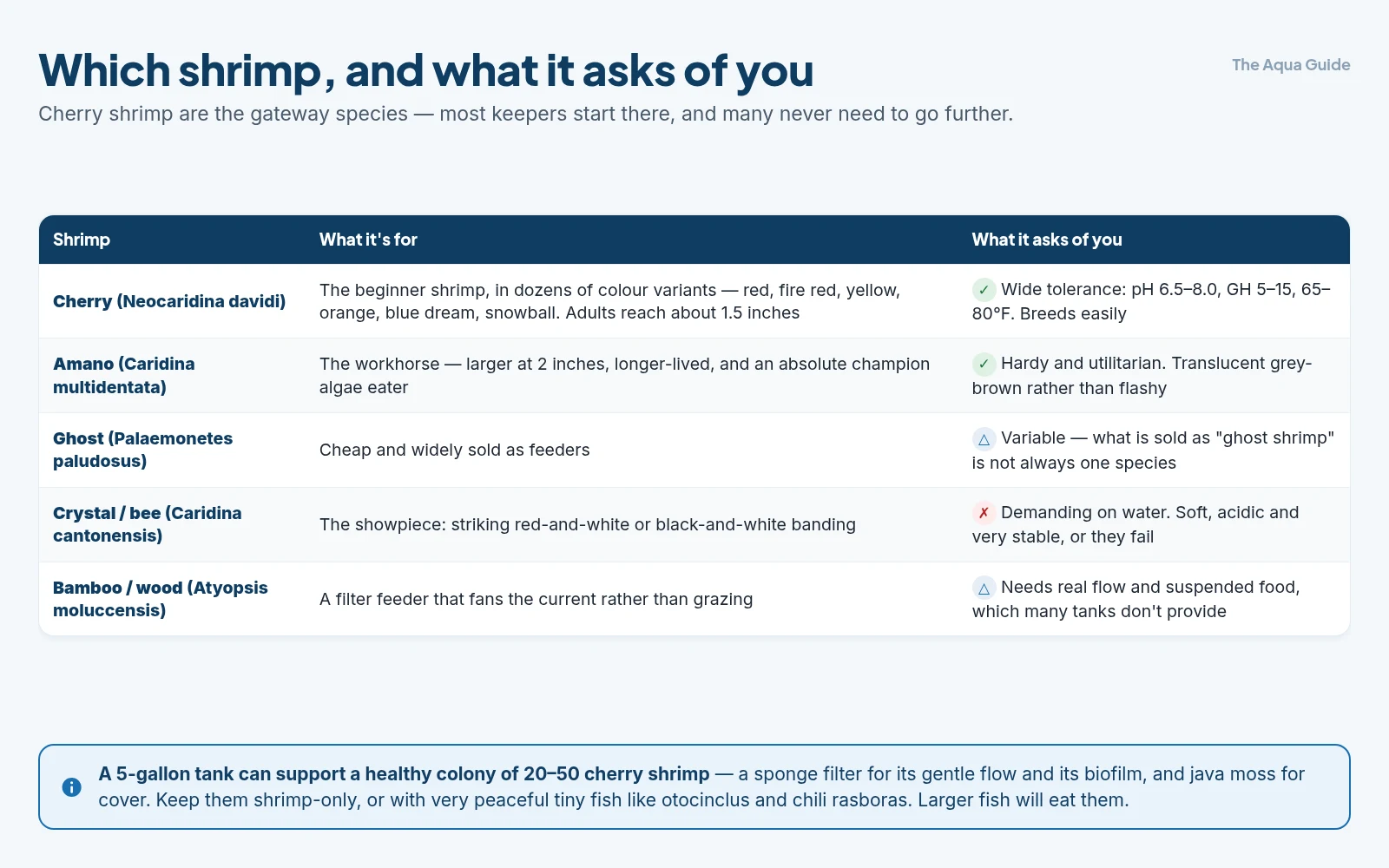
The beginner shrimp. Originally bred from a wild Taiwanese species, cherry shrimp now come in dozens of color variants. They tolerate a wide range of water conditions, breed prolifically, and form thriving colonies in modest setups.
Size: Adults reach about 1.5 inches.
Color variants: Red cherry (the original), fire red, painted fire red (most saturated), yellow, orange, blue dream, sky blue, snowball (white), black rose, chocolate, green jade, rili (pattern variants). Each represents selective breeding from the same Neocaridina species.
Water parameters: Wide tolerance — pH 6.5–8.0, GH 5–15, temperature 65–80°F. Adaptable enough for most beginner tanks.
Breeding: Easy. Females develop a "saddle" (yellow patch in the back) when ready to breed, then carry eggs in their swimmerets ("berried") for 3–4 weeks until tiny shrimplets emerge. Shrimplets are miniature versions of adults and can survive on tank biofilm immediately.
Tankmates: Best in shrimp-only tanks or with very peaceful tiny fish (otocinclus, small rasboras, chili rasboras). Larger fish will eat them, especially babies.
Tank requirements: A 5-gallon tank can support a healthy colony of 20–50 cherry shrimp. Sponge filter (gentle, with biofilm), java moss or other dense plants, no copper-based medications ever, stable parameters.
Cherry shrimp are the gateway species — most shrimp keepers start here, and many never need to go further.
Amano Shrimp (Caridina multidentata)
The workhorse. Larger, longer-lived, and an absolute champion algae eater. Amano shrimp are the species that gave them a job in the hobby.
Size: Adults reach 2 inches.
Color: Translucent grey-brown with darker speckles and a row of dashes along their sides. Not flashy — but utilitarian.
Water parameters: pH 6.5–8.0, GH 5–15, temperature 65–80°F. Hardy and adaptable.
Breeding: Will NOT breed in freshwater. Amanos require brackish water for their larvae to develop, and the process is complex. Almost all amanos in the hobby are wild-caught or specially produced. They live in your tank but don't multiply.
This means amanos are bought, not bred. The population stays stable, which is good for control but means they're more expensive over time than self-breeding species.
Tankmates: Tolerate larger tankmates than cherries because of their adult size. Compatible with most peaceful community fish, even small to medium tetras and rasboras. Avoid known shrimp-hunters (cichlids, larger barbs).
Tank requirements: They appreciate flowing water more than cherries. A good amano colony of 6–10 in a 20+ gallon community tank is the classic algae cleanup crew. Best for: Hair algae, biofilm, leftover food.
Ghost Shrimp (Palaemonetes paludosus)
The cheap option. Often sold as feeder shrimp, ghost shrimp are inexpensive, hardy, and useful as both algae eaters and breeding food for predatory fish.
Size: Adults reach 1.5 inches.
Color: Mostly transparent — you can see their internal organs through the body. Some individuals have small color spots.
Water parameters: pH 7.0–8.0, GH 5–15, temperature 65–82°F. Hardy.
Breeding: Sometimes breed in freshwater (results vary). Some sources sell freshwater-breeding strains; others require brackish for larval development.
Tankmates: Hardy but small enough to be eaten by many community fish. Often kept as feeders for predatory fish — though many keepers use them as functional cleaners in peaceful tanks too.
Tank requirements: Similar to cherry shrimp. Lower cost makes them a good "starter shrimp" for beginners testing whether their tank can support shrimp at all.
Crystal Shrimp / Bee Shrimp (Caridina cantonensis)
The next-level species. More demanding than cherries, but striking — banded patterns in red-and-white, black-and-white, or other variants. Highly bred for color quality (graded as A, S, SS, SSS, depending on pattern).
Size: Adults reach 1 inch.
Color/grades: White-and-red (crystal red shrimp, CRS) or white-and-black (crystal black, CBS) banded patterns. Higher grades show whiter white and more solid bands.
Water parameters: Demanding. pH 6.0–6.8, GH 3–6, temperature 68–76°F. Soft, slightly acidic, cool water — much more specific than cherries.
Breeding: In the right conditions, will breed. But getting and maintaining the right conditions takes effort. Most crystal keepers use RO water + remineralizer to control parameters precisely.
Tankmates: Best kept in species-only tanks at the high-grade level. Mixing with other shrimp can cause hybridization. Mixing with fish risks predation.
Tank requirements: Dedicated setup with controlled water parameters. Not recommended for beginners — start with cherries and graduate to crystals once you've mastered shrimp keeping.
Bamboo Shrimp / Wood Shrimp (Atyopsis moluccensis)
The unusual filter feeder. Bamboo shrimp don't graze like other shrimp — they have fan-like appendages that they hold up in the current, filtering food particles out of the water flow.
Size: Adults reach 3–4 inches — larger than most aquarium shrimp.
Color: Brown, reddish-brown, or olive-grey. Visible white stripe down the back of many individuals.
Water parameters: pH 6.5–7.5, GH 5–10, temperature 75–82°F.
Feeding: Need food particles suspended in flowing water — they won't graze the substrate. Provide good water flow, dose with powdered foods, or supplement with crushed flakes that drift through their feeding zone.
Breeding: Brackish-water larval development; not bred in freshwater.
Tankmates: Peaceful with anything that won't eat them. Compatible with peaceful community fish.
Tank requirements: Need flowing water (a strong but adjustable filter outflow works), strategic placement where they can perch in the current.
Other Notable Species
Blue dream shrimp — variant of Neocaridina (related to cherries), striking blue color. Snowball shrimp — white Neocaridina variant. Tiger shrimp (Caridina mariae) — striped pattern, intermediate difficulty. Bumblebee shrimp — black-and-yellow patterned Caridina. Yellow / orange neocaridina — colorful cherry-shrimp variants.
For beginners: stick to Neocaridina (cherry and color variants) plus amano shrimp — these cover 95% of useful applications and are forgiving enough to learn on.
Setting Up a Shrimp Tank
A dedicated shrimp tank is the safest setup for serious colony building.
Tank size: 5–10 gallons minimum; 20 gallons is comfortable for a large colony.
Filter: Sponge filter is standard. Gentle flow, biofilm production, and no risk of sucking up babies.
Substrate: Active soil substrates (like ADA Aqua Soil) help maintain stable parameters for Caridina shrimp. Inert substrates (sand, gravel) work for Neocaridina (cherries).
Plants: Dense planting helps colonies thrive. Java moss is essential — provides hiding, surface area for biofilm, and protected spots for shrimplets. Other low-tech plants (anubias, java fern, ferns) add cover.
Hiding places: Driftwood, leaf litter (Indian almond leaves are popular), small caves. Shrimp feel safer with abundant hiding spots.
Lid: Yes — shrimp can climb out, especially during stressful conditions or when berried females release.
Lighting: Modest. Shrimp don't need bright light; their colors look best under moderate warm-toned lighting.
Water Parameters and Quality
Stability matters more than perfection. Shrimp react badly to sudden parameter changes. Keep things consistent rather than chasing ideal numbers.
No copper. Many medications, some fertilizers, and even some tap water sources contain copper that's toxic to shrimp. Always check before adding anything.
Slow water changes. 10–15% weekly is gentler than larger less-frequent changes. Drip the new water in slowly.
Cycle thoroughly. Ammonia and nitrite are lethal to shrimp. Make sure your tank is fully established before adding shrimp.
Temperature. Most species do well at room temperature (70–75°F). Cherries tolerate wider range; crystals need cooler.
Feeding Shrimp
Less is more:
Tank biofilm — naturally growing on glass, plants, and decor — is the foundation of shrimp diet. Established tanks provide significant food without any added feeding.
Algae — shrimp eat various algae, especially soft types and biofilms. They're useful cleanup crew.
Supplemental food — once a day or every other day, a small amount of shrimp-specific food, blanched vegetables (zucchini, spinach), or sinking pellets. Tiny amounts only. Shrimp eat slowly; uneaten food fouls quickly.
Indian almond leaves — release tannins and biofilm shrimp love. Drop a leaf in monthly.
Don't overfeed. Cherry shrimp colonies survive on biofilm alone for weeks. The biggest beginner mistake is feeding too much.
Compatibility With Fish
This is the central tension of shrimp keeping. Many fish will eat shrimp — especially baby shrimp.
Safe community fish:
- Otocinclus catfish (too peaceful and small-mouthed)
- Small peaceful rasboras (chili rasbora, ember tetra in cherry shrimp tanks)
- Very small peaceful tetras (with caveats — adult shrimp safe, babies eaten)
- Pygmy corydoras (cories generally ignore shrimp)
Risky fish:
- Most tetras (will eat babies; may eat smaller adults)
- Bettas (varies by individual; many betta-shrimp combinations work, others end badly)
- Angelfish, gouramis, and other larger community fish (often eat shrimp)
- All cichlids (almost always eat shrimp)
- Loaches (active hunters)
Definitely incompatible:
- Any predatory fish (cichlids, larger barbs, dwarf puffers)
- Goldfish (will eat anything)
- Bottom-dwelling predators
For best colony growth, a shrimp-only tank is ideal. For community living, accept that babies will be eaten and adult colony will be smaller than maximum potential.
Breeding Cherry Shrimp
In a well-set-up shrimp tank, cherry shrimp breed without intervention. The pattern:
Females develop a saddle — a yellow patch visible through the back/upper body, indicating developing eggs.
Mating — males chase females after molting, transferring sperm. Females then carry fertilized eggs.
Berried females carry eggs in their swimmerets (under their tail) for 3–4 weeks. The eggs are visible — yellow or green depending on variant. Fanning their swimmerets keeps eggs oxygenated.
Hatching — tiny shrimplets emerge over a few days. They're miniature adults, fully-formed, immediately able to feed on biofilm.
Growth — 2–3 months to sexual maturity.
A colony of 10 cherry shrimp typically grows to 50–100+ within 6 months in good conditions.
Common Shrimp Problems
Sudden deaths. Usually water quality issue — copper exposure, ammonia spike, sudden parameter shift. Check water source, recent additions, medication history.
Population dropping over months. Often shrimplets being eaten by tankmates, or food shortage in colony. Add cover; check stocking.
Females not berrying. Possibly stress, parameter issues, or no males present.
Shrimp climbing out of the tank. Usually water-quality-driven panic. Investigate immediately.
Failure to molt (stuck molt). Usually a calcium issue. Provide cuttlebone or other calcium source.
The Bottom Line
Freshwater shrimp — particularly cherry shrimp and amano shrimp — are one of the most rewarding additions to aquarium hobby: colorful, peaceful, hardworking cleanup crew that often breed without effort. Start with cherry shrimp as the gateway species — wide parameter tolerance, prolific breeders, beautiful colors. Add amano shrimp for serious algae cleanup, especially hair algae (but accept they won't breed in freshwater). Graduate to crystal shrimp once you've mastered the basics if you want to go deeper. Set up a dedicated shrimp tank with sponge filter, dense plants (especially java moss), stable water parameters, and no copper. Feed sparingly — biofilm provides most of their diet. Be cautious about tankmates — most fish will eat shrimp, especially babies. Established cherry shrimp colonies become low-maintenance, self-sustaining, beautiful systems that many keepers find more rewarding than fish tanks. The hobby's growth in recent years has been driven largely by shrimp keeping; once you have a thriving colony, it's easy to see why.
Related guides
- Aquarium snails: helpful vs pest
- The beginner's guide to breeding invertebrates
- Algae eaters: which actually work
- Understanding pH, KH and GH
- Community tank compatibility: what gets along
- How to acclimate new fish properly
- Choosing the right filter: HOB vs sponge vs canister
- Tap, RO and remineralised water explained
Got questions about your specific setup? Drop them in our Community Forum — we love helping new fishkeepers get started right.