Once your tank has been running well for a while, two new worlds open up: breeding your fish and keeping invertebrates. Both add a layer of interest and reward to fishkeeping that goes beyond just maintaining a healthy tank. The good news: both are accessible to beginners, with a few well-chosen species and modest equipment. This is the hub for everything related to breeding and inverts. Each topic below opens into a more detailed guide, but by the end of this page you'll have the whole framework for getting into both.
At a glance: livebearers or egg-layers?
| Livebearers | Egg-layers | |
|---|---|---|
| What arrives | Free-swimming young, able to eat straight away | Eggs, then a yolk-sac period before the fry can take food |
| Who | Guppies, platies, mollies, swordtails | Tetras, corydoras, cichlids, angelfish and most others |
| Your job | Getting the fry away from the adults, who will eat them | Keeping the eggs alive, then having the right first food ready |
| Difficulty | It happens whether you plan it or not | It needs planning, conditioning and usually a separate tank |
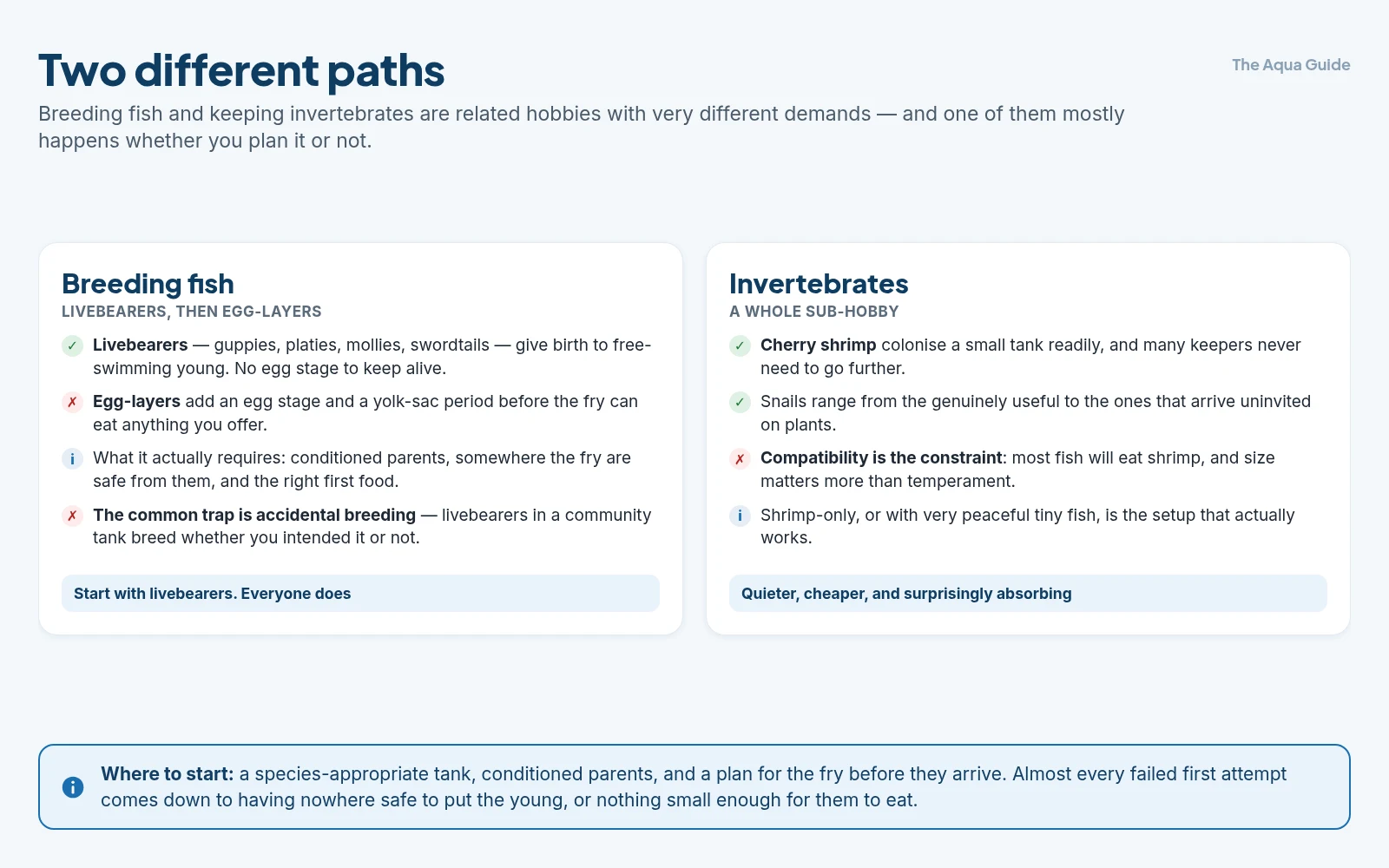
Almost everyone starts with livebearers, and the reason is simple: there is no egg stage to keep alive, and the fry can eat from the moment they appear.
Two Different Paths
Breeding fish means producing the next generation — pairs spawn, eggs or fry appear, and you raise the young to maturity (or sell/give them away). It's a satisfying step from "keeper of fish" to "active participant in their lifecycle." Some fish do this almost too readily; others require careful setups. The right choice depends on your patience, your tank, and your goals.
Keeping invertebrates means adding shrimp, snails, crabs, or other non-fish creatures to your tank — either for their own sake or as functional cleanup crew. Shrimp in particular have become hugely popular in the hobby for their beauty, their cleaning behavior, and the fact that many breed readily in freshwater. Some invertebrates are simply great tank members; others are entire hobbies of their own.
These two paths overlap: shrimp themselves breed, and some keepers focus their entire setup on raising shrimp colonies. But you don't have to do both — choose what interests you.
Why Bother Breeding?
A few reasons keepers start breeding:
The hobby naturally goes there. Watching fish behavior, seeing courtship displays, eventually wanting to see them through their lifecycle — it's a natural progression.
Some fish breed whether you plan to or not. Livebearers especially produce fry constantly. If you have a male and a female platy, you will eventually have fry. The question becomes whether you let nature take its course or manage it.
Pride in raising your own. Successfully raising fish from egg or fry to adult is genuinely rewarding.
Economic. Selling or trading homebred fish at local clubs and online communities can fund the hobby (or at least offset costs).
Conservation. For some uncommon species, captive breeding by hobbyists helps maintain populations and reduces wild collection.
Genetics and lines. Some hobbyists become serious about line-breeding for color, fin shape, or other traits — a deep specialty within the hobby.
You don't need a serious goal — even casual "see what happens" breeding is fun and educational.
Two Categories of Fish: Livebearers vs. Egg-Layers
The single most important breeding distinction is whether fish are livebearers or egg-layers.
Livebearers (guppies, platies, mollies, swordtails) give birth to fully-formed live fry. No eggs, no fry-from-eggs stage to manage — just one day a pregnant female releases small fish that swim and feed immediately. They're the easiest beginner breeders by far. (Detailed guide on livebearers in this section.)
Egg-layers lay eggs, which fertilize externally and hatch over hours to days, producing tiny non-swimming larvae that take days or weeks to become free-swimming. The keeper has to protect eggs from being eaten, often raise the fry separately, and feed them specialized first foods. More work, more reward, more variety — egg-layers cover most aquarium fish species (tetras, barbs, danios, corydoras, gouramis, cichlids). (Detailed guide on egg-layers in this section.)
For absolute beginners: start with livebearers. They're forgiving, breed reliably, and teach the basic skills. Move to egg-layers once you've raised a batch of livebearer fry successfully.
What Breeding Actually Requires
Common misconception: breeding fish requires a fancy elaborate setup. Reality:
A second tank is helpful but not always required. For livebearers, the main tank with hiding places often works fine — fry that can hide survive. For egg-layers, a separate breeding tank is usually needed because parents eat the eggs/fry.
Sponge filter is the standard. Gentle, fry-safe, easy to maintain. (See Part 6.)
Hiding places — dense plants, spawning mops, java moss — give fry escape routes.
Appropriate first foods for the species. Livebearer fry eat crushed flakes; egg-layer fry usually need live first foods like baby brine shrimp or microworms. (See live food guide.)
Patience. Most breeding is about giving fish stable conditions and time. They do most of the work.
A 10-gallon tank, a sponge filter, a heater, some hiding cover, and patience — that's enough to breed many species.
The Lifecycle to Understand
Whether livebearer or egg-layer, fish go through:
Conditioning — feeding parents well with varied high-quality food, often including live or frozen foods, to bring them into breeding condition.
Pair formation — males pursuing females, displaying, sometimes building nests (gouramis) or claiming territory (cichlids).
Spawning — the actual reproductive event: eggs deposited and fertilized (egg-layers), or internal fertilization and gestation (livebearers).
Egg/embryo period — eggs develop, hatch, and yolk sacs sustain larvae for the first few days.
Free-swimming fry — young fish start swimming and feeding.
Grow-out — weeks to months of growth toward adult size.
Each species has variations on this pattern, but understanding it helps anticipate what's happening in your tank.
Invertebrates: A Whole Sub-Hobby
Invertebrates are not just "extras" — for many keepers, they become the main focus. Two categories matter most for beginners:
Shrimp — small aquatic crustaceans, peaceful, colorful, and many species reproduce in freshwater. Cherry shrimp are the gateway species; amano shrimp are workhorses; many others (crystal, blue dream, snowball, ghost) offer variety. They need decent water quality, no predatory tankmates, and stable conditions. (Detailed shrimp guide.)
Snails — slow-moving, helpful (mostly), and add interest. Nerite snails are excellent algae cleaners; mystery snails are charming pets in their own right; pest snails are common (and not always bad). (Detailed snail guide.)
Other invertebrates (crayfish, freshwater crabs, freshwater clams) are more specialized and less suited to mixed community tanks.
Compatibility: Fish + Inverts Together?
This is the crucial question for many keepers. The general rule: most fish will eat smaller invertebrates if they fit in their mouths.
Safe combos:
- Small peaceful fish (tetras, rasboras) with adult amano shrimp (too big to eat)
- Otocinclus catfish with cherry shrimp (otos are too peaceful to eat them)
- Snail-tolerant fish with nerites and mystery snails
- Shrimp-only tanks for the most flexibility
Risky combos:
- Most cichlids with any shrimp (cichlids hunt them)
- Larger community fish with baby shrimp (they get eaten)
- Pufferfish with snails (they hunt them — sometimes that's the point!)
- Loaches with snails (many are dedicated snail-eaters)
Plan your tank with these compatibilities in mind. Many keepers maintain a separate shrimp-only tank to let colonies thrive without predator pressure.
A Common Trap: Accidental Breeding
Sometimes breeding happens whether you wanted it or not. Especially with livebearers, you may suddenly notice tiny fish in your tank that weren't there yesterday. This isn't necessarily a problem — but it requires decisions:
Let nature manage it. In tanks with other fish, many fry get eaten. Population stays stable.
Save and raise them. Catch fry, move them to a breeding tank or use a breeder box, raise to adulthood.
Prevent it. Separate sexes, or keep only same-sex groups, if you don't want fry at all.
Be aware that accidental breeding can quickly overwhelm a tank if all the fry survive. A pair of mollies producing 30 fry every month is a lot of mollies a year later if you don't manage the population.
Where to Find Mates and Sell Offspring
A few resources for the breeding-curious:
Local aquarium clubs. The single best resource. Members trade fish, share knowledge, and often run "BAP" (Breeders Award Programs) that recognize successful spawning.
Online communities (Reddit, fishkeeping forums, Facebook groups). Place to ask questions, share photos, and sometimes find mates or sell fry.
Local fish stores. Some will buy or trade local-bred fish for credit. Build a relationship with the store first.
Aquabid and other online marketplaces — for more serious selling of quality bred fish.
For invertebrates, especially shrimp, dedicated communities exist (e.g., shrimp-focused subreddits) and prices for high-quality lines can be surprising.
Where to Start
If you're new to breeding and inverts, a reasonable starting path:
Month 1–2: Add a small group of cherry shrimp to a well-established peaceful community tank. Watch them. Learn their behaviors.
Month 2–3: Add a few snails — a couple of nerites for the glass and maybe a mystery snail. Observe.
Month 3–6: If your community has livebearers (or you add some), let breeding happen naturally. Fry will appear. Save a few; let nature manage the rest.
Month 6+: As you gain confidence, consider a small dedicated breeding tank for either a more challenging fish species or an active shrimp colony.
This gentle ramp lets you learn each piece without overwhelming yourself.
The Bottom Line
Breeding fish and keeping invertebrates open up two rewarding sub-hobbies within fishkeeping. Livebearers are the easiest entry point for breeding — they handle most of the work themselves; egg-layers require more setup but offer enormous variety. Shrimp (especially cherry and amano) add color, behavior, and cleanup value to community tanks; snails can be helpful workers (nerite, mystery) or pest populations to manage (pond, bladder). Both paths require modest equipment — a small breeding tank with a sponge filter, hiding places, and patience — and both reward the keeper with a deeper connection to their tank's lifecycle. Start small, learn one species at a time, and let the hobby grow naturally from there. The detailed guides in this section cover each piece in depth.
Related guides
- The easiest fish to breed: livebearers
- Breeding egg-layers: corydoras, tetras and beyond
- Setting up a breeding tank
- Raising fry: the first weeks
- Live and cultured foods for fry
- Freshwater shrimp: cherry, amano and more
- Aquarium snails: helpful vs pest
- Community tank compatibility: what gets along
Got questions about your specific setup? Drop them in our Community Forum — we love helping new fishkeepers get started right.