If you want to start breeding fish, livebearers are where to begin. Unlike egg-laying species that require careful setup and specialized food for the fry, livebearers give birth to fully-formed, swimming, eating young — and they do it whether you ask them to or not. Here's the complete guide to breeding the four common beginner livebearers: guppies, platies, mollies, and swordtails.
Why Livebearers Are the Beginner's Path
Three things make livebearers the perfect introduction to breeding:
They breed readily. Healthy adults in a tank with both sexes will produce fry on their own. No special triggers, no perfect water parameters, no carefully constructed breeding tanks — just the right fish in a decent tank.
Fry are born ready to eat. Newborn livebearer fry are miniature versions of adults — they can swim immediately, take crushed regular flake food, and don't need the live "infusoria" or microscopic foods that egg-layer fry require.
They're forgiving. Even with mistakes (skipped water changes, less-than-ideal parameters, mediocre food), livebearers usually produce viable young. The species are hardy enough to handle beginner setups.
The trade-off: livebearers breed so reliably that population control becomes the challenge more often than getting them to breed at all.
The Four Beginner Livebearers
Guppies (Poecilia reticulata)
The classic. Small (1.5–2 inches), wildly colorful in males, peaceful, and tolerant of a wide range of water conditions. Females are larger and less brightly colored; males have the famous flowing tails and saturated colors.
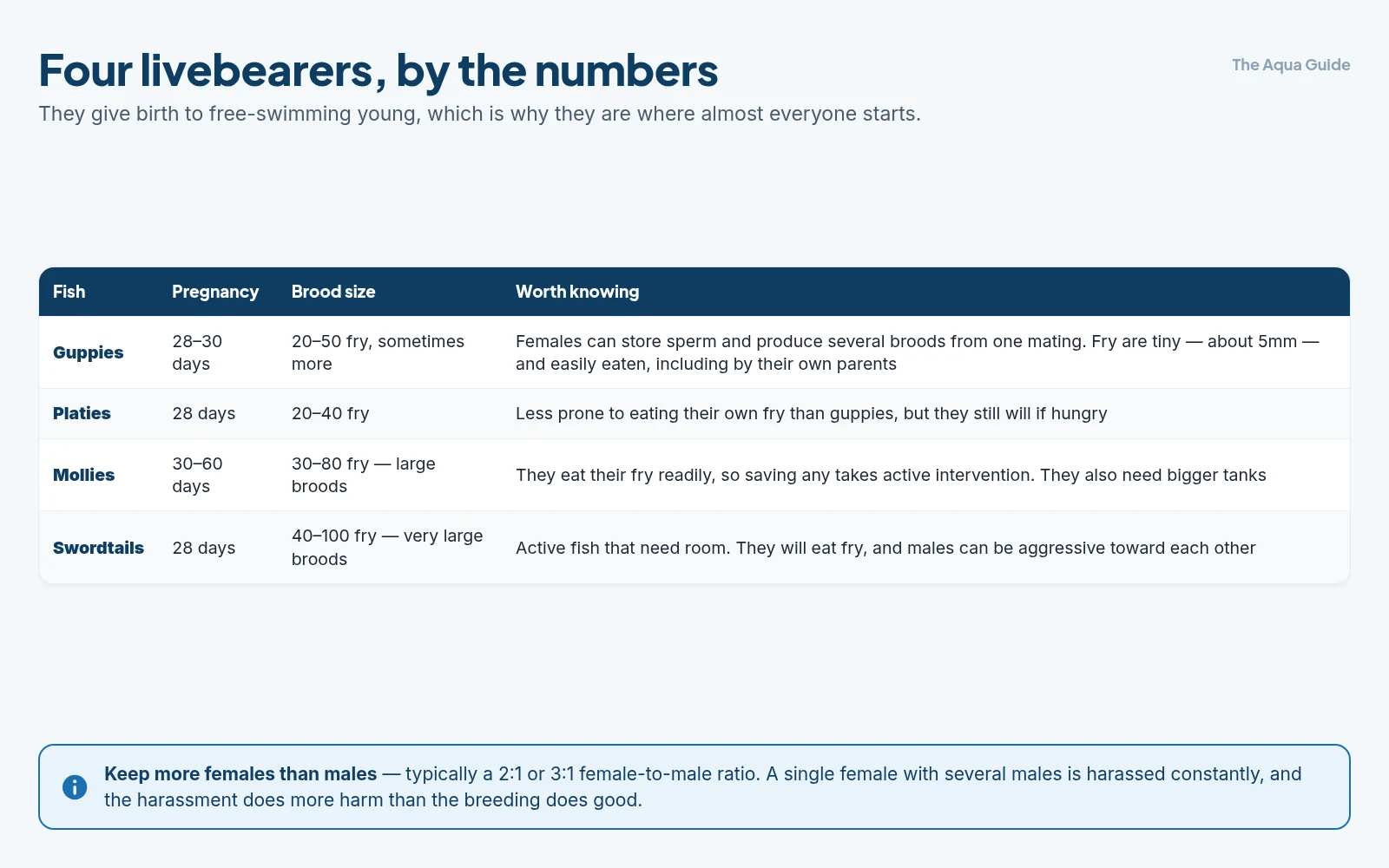
Pregnancy cycle: 28–30 days. Females can store sperm and produce multiple broods from a single mating.
Brood size: 20–50 fry per delivery, sometimes more.
Considerations: Guppy fry are tiny (about 5mm) and easily eaten by adult guppies including their own parents. Hiding places matter.
Platies (Xiphophorus maculatus)
Slightly larger (2–2.5 inches), peaceful, hardy, and available in many color varieties (red, blue, gold, mickey mouse pattern, salt-and-pepper). A great beginner livebearer if you want something a bit chunkier than guppies.
Pregnancy cycle: 28 days.
Brood size: 20–40 fry.
Considerations: Platies are less prone to eating their own fry than guppies but still will if hungry.
Mollies (Poecilia sphenops, P. latipinna)
Larger again (3–4 inches for common, larger for sailfin), available in many color varieties (black, gold, dalmatian, lyretail). Slightly more demanding than guppies and platies — they appreciate slightly harder water and prefer some salt in the water (which limits tankmate compatibility).
Pregnancy cycle: 30–60 days.
Brood size: 30–80 fry — large broods.
Considerations: Mollies eat their fry readily, so saving fry requires active intervention. They also need bigger tanks (20+ gallons for a group).
Swordtails (Xiphophorus hellerii)
Larger still (4–5 inches), active swimmers, distinctive sword-like extension on the lower tail of males. Beautiful fish but need more swimming space — minimum 30 gallon tank.
Pregnancy cycle: 28 days.
Brood size: 40–100 fry — very large broods.
Considerations: Active fish that need room. Will eat fry. Males can be aggressive toward each other.
Sexing Livebearers
Telling males from females is straightforward in livebearers:
Males have a gonopodium — a modified anal fin that's narrow, pointed, and stick-like, used for transferring sperm to females. It's the unmistakable male identifier. Males are typically smaller, more colorful, and have more elaborate fins than females.
Females have a normal fan-shaped anal fin — the same shape as their other fins. Females are larger, less colorful, often have a visible "gravid spot" (dark patch near the anal fin) when carrying fry.
Even in juveniles, the developing gonopodium starts to show by about 6–8 weeks of age, allowing early sex identification.
The Ideal Ratio
Critical rule for livebearer breeding: keep more females than males, typically 2:1 or 3:1 female-to-male ratio.
Why? Male livebearers chase females constantly to mate. With too few females, individual females get harassed to exhaustion. The extra females spread the male attention around.
Example for a 20-gallon community: 1 male guppy + 3 females, OR 2 males + 5 females. Never 5 males + 1 female.
At a glance: reading a pregnancy
| When | What you see |
|---|---|
| Days 1–14 | Gradually visibly bigger. The "gravid spot" near the anal fin — a dark patch — darkens and enlarges |
| Days 14–25 | The body becomes noticeably boxy and squared off as the fry develop. Some keepers can see tiny eyes through the gravid spot |
| Days 25–30 | She may become reclusive, hide more, stay near the bottom, or seek out plant cover. Delivery is close |
| Delivery | Usually a single session over several hours. Fry emerge one at a time, fall briefly, then start swimming |
The fry can swim and eat from the moment they arrive, which is the whole advantage of livebearers — there is no egg stage to keep alive.
The Pregnancy
Once a female is pregnant (or carrying stored sperm from a previous mating), she'll show progressive signs:
Days 1–14: Gradually becoming visibly bigger. The "gravid spot" near the anal fin (a dark patch) darkens and enlarges.
Days 14–25: Body becomes noticeably boxy and squared off as fry develop. Some keepers can see tiny eyes through the gravid spot in late pregnancy.
Days 25–30: Female may become reclusive, hide more, or stay near the bottom. Some seek out plant cover. These are signs delivery is near.
Delivery: Usually happens in a single session over several hours. Fry emerge one at a time, fall briefly, then start swimming.
The whole cycle from one delivery to the next is roughly 28 days, and females can be pregnant again immediately after delivering (since they store sperm).
Saving the Fry
Adult livebearers — including the parents — will eat fry when they encounter them. The instinctive opportunism is real. To save fry, choose one approach:
Option 1: Plant Cover and Hope
Provide dense plants (java moss, hornwort, water sprite, floating plants) where fry can hide. Some fry will be eaten; some will survive and grow up. Best for: community tanks where you don't need to save every fry. Some keepers find this most natural and humane.
Option 2: Breeder Box
Hang a small "breeder box" inside the tank (mesh or plastic, partitioned in two) and move the pregnant female in shortly before delivery. She delivers in one section; fry pass through holes/slots into a safe second section. Mother then returns to the main tank.
Pros: Saves most fry, uses main tank water.
Cons: Stressful for mother if she's confined too long; timing the move is tricky.
Option 3: Dedicated Breeding/Fry Tank
A separate small tank (5–10 gallons) with sponge filter, where fry are raised alone. Either move the very-pregnant female into it to deliver, or transfer newborn fry from the main tank to this dedicated nursery.
Pros: Best survival rates, easiest to feed fry properly, easiest water management.
Cons: Requires a second tank running.
Option 4: Heavily Planted Species Tank
Some keepers run a single-species livebearer tank that's so heavily planted (dense java moss, floating cover) that fry survive without intervention. Population grows naturally to whatever the tank supports.
The right choice depends on your goals. For just-curious breeding, plant cover in the community is fine. For serious raising, a fry tank is best.
Feeding the Fry
Livebearer fry are easy to feed:
First day: They're born with a tiny yolk reserve and will start hunting almost immediately.
First week: Crushed flake food (very fine, almost powdered), powdered fry food, or baby brine shrimp if available. Feed 4–5 times per day in tiny amounts.
Weeks 2–4: Continue crushed flake or small pellets; fry are growing rapidly. Frozen baby brine shrimp is a huge boost if available.
Weeks 4–8: Transitioning to regular flake food (maybe still crushed for variety). Fry are visibly young fish by now.
8+ weeks: Eating standard adult food. Approaching the size where they can join the community tank.
Key principle: Frequent small feedings, varied diet, watch for any uneaten food (more critical in small fry tanks than display tanks).
Growth Timeline
A rough guide:
- Birth: 5–8mm long depending on species
- 1 month: 10–15mm, recognizable as miniature versions of adults
- 2 months: 20mm, sex starts becoming visible
- 3 months: 25–35mm, fully sexable, often beginning to breed themselves
- 4–6 months: Sexually mature for most species, full adult size for guppies/platies
Mollies and swordtails take longer to reach full size (6–12 months for full growth), though they're sexually mature earlier.
When to Move Fry to the Display Tank
A fry can safely join the display tank when:
- It's too big to be eaten — typically when it's more than half the mouth-width of any potential predator
- It's eating regular food comfortably
- It looks recognizably like a small adult
For guppy fry in a typical community with small peaceful fish, this is around 6–8 weeks. For larger species or tanks with bigger fish, longer.
Move gradually: net carefully, acclimate to display tank water, release in a quiet area with hiding cover.
Common Issues
No fry appearing despite male and female adults. Causes: water too cold, fish too young (not sexually mature), poor health, female recently delivered (she may need recovery time).
Female gets pregnant once but never again. Probably stored sperm finished and male isn't successfully mating. Check male's gonopodium for damage.
Fry born deformed or dying. Genetic issue (inbreeding), poor diet for parents, water quality issues. Consider new bloodlines.
Population exploding. Real risk. A pair of mollies producing 50 fry monthly will overwhelm a tank in months if all survive. Plan removal/rehoming or accept population control via natural predation.
Females dying after multiple pregnancies. Constant pregnancy is hard on females. Give them rest, or ensure good female-to-male ratio.
The Bottom Line
Livebearers (guppies, platies, mollies, swordtails) are the easiest fish to breed because they give birth to fully-formed, free-swimming, eating fry that don't need special first foods or careful setups. Keep more females than males (2:1 minimum), provide good food and stable conditions, and breeding happens on its own. Save fry through plant cover (casual approach), a breeder box (active management), or a dedicated fry tank (best survival rates). Fry mature in 3–6 months and join the display tank when they're too big to be eaten. The main challenge is usually population control rather than getting them to breed — plan for what to do with the eventual abundance. Whether you breed casually or actively raise generation after generation, livebearers teach the foundational skills and are the gateway to the whole breeding side of fishkeeping.
Related guides
- Setting up a breeding tank
- Raising fry: the first weeks
- Live and cultured foods for fry
- Breeding egg-layers: corydoras, tetras and beyond
- The beginner's guide to breeding invertebrates
- Community tank compatibility: what gets along
- How many fish can my tank hold?
- Beginner-friendly fish species
Got questions about your specific setup? Drop them in our Community Forum — we love helping new fishkeepers get started right.