Two types of aquarium plant sit at opposite ends of the tank — and at opposite ends of the difficulty scale. Floating plants drift across the surface and are among the easiest, most beneficial plants you can keep. Carpeting plants form a lush lawn across the bottom and are some of the most rewarding but demanding. Both are popular goals for new planted-tank keepers, so let's cover what each offers, how to keep them, and which is realistic for a beginner.
At a glance: which floater, and how carpets go in
| Plant | What it's like |
|---|---|
| Duckweed | Tiny and explosively fast. Effective, but notorious for being impossible to fully remove once established |
| Frogbit | Attractive, with nice round leaves and long roots. Easier to control than duckweed |
| Salvinia | Textured floating fronds |
| Water sprite, water lettuce | Hardy, and readily grown under a standard light. Large enough to scoop out individually |
| Planting a carpet | Separate it into many small portions, plant each clump spaced across the foreground, and let the runners fill the gaps |
The one catch with floaters is that they can cover the whole surface, blocking light to the plants below and reducing gas exchange. Management is simply scooping out the excess regularly.
Floating Plants: Easy and Hugely Beneficial
Floating plants live on the water's surface, with their leaves above or at the waterline and their roots dangling down into the water. They're about as easy as plants get — you literally just place them on the surface — and they bring serious benefits.
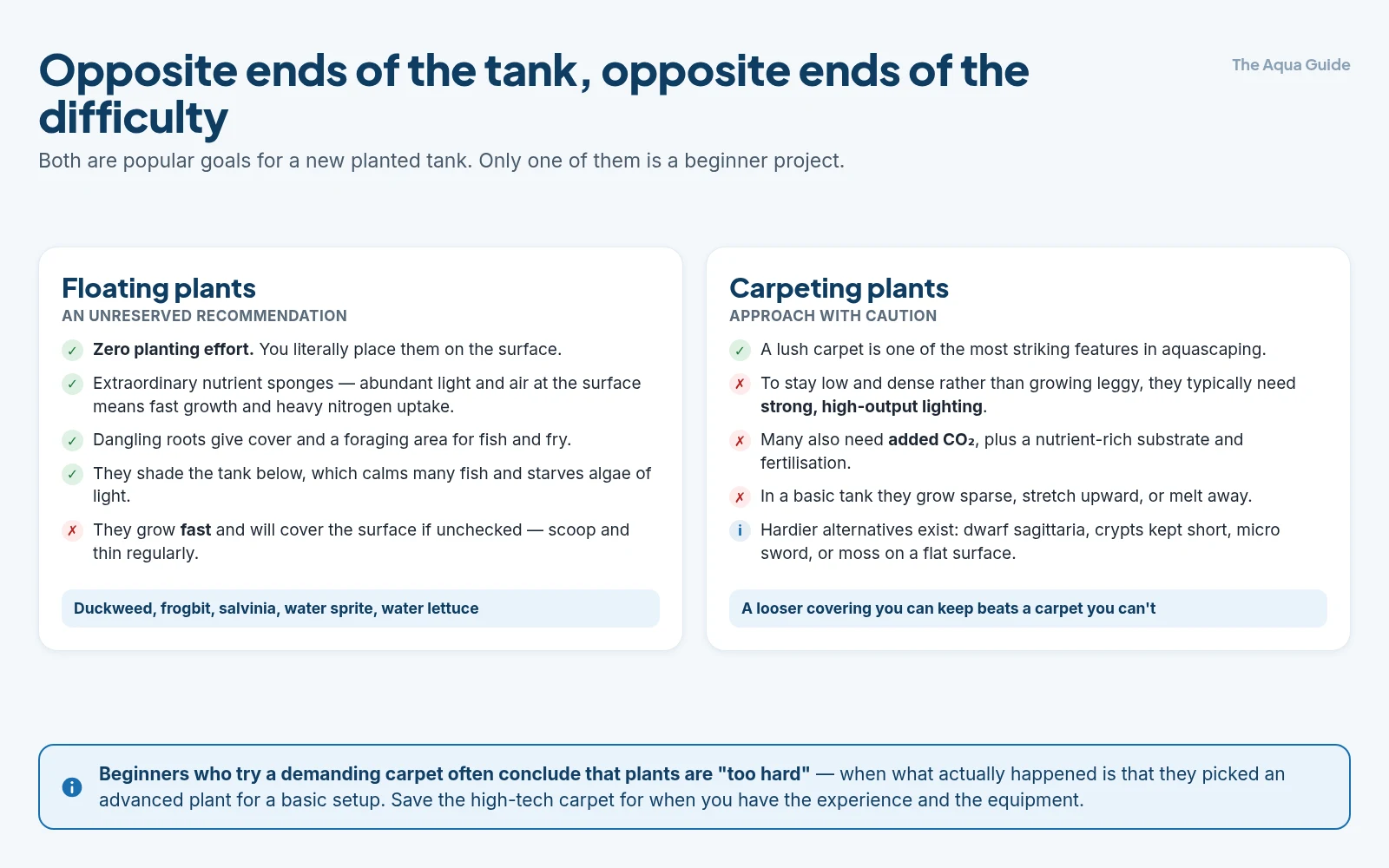
Why they're great: Floating plants are extraordinary nutrient sponges. Because they sit at the surface with access to abundant light and air, they grow fast and consume large amounts of nitrogen (ammonia and nitrate), which makes them outstanding for water quality and for out-competing algae. Their dangling roots provide cover and a foraging area for fish and fry. They also shade the tank below, which many fish find calming and which helps control algae by reducing light to it. For a beginner wanting cleaner, more stable water with zero planting effort, floating plants are an easy win.
Easy floating plants include duckweed (tiny and explosively fast — effective but hard to remove once established), frogbit (attractive, with nice round leaves and long roots), salvinia (textured floating fronds), and water sprite or water lettuce. Most are very hardy and grow readily under a standard light.
The one catch: floating plants grow fast, and can cover the entire surface if left unchecked, blocking light to plants below and reducing surface gas exchange. Management is simple — just scoop out and thin the excess regularly. Duckweed in particular is notorious for being impossible to fully remove, so some keepers avoid it in favor of larger floaters that are easier to control. Otherwise, floating plants are a low-effort, high-reward choice.
Carpeting Plants: Rewarding but Demanding
Carpeting plants are low-growing species that spread horizontally across the substrate to form a dense green "lawn" or "carpet" across the foreground of the tank. A lush carpet is one of the most striking features in aquascaping — and one of the harder things for a beginner to achieve.
Why they're challenging: Most true carpeting plants are demanding precisely because of where and how they grow. To stay low, dense, and green rather than growing tall and "leggy" reaching for light, carpets typically need strong, high-output lighting. Many also need added CO₂ to grow densely enough to form a proper carpet, plus a nutrient-rich substrate and fertilization. In a basic beginner tank (standard light, no CO₂), most carpeting plants struggle — they grow sparse, stretch upward, or melt away. This is why beginners who try a demanding carpet often fail and conclude plants are "too hard," when really they picked an advanced plant for a basic setup.
Easier carpet-like options for beginners: If you want a foreground covering without a high-tech setup, some hardier low-growers are more forgiving — for example, dwarf sagittaria, certain crypts kept short, or micro sword can spread along the bottom in lower-tech conditions, and even moss attached to a flat surface or mesh can create a carpet-like effect without demanding light or CO₂. These won't be quite the manicured "aquascaping" carpet, but they give a planted foreground that a beginner can actually keep alive.
How carpets are planted: by separating the plant into many small portions and planting each little clump spaced out across the foreground, so they send out runners and gradually fill in the gaps to form a continuous carpet. It takes patience, good light, and (for the demanding species) CO₂ and nutrients.
Which Should a Beginner Choose?
The honest guidance: start with floating plants, approach carpeting plants with caution.
Floating plants are genuinely beginner-friendly — easy, fast, beneficial, and forgiving. Add some to almost any tank and enjoy cleaner water and happier fish with minimal effort. They're an unreserved recommendation for newcomers.
Carpeting plants are a different matter. A true, lush carpet is an advanced project requiring high light, usually CO₂, and patience — not where a beginner should start. If you want a foreground covering on a basic setup, choose one of the hardier, more forgiving low-growers rather than a demanding aquascaping carpet, and accept it'll be a looser covering than the showpiece carpets you see online. Save the high-tech carpet for when you've gained experience and are ready to invest in the equipment.
The Bottom Line
Floating and carpeting plants sit at opposite ends of the difficulty range. Floating plants — duckweed, frogbit, salvinia, water sprite — are among the easiest and most beneficial plants you can keep: they require zero planting, grow fast, soak up nitrogen to out-compete algae, and provide cover and shade, needing only occasional thinning to keep them in check. Carpeting plants form a beautiful foreground lawn but are mostly demanding, typically needing high-output light, added CO₂, and rich nutrients to carpet properly — making true carpets an advanced project, not a beginner one. For newcomers: embrace floating plants freely, and if you want a foreground covering, choose a hardy low-grower over a high-tech carpet until you're ready to level up. Both can be wonderful; just match your ambition to your experience and equipment.
Related guides
- The easiest fast-growing plants for beginners
- How to plant and anchor aquarium plants
- Do I need CO₂, fertiliser and special lighting?
- The beginner's guide to live aquarium plants
- The best live plants for clearing cloudy water
- Substrate choices for aquascapes
- Aquarium plants quick reference
- CO₂ injection: pressurised systems and alternatives
Got questions about your specific setup? Drop them in our Community Forum — we love helping new fishkeepers get started right.