You bought healthy-looking plants, put them in your tank, and within days they're turning translucent, mushy, or yellow and falling apart. It's alarming, and many beginners assume they've killed their plants or that live plants are just too hard. Here's the reassuring news: melting and yellowing are extremely common, usually temporary, and almost always fixable once you know the cause. Let's diagnose what's happening and what to do.
At a glance: is this normal?
| If... | Then... |
|---|---|
| You just added the plants and they are melting | Almost certainly normal adjustment. Trim the mushy leaves, leave the plant in place, wait a few weeks for new growth |
| Melting continues well past the settling-in period | Something in the tank needs attention — start with light, then nutrients |
| It appears on established plants that were previously fine | The same: light or nutrients, or a change in water conditions |
| Only the older leaves yellow while new growth looks healthy | Normal turnover. Not a problem |
| A demanding species declines whatever you do | A mismatch rather than a fault. Choose plants suited to your conditions |
Drastic shifts in temperature, pH or chemistry stress plants into melting too, just as they stress fish. Stable, suitable water helps plants as much as it helps the fish.
First: Melting Is Often Normal (and Temporary)
The most important thing to understand is that new plants very commonly "melt" when they first go into a tank — and then recover. This isn't a sign you've done something wrong; it's a normal adjustment process.
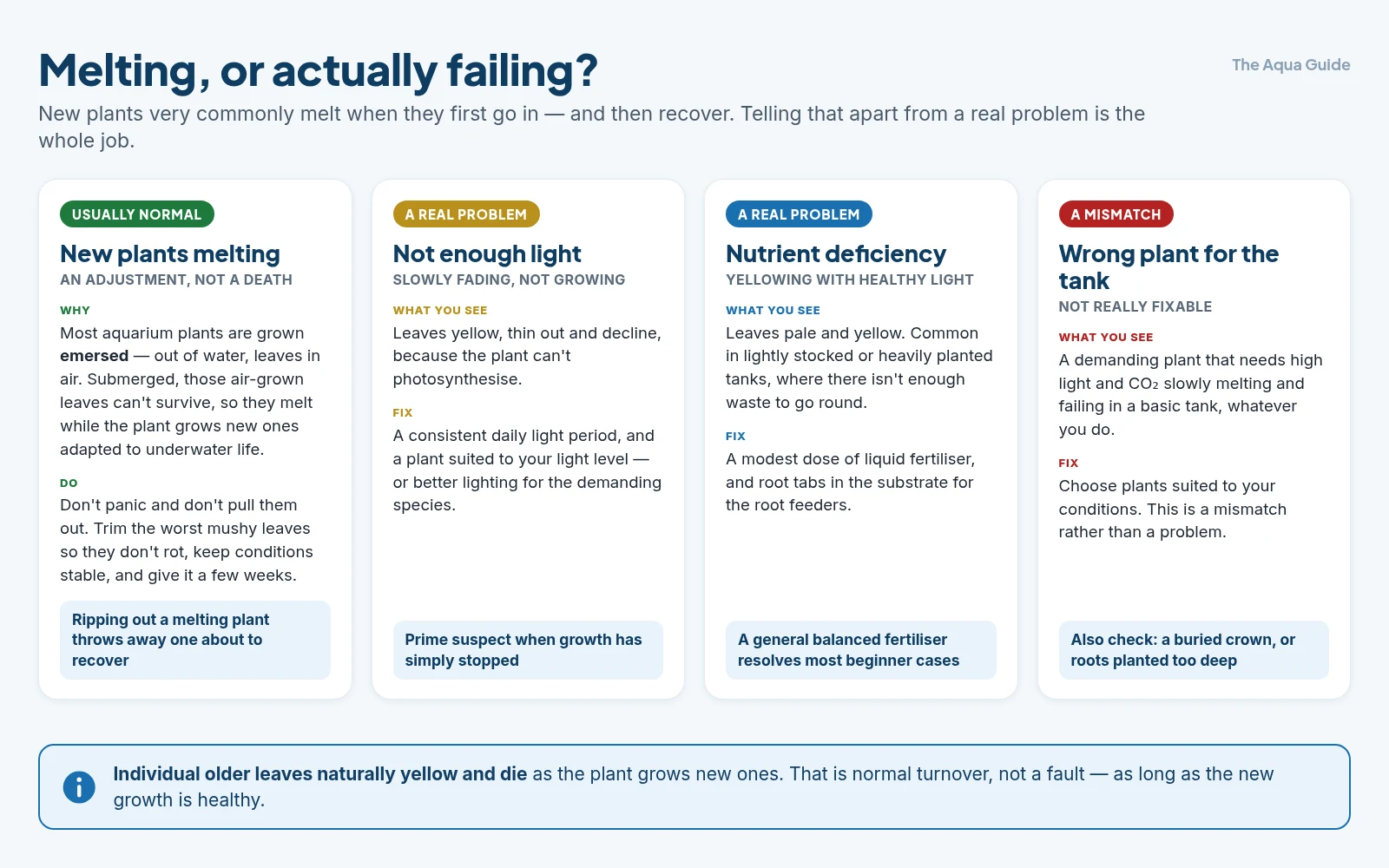
Here's why. A huge proportion of aquarium plants are grown by suppliers emersed — that is, grown out of water, with their leaves in air, in nurseries. When you put them in your tank, they're suddenly submersed, fully underwater, and their air-grown leaves can't survive submerged. So those old leaves melt away — turning translucent, mushy, and disintegrating — while the plant grows new leaves adapted to underwater life. It looks like the plant is dying, but it's actually transitioning.
So if you've just added new plants and they're melting, the usual advice is: don't panic, and don't pull them out. Leave the plant in place (trim off the worst mushy leaves so they don't rot and foul the water), keep your conditions stable, and give it a few weeks. In most cases, new submerged-adapted growth appears and the plant takes off. Ripping out a "melting" plant is a common mistake that throws away a plant that was about to recover.
When It's Not Just Adjustment: The Real Causes
If melting or yellowing continues well beyond the initial adjustment period, or appears on established plants that were previously fine, then something in the tank needs attention. Here are the usual culprits.
Not enough light. Plants starved of light can't photosynthesize, so leaves yellow, thin out, and decline. If your plants are slowly fading and not growing, too little light (or the wrong plant for your light level) is a prime suspect. The fix: ensure a consistent daily light period and, if needed, a plant suited to your lighting — or improve the lighting for more demanding species.
Nutrient deficiency. Yellowing leaves, especially with healthy light, often signal a lack of nutrients. Plants need nitrogen and various minerals and trace elements; if the tank doesn't provide enough (common in lightly-stocked or heavily-planted tanks), leaves pale and yellow. The fix: add a modest dose of liquid fertilizer, and for root feeders, root tabs in the substrate. Different deficiency patterns point to different nutrients, but a general balanced fertilizer resolves most beginner cases.
Wrong plant for the setup. A demanding plant that needs high light and CO₂ will slowly melt and fail in a basic tank, no matter what you do. This isn't a fixable "problem" so much as a mismatch — the fix is choosing plants suited to your conditions. (Matching plants to your setup is its own topic.)
Poor water conditions or sudden changes. Drastic shifts in temperature, pH, or water chemistry can stress plants into melting, just as they stress fish. Stable, suitable water helps plants as much as fish. Also, plants buried incorrectly (a rotting root crown, or roots planted too deep on certain species) can decline.
Old age or natural die-off. Individual older leaves naturally yellow and die as the plant grows new ones — this is normal turnover, not a problem, as long as new growth is healthy.
How to Diagnose Yours
Match your situation to narrow it down. If the plant is newly added and melting, it's almost certainly the normal emersed-to-submersed adjustment — leave it, trim the mush, and wait. If an established plant is yellowing slowly with otherwise stable conditions, suspect light or nutrients — check your light schedule and consider fertilizer. If a plant has never thrived since you got it, it may be the wrong species for your setup. If decline coincided with a water change or parameter swing, suspect a conditions shock. And if it's just the occasional old leaf yellowing while new growth looks great, that's normal turnover — nothing to fix.
What to Do While You Wait
Whatever the cause, a few steps help. Trim away dead, mushy, or badly yellowed leaves — they won't recover and will only rot and add waste to the water (cutting them also lets the plant direct energy to new growth). Keep your conditions stable and your light consistent. Don't keep uprooting and moving the plant, which adds stress; plants do best left to settle and adapt. And be patient — plant recovery and new growth take weeks, not days. Resisting the urge to intervene constantly is often the best thing you can do.
The Bottom Line
Melting and yellowing leaves are usually not a death sentence. The most common cause by far is the normal "melt" new plants go through as they transition from being grown in air to living underwater — leave the plant in place, trim the mush, and new submerged growth typically follows within weeks. If decline continues or hits established plants, the usual causes are too little light, nutrient deficiency (add a little fertilizer), the wrong plant for your setup, or a water-conditions shock. Diagnose by whether the plant is new, established-and-fading, or never-thriving, then address the matching cause. Above all, be patient and resist ripping out struggling plants — many recover beautifully if simply left to adapt.
Related guides
- How to plant and anchor aquarium plants
- The easiest fast-growing plants for beginners
- Do I need CO₂, fertiliser and special lighting?
- Advanced fertilisation: dosing methods for planted tanks
- Aquarium lighting basics: brightness and photoperiod
- The beginner's guide to live aquarium plants
- Substrate choices for aquascapes
- Aquarium plants quick reference
Got questions about your specific setup? Drop them in our Community Forum — we love helping new fishkeepers get started right.