If you're new to live plants, the smartest way to start is with species that are hard to kill and quick to grow. Fast-growing plants are a beginner's best friend: they're forgiving, they soak up excess nutrients to starve out algae, and their quick growth gives you fast feedback that your tank is healthy. Here are the easiest fast-growing plants to start with, why fast growth matters, and how to keep them thriving — no special equipment required.
At a glance: why fast growth helps a beginner
| Because | What it means for you |
|---|---|
| They are nutrient sponges | Growing quickly means consuming a lot of nitrogen — ammonia and nitrate — straight out of the water |
| They out-compete algae | Algae is fighting for the same nutrients, so a tank with vigorous fast plants suffers far fewer algae problems |
| They are resilient | If part of a stem fails, the plant keeps growing from elsewhere |
| They give you fast feedback | Visible new growth within days or a couple of weeks tells you your conditions are good |
The only "downside" — needing occasional trimming — is a sign of success, not a problem. A tank that needs trimming is a tank that is thriving, and the cuttings are free plants.
Why Fast Growth Is a Beginner's Advantage
It might seem like fast-growing plants would be more work (more trimming, mainly), but for a beginner their speed is a huge asset for a few reasons.
Fast growers are nutrient sponges. Because they grow quickly, they consume a lot of nitrogen — ammonia and nitrate — pulling those compounds out of the water rapidly. This directly out-competes algae, which is fighting for the same nutrients, so a tank with vigorous fast plants suffers far fewer algae problems. Fast growth also means these plants establish quickly and are resilient: if part of a stem fails, the plant keeps growing from elsewhere. And they give you rapid feedback — visible new growth within days or a couple of weeks tells you your conditions are good, which is reassuring and instructive for a beginner. The only "downside," needing occasional trimming, is a sign of success, not a problem.
The Easiest Fast-Growing Plants
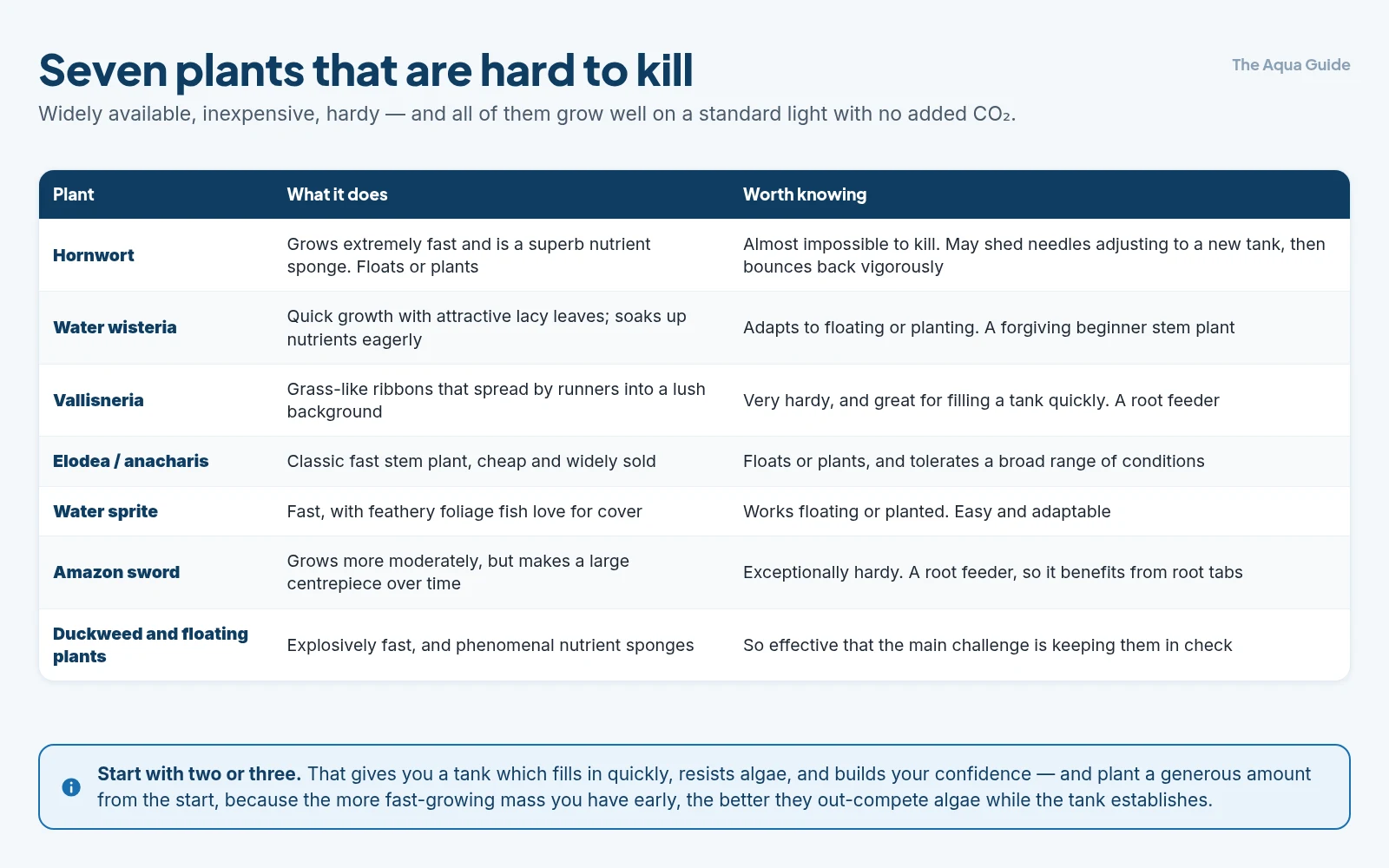
These species are widely available, inexpensive, hardy, and grow well in basic tanks with a standard light and no added CO₂.
Hornwort is almost impossible to kill. It grows extremely fast, can float or be planted, tolerates a wide range of conditions, and is a superb nutrient sponge. It may shed some needles when adjusting to a new tank, but it bounces back vigorously.
Water Wisteria grows quickly with attractive, lacy leaves, adapts to floating or planting, and soaks up nutrients eagerly. A forgiving, fast, beginner-friendly stem plant.
Vallisneria (Val) is a fast-growing grass-like plant that sends up tall ribbons and spreads via runners to form a lush background. Very hardy and great for filling a tank quickly.
Elodea / Anacharis is a classic fast-growing stem plant, cheap and widely sold, that grows rapidly and absorbs nutrients well. Like hornwort, it can float or be planted and tolerates a broad range of conditions.
Water Sprite is a fast grower that works floating or planted, with feathery foliage that fish love for cover. Easy and adaptable.
Amazon Sword grows more moderately than the stem plants but is exceptionally hardy and beginner-proof, making a large, attractive centerpiece over time (it's a root feeder, so it benefits from root tabs in the substrate).
Duckweed and other floating plants grow explosively fast and are phenomenal nutrient sponges — so effective that the main challenge is keeping them in check. (Floating plants get their own detailed guide.)
Starting with two or three of these gives you a tank that fills in quickly, resists algae, and builds your confidence.
What They Need (Not Much)
The beauty of these plants is how little they require. A standard aquarium light on a consistent daily schedule is enough — no high-output lighting needed. They draw nutrients from your fish waste and the water column, so in a stocked tank you often need no added fertilizer at all, though a little liquid fertilizer can boost growth if your tank is lightly stocked. They don't need added CO₂. The root feeders among them (like Amazon sword and vallisneria) appreciate root tabs tucked into the substrate, but the stem and floating plants feed happily from the water. Give them light and let your fish feed them, and they'll thrive.
How to Use Them Well
A few tips to get the most from fast growers. Plant or float a generous amount from the start — the more fast-growing plant mass you have early, the better they out-compete algae while your tank establishes. Trim them as they grow; for stem plants, snip the tops and replant the cuttings to make them bushier and to propagate more plants for free. Don't be alarmed by some initial melt or shedding as they adjust — they recover fast. And thin out floating plants regularly so they don't completely block light to plants below.
A Note on "Too Successful"
Fast-growing plants can grow so well that they need regular trimming, and floating ones can take over the surface. This is a good problem — it means your plants are healthy and your tank is balanced. Just keep up with trimming, and enjoy the free extra plants you can propagate from the cuttings or share with other hobbyists. A tank that needs trimming is a tank that's thriving.
The Bottom Line
For beginners, fast-growing plants are the ideal starting point: they're hardy, forgiving, and act as nutrient sponges that out-compete algae and give you quick feedback on your tank's health. Easy, widely-available options include hornwort, water wisteria, vallisneria, elodea/anacharis, water sprite, Amazon sword, and floating plants like duckweed. They thrive on a standard light with no CO₂ and little or no added fertilizer, feeding mostly on your fish's waste. Plant a generous amount, trim as they grow (replanting cuttings for free plants), and don't worry about a little initial melt. Start with a few of these, and you'll have a lush, algae-resistant tank that builds your confidence for whatever you want to grow next.
Related guides
- The beginner's guide to live aquarium plants
- Floating and carpeting plants for beginners
- How to plant and anchor aquarium plants
- Why are my plant leaves melting or yellowing?
- Do I need CO₂, fertiliser and special lighting?
- Aquarium plants quick reference
- The best live plants for clearing cloudy water
- The beginner's guide to aquarium algae
Got questions about your specific setup? Drop them in our Community Forum — we love helping new fishkeepers get started right.