One of the most appealing things about live plants is that they don't just decorate your tank — they actively clean it. You'll often hear that plants act as a "natural filter," but what does that actually mean? How do plants deal with the toxic and not-so-toxic compounds in your water? Understanding the mechanism helps you appreciate why a planted tank is a healthier tank, and how plants work alongside (not instead of) your beneficial bacteria.
At a glance: what plants add, and what they don't
| What plants do | |
|---|---|
| Ammonia | Many take it up directly, and often prefer it — grabbing some before it can harm fish |
| Nitrite | Absorbed as a nitrogen source, though the bacteria handle the bulk of it |
| Nitrate | Consumed as fertiliser, slowing the buildup that nothing else in the cycle removes |
| Algae | Out-competed, because plants are taking the same nutrients algae needs |
| What they don't do | Replace your cycle or your filter. A planted tank still needs both |
A common beginner mistake is assuming a planted tank doesn't need cycling because "the plants handle it". They don't. Think of it as bacteria plus plants.
Plants Eat Nitrogen — Literally
Here's the core idea: nitrogen is a nutrient that plants need to grow, and the nitrogen compounds in your aquarium — ammonia, nitrite, and nitrate — are sources of exactly that nutrient. So to a plant, your fish waste isn't pollution; it's food. Plants absorb these nitrogen compounds from the water and use them as fertilizer to build new leaves and roots.
This is why plants are described as a natural filter. They literally consume the same waste products your nitrogen cycle is busy processing, pulling them out of the water and turning them into plant growth. The result is cleaner water with lower levels of the compounds that stress fish and fuel algae.
Plants Prefer Ammonia (Which Is a Big Deal)
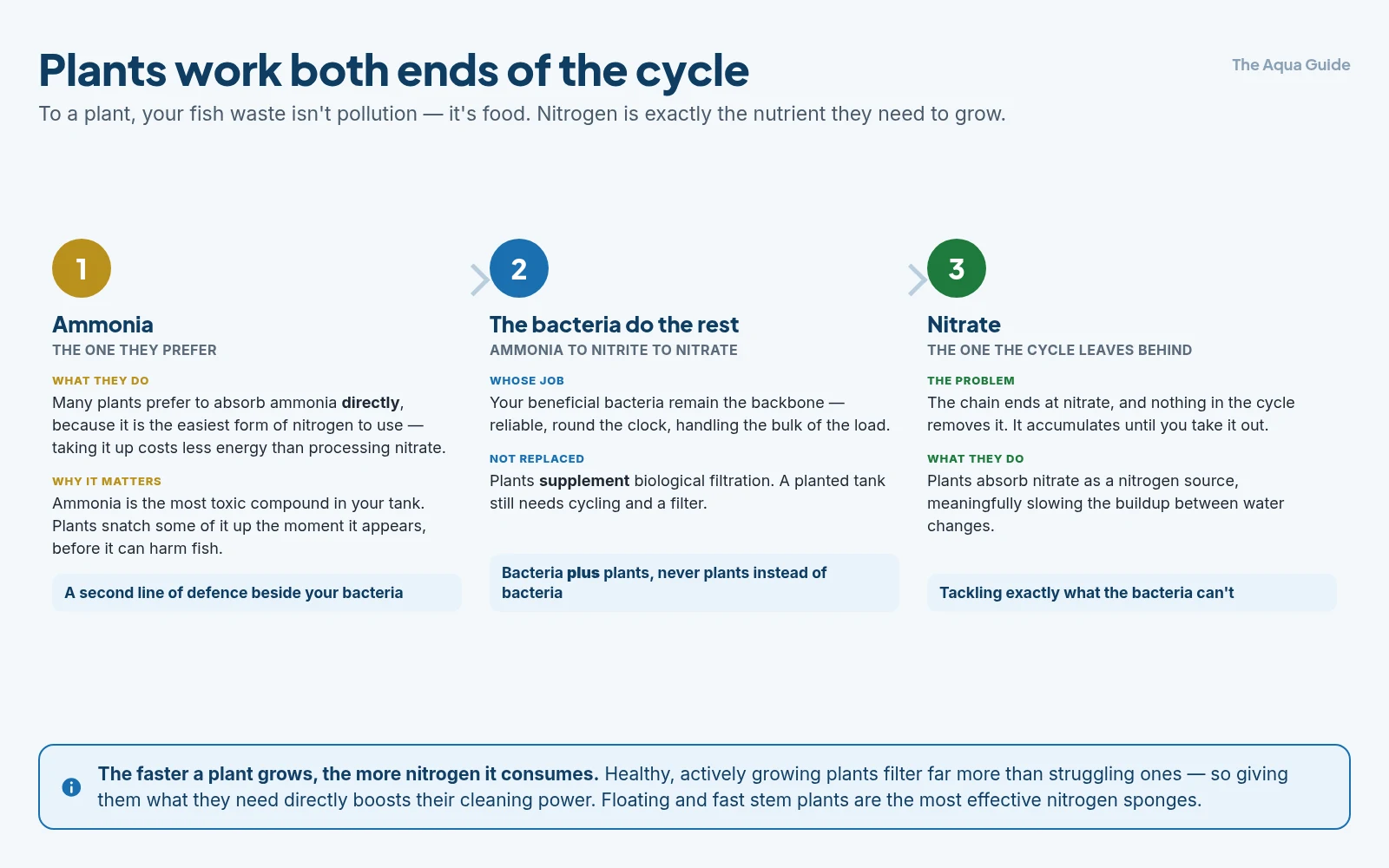
Here's a detail that matters more than most beginners realize: many aquarium plants actually prefer to absorb ammonia directly, over nitrate, because ammonia is the easiest form of nitrogen for them to use. Taking up ammonia costs the plant less energy than processing nitrate, so given the choice, plants often grab ammonia first.
Why is this such a big deal? Because ammonia is the most toxic compound in your tank. A planted tank has plants snatching up some of that ammonia the moment it appears, before it can harm fish — providing a second line of defense alongside your beneficial bacteria. In a heavily-planted tank, plants can absorb so much ammonia directly that the tank stays remarkably stable and safe. This is part of why dense plantings make tanks so forgiving.
Plants and Nitrate: Tackling the One the Cycle Leaves Behind
Recall that your nitrogen cycle converts ammonia to nitrite to nitrate — but the chain ends at nitrate, which nothing in the cycle removes. Nitrate just accumulates until you take it out with water changes. This is where plants offer their other major benefit: they consume nitrate too.
Plants absorb nitrate from the water as a nitrogen source, helping keep it lower between water changes. In a well-planted tank, the plants can meaningfully slow the buildup of nitrate, meaning more stable water and, in some cases, less frequent water changes needed to keep nitrate in check. They're tackling the very thing your bacteria can't — the end product that would otherwise just pile up.
So plants help at both ends of the cycle: grabbing toxic ammonia before it builds, and consuming the leftover nitrate the bacteria can't remove.
Plants Work With Bacteria, Not Instead of Them
This is the crucial caveat, and it's important not to misunderstand it: plants supplement your biological filtration; they don't replace it. A common beginner mistake is assuming a planted tank doesn't need cycling or a filter because "the plants handle it." That's not how it works.
Your beneficial bacteria are still the backbone of waste processing — they're reliable, work around the clock, and handle the bulk of the load. Plants are a valuable addition that takes some of the burden off the bacteria and adds a buffer of safety, but they're not a substitute for a properly cycled tank with a working filter. The two systems work together: bacteria do the heavy, dependable processing, and plants absorb extra nutrients, grab some ammonia directly, and consume nitrate. A planted tank is best thought of as bacteria plus plants, not plants instead of bacteria.
Why This Makes Planted Tanks More Stable
Put it all together and you can see why planted tanks are so forgiving. With plants pulling ammonia directly from the water, accumulating nitrate being consumed rather than just building up, and the plants out-competing algae for those nutrients, the whole system has more buffers against things going wrong. A mistake that might spike ammonia in a bare tank is partly absorbed by the plants. Nitrate that would climb steadily is kept in check. This added stability is one of the strongest practical arguments for keeping live plants, especially for beginners who benefit most from a forgiving tank.
Getting the Most From Plants' Filtering Power
To maximize this natural filtration, fast-growing plants are your friends — the faster a plant grows, the more nitrogen it consumes, so vigorous growers absorb the most ammonia and nitrate. Healthy, actively-growing plants filter far more than struggling ones, so giving your plants what they need to thrive (adequate light, and the nutrients from fish waste) directly boosts their cleaning power. Floating and fast stem plants are particularly effective nitrogen-sponges. The healthier and faster your plants grow, the more they clean.
The Bottom Line
Plants help process your tank's waste by absorbing nitrogen compounds as fertilizer — and they tackle both ends of the problem: many plants take up toxic ammonia directly (often preferring it), grabbing it before it can harm fish, and they consume the nitrate that your nitrogen cycle leaves behind and that nothing else removes. This makes planted tanks cleaner and notably more stable. But plants supplement your beneficial bacteria rather than replacing them — a planted tank still needs cycling and a filter; the plants are a powerful addition, not a substitute. For the strongest effect, keep healthy, fast-growing plants, which consume the most nitrogen and do the most cleaning.
Related guides
- How does the aquarium nitrogen cycle work?
- The beginner's guide to live aquarium plants
- The easiest fast-growing plants for beginners
- What are safe ammonia, nitrite and nitrate levels?
- The best live plants for clearing cloudy water
- How to speed up the nitrogen cycle
- The beginner's guide to aquarium algae
- The nitrogen cycle, explained
Got questions about your specific setup? Drop them in our Community Forum — we love helping new fishkeepers get started right.