Live plants transform an aquarium. They turn a sterile glass box into a living, breathing slice of nature — and they're not just decoration. Healthy plants make your water cleaner, your fish calmer, and your whole tank more stable and easier to keep. Yet many beginners avoid them, assuming they're difficult, expensive, or require special equipment. The truth is that a thriving planted tank is well within reach for a complete beginner. This guide is your starting point.
Think of this as the hub for everything plants. Each topic below opens into a more detailed guide, but by the end of this page you'll understand why plants are worth it and how to get started.
At a glance: where to start
| Question | The short answer |
|---|---|
| Do I need CO₂ and special lighting? | For a beginner tank, usually not. That is true only for demanding high-tech setups |
| Which plants should I start with? | The forgiving fast growers that tolerate low light and inconsistent dosing |
| What do plants actually need? | Light, nutrients and carbon — in that order of how often they are the problem |
| My new leaves are melting. Have I killed it? | Melting after planting is normal and usually temporary. Which is which has its own guide |
| Won't plants just feed the algae? | The opposite. Healthy plants out-compete algae for the same nutrients |
| How do I plant them so they stay put? | It depends on the type — rooted, attached, floating and carpeting are each handled differently |
Master the easy plants first. A lush, living planted tank is not just achievable for a beginner — it actually makes fishkeeping easier.
Why Live Plants Are Worth It
Plants do far more than look good, though they do look wonderful. They actively improve your tank in ways that make fish-keeping easier.
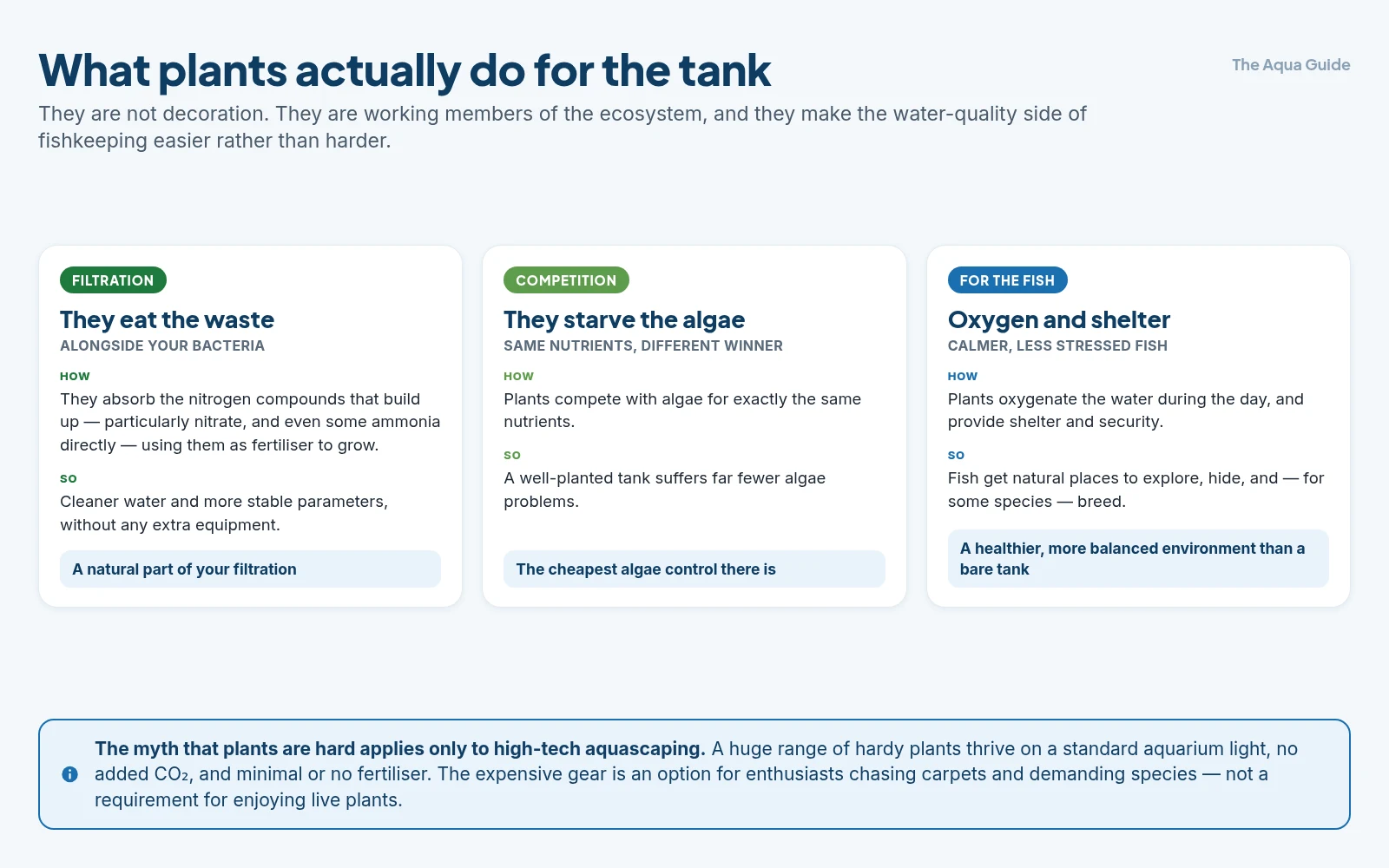
Most importantly, plants are a natural part of your filtration. They absorb the nitrogen compounds that build up in your water — particularly nitrate, and even some ammonia directly — using them as fertilizer to grow. This means plants genuinely help keep your water cleaner and your parameters more stable, working alongside your bacteria. They also compete with algae for those same nutrients, so a well-planted tank suffers far fewer algae problems. On top of that, plants oxygenate the water during the day, provide shelter and security that reduces fish stress, and give fish natural places to explore, hide, and (for some species) breed. A planted tank is simply a healthier, more balanced environment than a bare one.
The takeaway: plants aren't just aesthetic. They're working members of your tank's ecosystem, and they make the water-quality side of fish-keeping easier, not harder.
The Myth That Plants Are Hard
The biggest barrier for beginners is the belief that live plants need expensive lighting, pressurized CO₂ systems, and constant fertilizing. This is true only for demanding, high-tech "aquascaping" setups — and it's absolutely not true for a beginner planted tank.
A huge range of beautiful, hardy plants thrive in basic conditions: a standard aquarium light, no added CO₂, and minimal or no fertilizer. These low-maintenance plants are forgiving, slow to fail, and perfect for learning. You can have a genuinely lush, healthy planted tank without any special equipment at all. The high-tech gear is an option for enthusiasts chasing carpets and demanding species — not a requirement for enjoying live plants. (Whether you need CO₂, fertilizer, and special lighting is worth its own detailed look, but the short answer for beginners is: usually not.)
Choosing Beginner-Friendly Plants
The forgiving species are the fast growers that tolerate low light and inconsistent dosing. The easiest fast-growing plants lists them, floating and carpeting plants covers the two groups that behave very differently, and the plant quick reference is the at-a-glance version.
What Plants Actually Need
Light, nutrients and carbon, in that order of how often they are the problem. Lighting basics covers brightness and photoperiod, do I need CO2, fertiliser and special lighting answers the question most beginners are really asking, and substrate choices covers what the roots sit in.
Common Beginner Worries
Melting leaves after planting is normal and usually temporary — why are my plant leaves melting or yellowing explains which is which. Plants and algae competing for the same nutrients is the other recurring worry, covered in the algae guide.
How to Get Started
Plant them properly and they will stay put and root: how to plant and anchor aquarium plants covers technique for rooted, rhizome and stem plants, which are handled differently.
The Bottom Line
Live plants are one of the best things you can add to a beginner aquarium — they improve water quality by absorbing nitrogen compounds, out-compete algae, oxygenate the water, and reduce fish stress, all while looking beautiful. The myth that they require expensive lighting and CO₂ applies only to high-tech setups; a huge range of hardy, forgiving plants thrive in a basic tank with a standard light and no special gear. Start with easy, fast-growing species, plant them properly, keep a consistent light schedule, and let your fish feed them. Master the easy plants first, and you'll discover that a lush, living planted tank is not just achievable for beginners — it actually makes fish-keeping easier. Explore the guides in this section to go deeper on each piece.
Related guides
- The easiest fast-growing plants for beginners
- How to plant and anchor aquarium plants
- Floating and carpeting plants for beginners
- Do I need CO₂, fertiliser and special lighting?
- Why are my plant leaves melting or yellowing?
- How do plants help process ammonia and nitrates?
- Aquarium plants quick reference
- Aquarium lighting basics: brightness and photoperiod
Got questions about your specific setup? Drop them in our Community Forum — we love helping new fishkeepers get started right.
Planted tanks, in depth
The case for plants is above. Everything below is the practice.
- Easiest plants to start with — fast growers that forgive mistakes
- Floating and carpeting plants — two groups, two sets of rules
- Plant quick reference — the at-a-glance table
- Planting and anchoring — rooted, rhizome and stem plants
- Substrate choices — what the roots sit in
- Lighting basics — brightness and photoperiod
- CO2, fertiliser and lighting — what you need and what you do not
- CO2 injection — pressurised systems and alternatives
- Fertiliser dosing — once you want more control
- Melting or yellowing leaves — what the plant is telling you
- How plants help the cycle — what they take up, and what they do not
- Plants for cloudy water — which species actually help