For low-tech planted tanks, an all-in-one liquid fertilizer dosed weekly handles most situations. For high-tech tanks with CO2 and demanding plants, you need more — measured, regular dosing of specific nutrients matched to your plants' growth rate. This is where advanced fertilization methods come in: the Estimative Index, PPS-Pro, and other frameworks for feeding planted tanks systematically. Here's the complete guide.
At a glance: is this for you?
| If your tank is... | Then... |
|---|---|
| Low-tech: hardy plants, standard light, no CO₂ | You almost certainly don't need any of this. Your fish provide most of the nutrients, and a little liquid fertiliser covers the gap |
| High light with added CO₂ | This is where dosing earns its place. Light and CO₂ drive growth fast enough that nutrients become the limiting factor |
| Showing deficiency despite good light | Start with a general balanced fertiliser before building a dosing regime |
| Struggling with algae | Fix light and CO₂ balance first. More nutrients into an unbalanced tank feeds the algae, not the plants |
Advanced dosing is a tool for a demanding planted tank, not a fix for a struggling one.
Why Advanced Fertilization Matters
In a tank with CO2 injection and strong lighting, plants grow fast. Fast growth means high nutrient demand. If any nutrient is limiting (insufficient for the growth rate), plants struggle while having everything else they need.
The result: plants that have plenty of light and CO2 but stall, develop deficiencies, or get outcompeted by algae if any single nutrient runs out.
Advanced fertilization methods ensure no nutrient becomes limiting by either:
- Dosing excess so plants always have what they need (Estimative Index)
- Targeting precise levels matched to plant consumption (PPS, lean dosing)
Each approach has trade-offs. None is "correct" — different methods suit different keepers.
The Essential Nutrients
Plants need multiple nutrients, divided into:
Macronutrients (high amounts needed)
- Nitrogen (N) — for protein and chlorophyll. Comes from fish waste plus dosed nitrate (KNO3)
- Phosphorus (P) — for energy transfer and DNA. From fish food plus dosed phosphate (KH2PO4)
- Potassium (K) — for overall plant health. From dosed K (potassium sulfate or KNO3/KH2PO4 byproduct)
Micronutrients (smaller amounts but still essential)
- Iron (Fe) — for chlorophyll production. Critical for red plants especially.
- Manganese, Zinc, Copper, Boron, Molybdenum — trace elements for various enzymes and processes
- Magnesium and Calcium — typically from tap water hardness; supplemented in soft-water tanks
A complete fertilization plan addresses all of these.
The Major Dosing Methods
Estimative Index (EI) — Tom Barr's Method
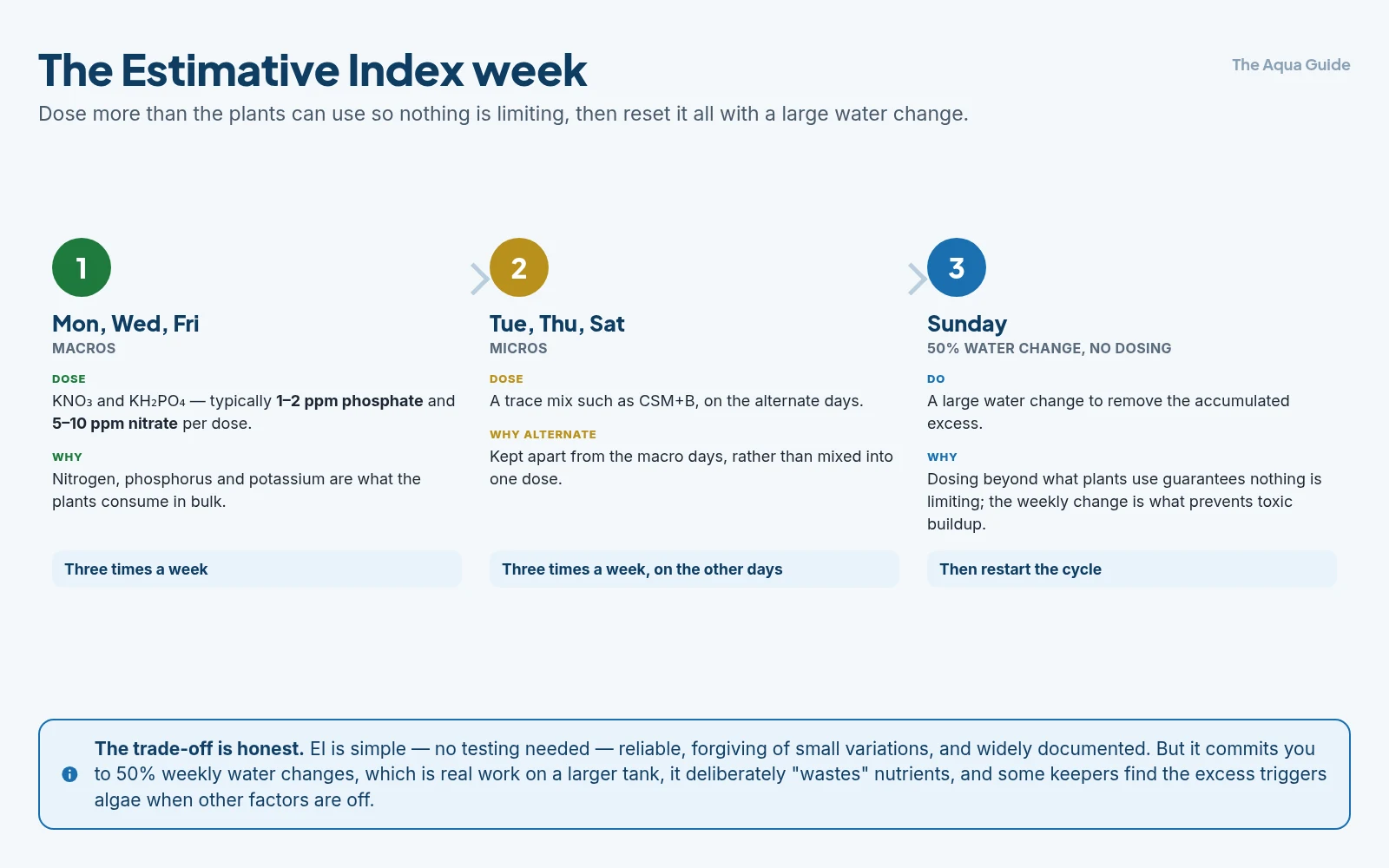
Philosophy: Dose nutrients in excess, do large water changes weekly to reset.
How it works:
- Macros dosed 3x/week (Monday, Wednesday, Friday) — typically 1-2 ppm phosphate, 5-10 ppm nitrate per dose
- Micros dosed 3x/week on alternate days (Tuesday, Thursday, Saturday)
- Large water change (50%) on Sunday to remove accumulated excess
- Restart the cycle
Rationale: By dosing more than plants can consume, you guarantee nothing is limiting. The weekly water change prevents toxic buildup.
Pros:
- Simple — no testing needed
- Reliable plant growth
- Forgiving — small variations don't matter much
- Widely documented online
Cons:
- Requires 50% weekly water changes (significant work in larger tanks)
- "Wastes" nutrients (dosed beyond what plants use)
- Some keepers find excess nutrients trigger algae if other factors are off
Best for: Heavily planted tanks with CO2, keepers willing to do big weekly water changes, beginners to high-tech wanting a simple framework.
PPS-Pro — Edward Venn-Watson's Method
Philosophy: Dose precisely what plants consume, avoid water changes from fertilizer accumulation.
How it works:
- Daily small doses of macros and micros (alternate days or together)
- Doses match plant consumption rate — no buildup of unused nutrients
- Minimal water changes for fertilizer reasons (still do them for fish/water quality)
- Tested parameters ensure correct dosing
Pros:
- Less water change burden
- Efficient use of fertilizers
- More natural rhythm of feeding
- Suits keepers who don't want big weekly resets
Cons:
- Requires testing to calibrate
- Less forgiving of inconsistency
- More complex setup
Best for: Experienced keepers, larger tanks where water changes are burdensome, those who prefer precision over redundancy.
Lean Dosing
Philosophy: Less is more. Dose minimum required, target slow steady growth.
How it works:
- Very low doses of macros and micros
- Slower growth than EI
- Closer to algae-balanced state — plants and algae compete fairly
- Less pruning needed
Pros:
- Less maintenance
- Less fertilizer cost
- Slower growth = less frequent trimming
- Workable in low-tech CO2-free tanks
Cons:
- Limited by available nutrients
- Demanding plants may struggle
- Reds may not develop fully
Best for: Low-tech tanks, low-maintenance keepers, planted tanks without CO2.
The Practical Setup
Whichever method you choose, the practical setup is similar:
Macro Stock Solutions
Dry chemicals dissolved in water for easy dosing:
KNO3 (Potassium Nitrate):
- Provides nitrogen and potassium
- Mix: ~3 tablespoons KNO3 in 500ml water (for typical home use)
- Dose: 5-10 ml per 50 gallons, 3x/week (EI), or smaller daily amounts (PPS)
KH2PO4 (Monopotassium Phosphate):
- Provides phosphorus and potassium
- Mix: ~1 tablespoon in 500ml water
- Dose: 5-10 ml per 50 gallons, 3x/week (EI)
K2SO4 (Potassium Sulfate):
- Provides additional potassium if needed
- Many keepers skip this since KNO3 and KH2PO4 provide enough K
Micro Stock Solution
CSM+B (Plantex or equivalent):
- Mix of iron, manganese, zinc, copper, boron, molybdenum
- Mix: ~1 tablespoon in 500ml water
- Dose: 5-10 ml per 50 gallons, 3x/week (alternate days from macros)
Iron (optional supplement):
- Specifically for red plant color
- Several commercial iron supplements available
Dosing Schedule
EI schedule for a 50-gallon tank:
| Day | Action |
|---|---|
| Monday | Dose macros (KNO3 + KH2PO4) |
| Tuesday | Dose micros (CSM+B) |
| Wednesday | Dose macros |
| Thursday | Dose micros |
| Friday | Dose macros |
| Saturday | Dose micros |
| Sunday | 50% water change, no dosing |
PPS schedule:
Daily smaller doses; alternating macro and micro days or combining (depending on chemical compatibility).
Mixing Stock Solutions
Basic process:
- Get appropriate jars/bottles (250-500ml, labeled)
- Measure dry chemical carefully (kitchen scale or measuring spoons)
- Add to bottle, fill with hot water
- Shake well until dissolved (may need to repeat with warm water for full dissolution)
- Cool, label clearly with chemical name and concentration
- Store in cool dark place
Important:
- Use deionized or RO water for stock solutions (tap water minerals can react)
- Keep macros and micros in separate bottles (they can react when concentrated)
- Don't mix iron + phosphate in the same bottle (precipitates out)
What to Buy
For a planted tank starter kit:
Dry chemicals (cheap, last years):
- Potassium nitrate (KNO3) — 1 lb is plenty
- Monopotassium phosphate (KH2PO4) — 0.5 lb plenty
- Optional: Potassium sulfate (K2SO4) — 0.5 lb
- CSM+B Plantex (micros) — 0.5 lb
Tools:
- Kitchen scale (gram resolution)
- Several 250-500ml bottles for stock solutions
- Marking labels
- Syringe or dropper for accurate dosing
Total cost: $40-60 for a year+ of fertilizers.
Pre-mixed commercial fertilizers (more expensive, more convenient):
- Seachem Flourish line (Flourish, Flourish Nitrogen, Flourish Phosphorus, Flourish Iron, etc.)
- Tropica Specialised Nutrition
- ADA Brighty K series
Total cost: $100-200+ for similar results.
For beginners, commercial fertilizers reduce the complexity. For long-term keepers, dry chemicals are dramatically cheaper.
Recognizing Deficiencies
Plants tell you what they need:
Nitrogen deficiency:
- Older leaves yellowing first
- Slow growth
- Pale plants overall
Phosphorus deficiency:
- Stunted growth
- Purple/dark coloration on older leaves
- Slow new growth
Potassium deficiency:
- Pinholes in leaves
- Yellow patches along leaf margins
- Particularly common deficiency
Iron deficiency:
- Pale/yellow new growth
- Red plants losing color
- Fragile delicate leaves
- One of the most common deficiencies
Magnesium deficiency:
- Yellowing between leaf veins (interveinal chlorosis)
- Veins remain green while tissue yellows
Identifying issues: Look at where deficiency appears (old vs new leaves), what pattern (interveinal, whole leaf, edges), and color/texture changes.
Adjusting Doses
A typical iteration:
Week 1-2: Start with recommended doses for your method/tank size.
Week 3-4: Observe plant growth. Healthy? Deficiencies appearing? Algae?
Week 5+: Adjust based on observations:
- Plants growing well, no deficiencies → maintain doses
- Slow growth, deficiency signs → increase doses
- Algae appearing → reduce doses, focus on water change frequency
- Specific deficiency → adjust specific nutrient
Test parameters monthly to confirm your dosing matches reality:
- Nitrate: 5-20 ppm (avoid 0 or above 40)
- Phosphate: 0.5-2 ppm (avoid 0)
- Iron: 0.1-0.5 ppm
Common Mistakes
Over-dosing iron. Causes algae, dark green water. Use sparingly.
Skipping water changes (EI). Excess nutrients build up; algae explodes.
Inconsistent dosing. Plants adapt to consistent levels; sudden swings cause stress.
Not testing tap water. If your tap water provides significant nitrate or phosphate, adjust dosing accordingly.
Mixing stock solutions wrong. Always read directions; some chemicals don't combine.
Same fertilizer for low-tech and high-tech. Low-tech needs much less; high-tech needs much more.
Treating fertilizer as algae cure. Algae isn't usually a nutrient problem; it's a balance problem. Adding more fertilizer rarely fixes algae.
When NOT to Use Advanced Fertilization
Skip dry chemical dosing if:
- Low-light, low-tech tanks — water column dosing once a week of all-in-one is enough
- Heavily fish-stocked tanks — fish waste provides plenty of nitrate
- Minimal planting — few plants don't need extensive fertilization
- Stable working systems — don't fix what isn't broken
For low-tech setups, a simple weekly dose of all-in-one liquid (like Seachem Comprehensive or Tropica Premium) plus occasional root tabs handles most needs.
The Bottom Line
Advanced fertilization frameworks (Estimative Index, PPS-Pro, lean dosing) ensure that high-tech CO2-injected planted tanks have all the nutrients they need for fast lush growth. EI doses excess macros and micros 3x/week with weekly 50% water changes — simple, reliable, requires water change commitment. PPS-Pro doses precisely what plants consume daily — efficient, requires testing to calibrate. Lean dosing keeps levels minimal for slower growth — suits low-maintenance and low-tech tanks. Practical setup: dry chemicals (KNO3, KH2PO4, CSM+B micros) mixed into stock solutions, dosed on schedule using simple syringes — $40-60 for a year's supply. Recognize deficiencies through plant symptoms (yellowing leaves, pinholes, pale new growth, interveinal chlorosis). Iterate doses based on observation; test parameters monthly to confirm. Skip advanced fertilization for low-tech tanks where simpler approaches work fine. The principle behind all methods: don't let any nutrient become limiting, and watch your plants for signs of what they need. With CO2 and proper fertilization, planted tanks reach their full potential.
Related guides
- Do I need CO₂, fertiliser and special lighting?
- CO₂ injection: pressurised systems and alternatives
- Why are my plant leaves melting or yellowing?
- Aquarium plants quick reference
- Aquarium lighting basics: brightness and photoperiod
- Substrate choices for aquascapes
- Hair, thread and string algae control
- The beginner's guide to live aquarium plants
Got questions about your specific setup? Drop them in our Community Forum — we love helping new fishkeepers get started right.