Your First Aquarium: A Day-by-Day Beginner's Guide (Day 1 to First Fish)
So you've decided to get a fish tank. Maybe you saw a beautiful planted aquarium on Instagram, or your kid won't stop asking for a pet, or you just want something peaceful to look at after a long workday. Whatever brought you here — welcome. Fishkeeping is one of the most rewarding hobbies you can pick up, and once you understand what's happening inside that glass box, it stops feeling like a chore and starts feeling like a little ecosystem you're tending to.
But here's the thing nobody tells you at the pet store: you don't add fish on day one. Or day three. Or day seven. Almost every beginner who fails at fishkeeping fails for the same reason — they buy a tank on Saturday, fill it with water, drop in five goldfish, and wonder why they're all dead by Friday.
This guide is going to walk you through the right way to start your first aquarium, day by day, for the first six weeks. It's going to take patience. There will be a stretch where it feels like nothing is happening. That waiting period is the entire point — and skipping it is the single most common beginner mistake.
Stick with the timeline, and by the end of this guide you'll have a stable, healthy tank that your fish will actually thrive in. Let's go.
At a glance: the timeline
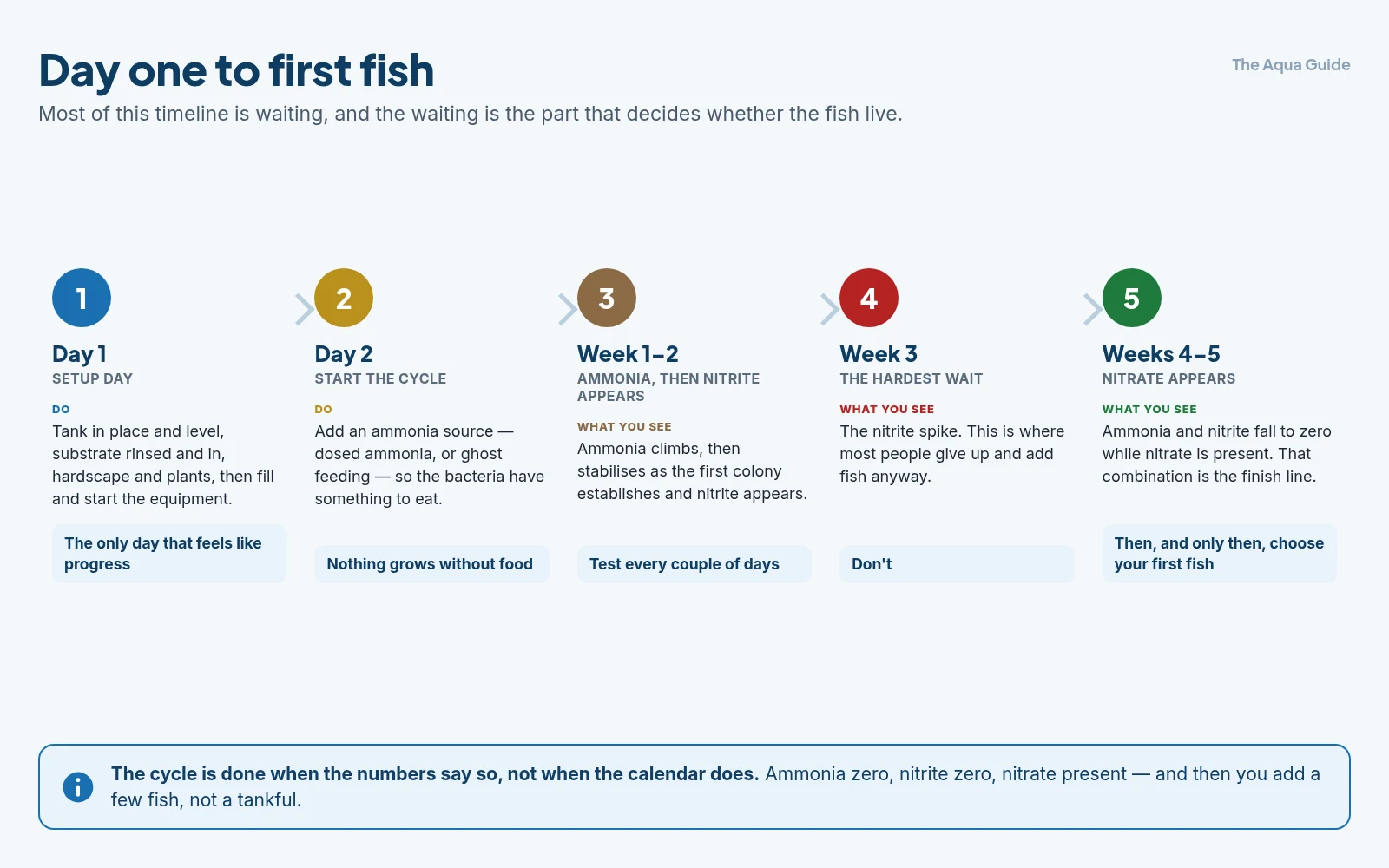
| When | What happens |
|---|---|
| Day 1 | Setup day — tank, substrate, hardscape, plants, water, equipment running |
| Day 2 | Start the nitrogen cycle with an ammonia source |
| Days 3–7 | The quiet week. Very little visible happens |
| Week 2 | The ammonia spike stabilises and nitrite appears |
| Week 3 | The nitrite spike — the hardest wait, and where most people give up |
| Weeks 4–5 | Nitrate appears, and ammonia and nitrite fall toward zero |
| Cycle complete | Choose your first fish — a few, not a tankful |
Four to eight weeks is normal. The tank is ready when the readings say so — ammonia zero, nitrite zero, nitrate present — and not a day before.
Before Day 1: What You Actually Need to Buy
Before we get to the timeline, let's talk shopping list. The pet store will try to sell you a "complete starter kit" — sometimes those are fine, sometimes they're junk. Here's what you actually need:
The Tank
Get a 20-gallon tank, minimum. I know it's tempting to start with a 5-gallon "nano" because it's cheaper and fits on a desk, but smaller tanks are actually harder to maintain. Water parameters swing more violently in less water — one mistake in a 5-gallon can wipe out everything overnight. A 20 or 29-gallon long is much more forgiving while you're learning.
If space is really tight, a 10-gallon is the absolute minimum I'd recommend. Anything smaller is hard mode.
Filter
Get one rated for your tank size — or one size larger. A hang-on-back (HOB) filter is the easiest for beginners. Sponge filters are also great but need an air pump.
Heater
If you're keeping tropical fish (which most beginner-friendly species are), you need a heater. Get an adjustable one rated for your tank size. Skip the cheap preset ones — they fail.
Lighting
Whatever came with your tank is usually fine for fish-only setups. If you want live plants, you'll need a proper plant light eventually, but don't worry about it for now.
Substrate
Sand or gravel — your call. Sand looks more natural and is better for bottom-dwelling fish. Gravel is easier to clean. Either works. Just avoid colored gravel that looks like a candy shop exploded.
Test Kit (THIS IS NON-NEGOTIABLE)
Get an API Freshwater Master Test Kit. The liquid one, not the strips. The strips are inaccurate and you'll waste money on them. The master kit costs more upfront but lasts forever and is the single most important tool you'll own.
Water Conditioner
Seachem Prime is the gold standard. One small bottle lasts ages.
Ammonia Source
You'll need this for cycling. Pure ammonia (no surfactants, no scents) from a hardware store works. Alternatively, you can drop in a small piece of raw shrimp or use fish food — we'll cover this on Day 2.
Decor
Whatever you find pretty, as long as it's aquarium-safe. Driftwood, rocks, plants (live or fake) — your call. Just rinse everything thoroughly with hot water (NO SOAP, ever) before it goes in the tank.
Budget Reality Check
Expect to spend somewhere between ₹6,000 and ₹15,000 ($75–$200) on your first complete setup, depending on tank size and quality. If someone quotes you ₹2,000 for "everything you need," they're cutting corners on something important — usually the filter or the test kit.
Day 1: Setup Day
Okay, you've got your stuff home. Today is exciting because you're actually building the thing. Take your time — rushing this is how leaks happen.
Step 1: Find the Right Spot
Pick a location that's:
Out of direct sunlight (causes massive algae problems)
Away from heating vents and AC units (temperature swings stress fish)
On a stand that can hold the weight — a 20-gallon tank with water and substrate weighs around 100 kg. Your IKEA bookshelf is not going to cut it.
Near a power outlet but not somewhere water spills will reach electronics
Step 2: Rinse the Substrate
Even "pre-washed" substrate is dusty. Rinse it in a bucket until the water runs mostly clear. This is annoying and takes longer than you think. Just do it — skipping this step means a cloudy tank for the next two weeks.
No soap. Not even a tiny bit. Ever. Soap residue kills fish.
Step 3: Set Up the Tank
Put the tank on the stand, level it, add the substrate, then slowly fill with tap water. To avoid blasting craters into your substrate, pour the water onto a plate or a folded plastic bag sitting on top of the substrate.
Step 4: Add Water Conditioner
Now, before you turn anything on, dose the entire tank with water conditioner according to the bottle instructions. Tap water has chlorine and chloramine in it, which kills both fish and the beneficial bacteria you're about to grow. Skip this step and you start from scratch.
Step 5: Install Equipment
Mount the filter, fill it with water, plug it in.
Set up the heater but don't plug it in for at least 30 minutes — heaters need to acclimate to water temperature before turning on, or the glass can crack.
Add your decor wherever you want it.
Step 6: Let It Run for 24 Hours
That's it for today. Let everything circulate. Watch for leaks. Admire your empty tank. Resist the urge to buy fish.
Why no fish yet? Your tank water right now is basically just dechlorinated tap water. It has no bacteria, no biological filtration, nothing to process fish waste. If you added fish today, their own waste would poison them within a week. We need to build up a colony of beneficial bacteria first. That's what the next few weeks are all about.
Day 2: Starting the Nitrogen Cycle
Today is when the real magic begins — except you can't see any of it, which is why this part is hard. We're going to start growing two types of beneficial bacteria that will eventually process all the waste your fish produce.
Understanding What We're Doing (Briefly)
Fish produce ammonia, which is toxic. One type of bacteria (Nitrosomonas) eats ammonia and produces nitrite, which is also toxic. A second type of bacteria (Nitrobacter) eats nitrite and produces nitrate, which is mostly harmless at low levels and gets removed with weekly water changes.
This whole chain — ammonia → nitrite → nitrate — is called the nitrogen cycle. Your tank needs to "cycle" before fish can live in it.
For a deeper dive, check our Water Guide and pH Guide.
Step 1: Add an Ammonia Source
Since there are no fish to produce waste yet, we need to fake it. Pick one method:
Method A — Pure Ammonia (Fastest): Add enough pure ammonia to reach 2-4 ppm in your tank. There are dosing calculators online, but for a 20-gallon you're looking at around 3-4 ml of household ammonia. Add slowly, test, adjust.
Method B — Fish Food (Easiest): Sprinkle a small pinch of fish food into the tank every day. As it decomposes, it produces ammonia. Slower, but more forgiving.
Method C — Raw Shrimp (Free): Drop one small uncooked shrimp into a mesh bag and let it decompose in the tank. Gross but effective.
I recommend Method A if you can get pure ammonia, Method B if you can't.
Step 2: Test Your Water
Use your master test kit to measure:
Ammonia (should be 2-4 ppm now)
Nitrite (should be 0)
Nitrate (should be 0)
pH (note whatever it is — we'll track changes)
Write these numbers down. Seriously, keep a little notebook or a notes file on your phone. You'll thank yourself later.
Step 3: Wait
That's all for today. Patience is the actual skill of fishkeeping.
Days 3–7: Week 1 — The Quiet Week
This week is going to feel like nothing is happening. Test every two or three days. You'll see ammonia stays high. Nitrite stays at zero. Nitrate stays at zero. It will feel like the tank is broken.
It's not broken. The bacteria are slowly establishing themselves. They need time — usually 7 to 14 days before you see the first sign of progress.
What to Do This Week
Test every 2-3 days. Log your readings.
Maintain ammonia around 2-4 ppm. If it drops below 2, add a bit more. If you're using fish food, just sprinkle a tiny pinch every couple of days.
Check the heater temperature. Aim for 78-82°F (25-28°C). Warmer water grows bacteria faster.
Resist the urge to do water changes. I know your gut says "the ammonia is high, I should change the water!" — but right now the high ammonia is feeding the bacteria you're trying to grow. Leave it alone.
Resist the urge to buy fish. The pet store fish will still be there in five weeks. The fish you buy this week will be dead in two.
Common Week 1 Question: "Why is the water cloudy?"
Totally normal. It's usually either substrate dust (you didn't rinse enough) or a bacterial bloom (good thing — it means bacteria are starting to colonize). It'll clear up on its own. Don't change the water trying to fix it.
Week 2: The Ammonia Spike Stabilizes, Nitrite Appears
Somewhere between day 8 and day 14, you'll see the first real sign of progress: nitrite appears. It might be 0.25 ppm at first, then 0.5, then climbing.
This is huge. It means your first bacteria colony is active and converting ammonia to nitrite. Celebrate quietly.
What to Do This Week
Keep testing every 2-3 days.
Keep dosing ammonia to maintain it at 2-4 ppm. The bacteria need to keep eating.
Don't do water changes. I know nitrite is climbing and it feels dangerous, but there are no fish in there, so it doesn't matter. The high nitrite is feeding the next bacteria colony you need to grow.
Optional: Add Live Plants
This is a great week to add live plants if you want them. Plants help by absorbing some ammonia and nitrate directly, and they make the tank look way better. Easy beginner plants:
Java fern
Anubias
Amazon sword
Vallisneria
All of these are forgiving and don't need fancy lighting or fertilizers to start. Don't bury java fern or anubias in the substrate — they attach to rocks or driftwood and rot if their rhizomes are buried.
Week 3: The Hardest Wait — Nitrite Spike
This is the psychologically hardest week. Your ammonia might be dropping faster (good!), but nitrite will be high — possibly off the chart. The water might look fine. You'll be tempted to declare the tank cycled and add fish.
Do not add fish. Nitrite is more toxic than ammonia. If you add fish now, they'll die of "brown blood disease" within days.
What to Do This Week
Keep dosing ammonia.
Keep testing.
Notice when ammonia starts processing faster. You might dose 2 ppm and find it at 0.5 ppm 24 hours later. That's your first colony working at full speed.
Nitrite will keep climbing or sit at maximum until the second bacteria colony catches up.
The "Did I Mess Something Up?" Anxiety
By week 3, almost every beginner starts panicking. The tank looks "done" but the numbers say otherwise. You'll see other beginners on forums claiming their tank cycled in 7 days. They're either lying or using bottled bacteria (which can help, but isn't magic).
Most tanks take 4-6 weeks to cycle properly. Some take 8. Just trust the test kit, not your gut.
Weeks 4–5: Nitrate Appears, the Finish Line Comes Into Sight
This is the breakthrough. One day you test the water and see nitrate showing up — even just 5 or 10 ppm. That means your second bacteria colony is active.
From here, things move fast. Within a week or so:
Ammonia will drop to 0 within 24 hours of dosing.
Nitrite will drop to 0 within 24 hours.
Nitrate will keep climbing.
When you can dose 2-4 ppm of ammonia at night and wake up to 0 ammonia AND 0 nitrite the next morning, with nitrate present — your tank is cycled. Congratulations. You just did the hardest part of fishkeeping.
Final Step Before Fish: The Big Water Change
Your nitrate is probably 40-80 ppm by now, which is too high for fish. Do a 50% water change with dechlorinated water. Match the temperature roughly (within a few degrees) so you don't shock the system.
After the water change, test again. Nitrate should be around 10-20 ppm. Ammonia and nitrite should still be 0. Now you're ready.
Cycle Complete: Choosing Your First Fish
This is the fun part. But please, please don't go overboard. A common beginner mistake is "stocking" the tank in week one with 20 fish from 5 different species. Don't.
The First-Fish Principle
Start with one species, in a small group, well within your tank's capacity. For a 20-gallon, that means something like 6-8 small schooling fish — not 20.
Beginner-Friendly Species
Browse our Species Dictionary for full care details, but for a first tank, you can't go wrong with:
Neon tetras or ember tetras — peaceful, colorful, small, school nicely (group of 6-8)
Platies — hardy, come in beautiful colors, easy to keep (group of 4-5)
Cory catfish — bottom-dwellers, peaceful, fun to watch (group of 6 minimum)
Harlequin rasboras — underrated, very hardy, beautiful color (group of 6-8)
Skip these popular-but-tricky fish for now:
Goldfish (need huge tanks, produce massive waste)
Bettas (need their own setup or carefully chosen tankmates)
Angelfish (get big, can be aggressive)
Anything labeled "common pleco" (grow to 2 feet long — yes really)
Buying and Acclimating
At the store:
Look at the whole tank — if any fish look sick or dead, walk away from that store entirely. Disease spreads through their water system.
Pick active, alert fish with clear eyes and intact fins.
Ask how long they've been at the store. Anything less than a week is risky.
At home, acclimate properly:
Float the sealed bag in your tank for 15 minutes to match temperature.
Open the bag and add a small cup of your tank water every 5-10 minutes for the next 30-45 minutes.
Net the fish out and put them in the tank. Do not pour the bag water into your tank — that's how diseases spread.
Turn the lights off for the first few hours. Let them settle.
Week 1 With Fish
You did it. There are fish in your tank. Don't relax yet — this is when new fishkeepers make their last big mistakes.
Feeding
Feed once a day, only as much as they can eat in 2 minutes. Then stop. Overfeeding is the #1 cause of water quality crashes. Uneaten food rots and produces ammonia faster than your bacteria can keep up.
If you're not sure how much that is, start with a pinch. You can always feed more tomorrow. You can't un-feed a tank.
Testing
Test ammonia and nitrite daily for the first week. Both should stay at 0. If they don't, your tank might be experiencing what's called a "mini-cycle" — do a 25% water change and test again the next day.
Test nitrate weekly. When it hits 20-40 ppm, time for a water change.
Observing
Spend a few minutes each day just watching your fish. You're learning what normal looks like for them. Normal behavior makes abnormal behavior obvious later. Are they eating well? Swimming actively? Hanging at the surface gasping (bad)? Hiding constantly (could be stress)?
Week 2 Onwards: Establishing Your Routine
Now you're a fishkeeper. Here's the rhythm of normal tank life:
Daily (1-2 minutes)
Feed once
Quick visual check — anyone missing? Anyone acting odd?
Weekly (15-20 minutes)
Test water (ammonia, nitrite, nitrate, pH)
Do a 20-25% water change with conditioned, temperature-matched water
Light cleaning — wipe inside glass, vacuum visible debris
Monthly (30-45 minutes)
Rinse filter media in tank water you just removed — never tap water. Tap water kills the bacteria living in your filter.
Trim plants if needed
Deep substrate vacuum
When to Add More Fish
Wait at least 2-3 weeks after your first fish before adding more. Watch your parameters. If everything stays stable, you can slowly add more — but add a few at a time, never a dozen at once.
When Something Goes Wrong
It will, eventually. Here's the short version of what to do:
Cloudy water? Usually a mini-bacterial bloom. Don't panic. Test parameters. If ammonia and nitrite are 0, just wait it out.
A fish looks sick? Isolate if you have a quarantine tank. Test water first — most "diseases" are actually water quality problems.
Fish at the surface gasping? Low oxygen or ammonia spike. Test immediately. Do a water change if ammonia is present.
Algae everywhere? Reduce lighting hours, reduce feeding, do more water changes.
For anything you can't diagnose, our Community Forum is full of people who've been through it. Post a clear question with your water parameters and a photo. You'll usually get an answer within hours.
For live, real-time help, jump into our Community Chat — someone's almost always online.
The Honest Truth About This Hobby
Fishkeeping isn't really about fish. It's about water. Once you accept that — that your real job is to maintain stable, clean water, and the fish are just the visible reward — everything gets easier.
You'll have setbacks. Every fishkeeper has lost a fish. Every fishkeeper has dealt with algae blooms, equipment failures, mystery deaths. The difference between hobbyists who stick with it and ones who quit is just patience and a willingness to learn from the mistakes.
You've already done the hardest part by reading this far instead of impulse-buying a goldfish. Trust the timeline. Test the water. Watch your fish. Ask questions when you're stuck.
In six months, you'll look back at the empty tank you started with and barely recognize it. The plants will have grown in. The fish will recognize you when you walk past. The whole thing will run itself, mostly.
Welcome to the hobby. Take it slow.
Quick-Reference Checklist
[ ] Day 1: Set up tank, dechlorinate water, install equipment
[ ] Day 2: Add ammonia source, take baseline readings
[ ] Week 1: Test every 2-3 days, maintain ammonia, wait
[ ] Week 2: Watch for first nitrite reading
[ ] Week 3: Nitrite spike — don't panic, don't add fish
[ ] Week 4-5: Nitrate appears, ammonia processes fast
[ ] Cycle complete: 50% water change, then add first fish
[ ] First week with fish: Test daily, feed lightly, observe
[ ] Establish weekly water change routine
Frequently Asked Questions
How long does it really take to cycle a tank? Anywhere from 3 weeks (with bottled bacteria and ideal conditions) to 8 weeks (slower setups). Average is 4-6 weeks. Trust the test kit, not the calendar.
Can I speed it up with bottled bacteria like Seachem Stability or Tetra SafeStart? Yes — these can cut cycling time roughly in half. They're not magic, but they help. Follow the bottle directions exactly.
Can I do a "fish-in" cycle instead? Technically yes, but it's stressful and often fatal for the fish. If you must (some places sell tanks with fish included), use very hardy fish, do daily water changes, and use a product like Seachem Prime that detoxifies ammonia between water changes. Honestly, just do fishless. It's kinder.
What if my pH keeps crashing during cycling? Bacteria struggle below pH 6.0. If your tap water is naturally soft and acidic, add a small piece of crushed coral to your filter to buffer it. Check our pH Guide for details.
Do I really need a 20-gallon tank? Can't I start smaller? You can, but it's harder. Smaller water volumes swing more drastically with any mistake. If you absolutely must go small, a 10-gallon is the minimum I'd recommend, and even then, expect a steeper learning curve.
Related guides
- How does the aquarium nitrogen cycle work?
- Fish-in vs fish-less cycling: which is right for you?
- What is ghost feeding, and how does it help cycling?
- How do I know if my tank is fully cycled?
- What equipment do you actually need vs store upsells
- Beginner-friendly fish species
- How to speed up the nitrogen cycle
- Adding fish in batches: how slow is slow enough?
Got questions about your specific setup? Drop them in our Community Forum — we love helping new fishkeepers get started right.