Walk into a fish store as a beginner and you'll leave with a cart full of gadgets, additives, and "essentials" you were told you can't live without. The reality is that a healthy aquarium needs a surprisingly short list of equipment — and a lot of what gets pushed is optional, situational, or outright unnecessary. Let's separate the genuine must-haves from the upsells, so you spend your money where it matters.
What aquarium equipment do you actually need?
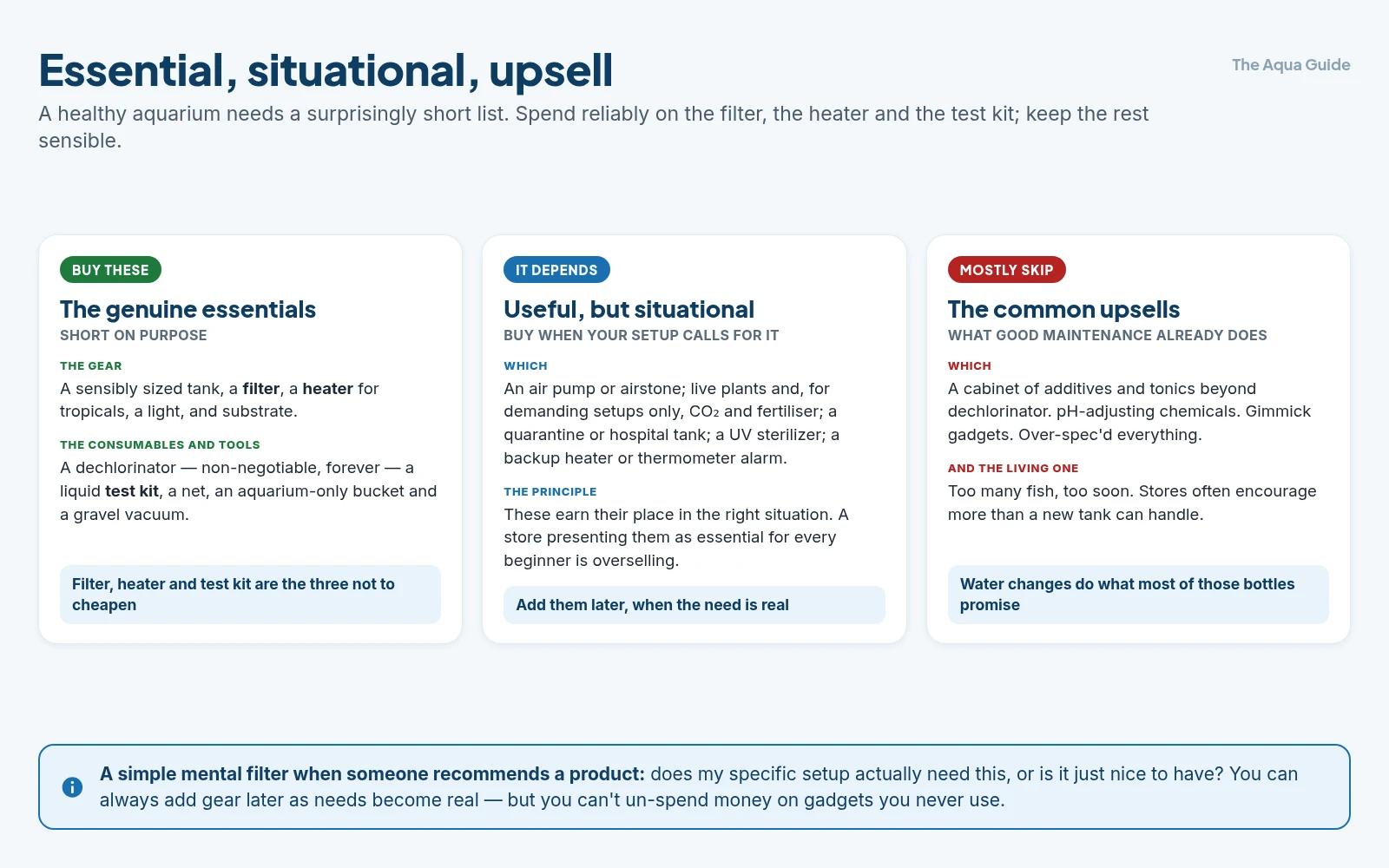
Four things are genuinely essential: a sensibly sized tank, a filter, a heater if you are keeping tropical fish, and a light. The filter and heater are the two worth not cheapening — much of the rest is situational or an upsell.
At a glance: the real list
| Item | Why it's on the list |
|---|---|
| A tank | Sized sensibly — bigger is more forgiving for beginners |
| A filter | It houses your beneficial bacteria and keeps the water moving and clean. One of the two worth buying reliably |
| A heater, for tropical fish | Tropical species need stable warmth. Skip it only for cold-water fish. The other one worth buying reliably |
| A light | So you can see your fish, and so live plants can photosynthesise |
| Substrate | Gravel or sand — functional, and a place for roots in a planted tank |
| A water conditioner | Non-negotiable. Every drop of tap water that enters the tank, forever |
| A liquid test kit | Often left off "starter" lists, and genuinely essential — it catches problems early and prevents expensive mistakes |
| Basic tools | A net, an aquarium-only bucket that has never held soap, and a gravel vacuum |
That is the real list. Get these right and you can run a thriving aquarium.
The Genuine Essentials
Here's what you actually need to run a healthy tank. This list is short on purpose.
A tank. Obviously — and sized sensibly (bigger is more forgiving for beginners).
A filter. This is essential. The filter houses your beneficial bacteria and keeps the water moving and clean. It's one of the two items most worth buying reliably.
A heater (for tropical fish). Tropical species need stable warmth, and a reliable heater provides it. Skip this only if you're keeping cold-water fish that don't need heating. Like the filter, it's worth not cheaping out on.
A light. Needed so you can see your fish and, if you have live plants, for them to photosynthesize. Most tanks come with one or take a simple fixture.
Substrate. Gravel or sand for the bottom — functional and (for planted tanks) a place for roots.
A water conditioner (dechlorinator). Non-negotiable. You'll treat every drop of tap water that enters the tank, forever.
A test kit. A liquid test kit lets you monitor your water and catch problems early. This is genuinely essential despite often being left off "starter" lists — it prevents expensive mistakes.
Basic maintenance tools. A net, a bucket (aquarium-only, never soaped), and a gravel vacuum/siphon for water changes.
That's the real list. A tank, filter, heater, light, substrate, conditioner, test kit, and a few cheap tools. Get these right and you can run a thriving aquarium.
The "It Depends" Category (Useful, but Situational)
These aren't upsells exactly — they're genuinely useful in the right situation, but not universal must-haves. Buy them if your setup calls for them, skip them if not.
An air pump / airstone — helpful for extra oxygenation or aesthetics, but not required if your filter provides good surface movement. Situational.
Live plants and plant supplies (CO₂, fertilizer) — wonderful for the tank, but optional, and the CO₂/fertilizer gear is only needed for demanding planted setups, not basic ones.
A quarantine/hospital tank — very wise once you're adding or treating fish, but something you can add later, not a day-one purchase.
A UV sterilizer — useful for specific problems like persistent green water, but absolutely not a beginner essential. There are cheaper ways to handle the issues it solves.
A backup heater or thermometer alarm — sensible insurance for valuable tanks, optional for a basic setup.
The principle: these earn their place when your specific situation needs them, but the store presenting them as essential for every beginner is overselling.
The Common Upsells (Usually Skippable)
Now the things frequently pushed that most beginners don't need, at least not at the start.
A cabinet full of additives and "tonics." Beyond dechlorinator, the vast array of bottled additives — pH adjusters, "clarity" boosters, mineral supplements, bacterial tonics, and so on — are mostly unnecessary for a basic, well-maintained tank. Good maintenance and water changes do what most of these bottles promise. Some have niche uses, but a beginner does not need a shelf of them.
pH-adjusting chemicals. As covered elsewhere, chasing a "perfect" pH with chemicals usually creates instability and does more harm than good. Stable water beats tweaked water; skip these.
Expensive gimmick gadgets. Automatic feeders (handy occasionally, not essential), fancy decorations, branded "miracle" products — nice extras, not requirements.
Over-spec'd everything. Being sold the most expensive filter, the priciest substrate, premium everything, when solid mid-range gear works perfectly well. Reliability matters for the heater and filter; beyond that, you're often paying for marketing.
Too many fish, too soon (the living "upsell"). Not equipment, but worth flagging: stores often encourage buying more fish than a new tank can handle. Stock slowly — it's better for the fish and your wallet.
How to Resist the Upsell
A simple mental filter when someone recommends a product: ask "does my specific setup actually need this, or is it just nice to have?" The genuine essentials are few and clear. Almost everything else is situational or optional. You can always add gear later as your needs become real — but you can't un-spend money on gadgets you never use. When in doubt, start with the essentials list, run your tank, and let actual needs (not the sales pitch) tell you what to add.
The Bottom Line
A healthy aquarium needs a short list: a tank, a filter, a heater (for tropicals), a light, substrate, a dechlorinator, a test kit, and a few cheap maintenance tools. Spend reliably on the filter, heater, and test kit; keep the rest sensible. Useful-but-situational items (air pump, plants, quarantine tank, UV sterilizer) can be added when your setup actually calls for them. And the cabinet of additives, pH chemicals, and gimmick gadgets the store pushes? Mostly skippable — good maintenance does what most of those bottles promise. Buy the essentials once, run your tank, and let real needs guide any additions.
Related guides
- The beginner's guide to aquarium equipment
- Choosing the right filter: HOB vs sponge vs canister
- Heater sizing and placement
- How to use a liquid test kit (and why strips fail)
- Do I need an air pump or airstone?
- Quarantine: why and how
- How much does a fish tank cost to set up and run?
- Understanding pH, KH and GH
Got questions about your specific setup? Drop them in our Community Forum — we love helping new fishkeepers get started right.