The filter is the single most important piece of equipment in your tank — it houses the bacteria that keep your fish alive — and there are three main types most beginners encounter. They're all good for the right setup, and they all have real trade-offs. Here's an honest comparison of hang-on-back, sponge, and canister filters, what each is genuinely best for, and how to pick the right one for your situation.
At a glance: which one, and when
| Choose | When |
|---|---|
| A HOB | For a typical first community tank. Affordable, easy, effective, and a clear step up from the very basic filters some kits include |
| A sponge filter | When your inhabitants need gentle flow — shrimp, fry, breeding, bettas — or when you want a near-silent, ultra-reliable backup |
| A canister | When the tank is large, heavily stocked, or you want pristine clarity and hidden equipment in a planted display |
| Two filters | A main HOB plus a small sponge. Bacteria colonise both, so if one fails — or you clean one — the other carries the load |
Every filter does the same three things: mechanical filtration traps debris, biological hosts the bacteria, chemical absorbs dissolved substances. The biology is the most important part, and any filter that gives the bacteria a good home will keep your tank healthy.
What All Filters Do
Quickly, so the differences make sense. Every filter does the same job: pull water through media that performs three kinds of filtration — mechanical (trapping debris), biological (hosting the beneficial bacteria that convert ammonia and nitrite), and (when needed) chemical (absorbing dissolved substances with media like activated carbon). The biology is the most important part — the bacteria are what actually keep ammonia and nitrite at zero — and any filter that gives them a good home will keep your tank healthy.
What differs between filter types is how they move and treat the water, how much they hold, how loud they are, how visible they are, and how much they cost. (Filter media in detail has its own guide.)
Hang-on-Back (HOB) Filters
A HOB filter hangs on the back rim of the tank with an intake tube reaching down into the water. It draws water up through the intake, runs it through media inside the unit, and returns it to the tank via a small waterfall outflow.
Strengths: Easy to install and access (everything's right there at the back of the tank), affordable, good media capacity for the price, and produces nice surface agitation from the outflow (good for oxygenation). Most all-in-one starter kits include a HOB. Maintenance is straightforward — open the lid, swap or rinse media, close it up.
Weaknesses: The waterfall outflow can be a bit noisy (a soft trickle), the unit is visible on the back of the tank, and the media chamber, while decent, is smaller than what a canister offers. HOBs also need the water level kept up — if it drops below the intake, the filter sucks air and stops working.
Best for: Most beginner tanks. A HOB sized correctly for your tank (or slightly over) is the default sensible choice, balancing cost, capacity, ease of use, and effectiveness.
Sponge Filters
A sponge filter is exactly what it sounds like — a large sponge inside the tank, with an air-driven uplift tube that pulls water through the sponge. It needs an air pump to work, and is essentially gentle, quiet biological filtration.
Strengths: Very cheap (just a sponge and an air pump), almost silent in operation, excellent biological filtration (the whole sponge is surface area for bacteria), and extremely gentle — won't suck in fry, shrimp, or tiny fish, which makes them the standard choice for breeding tanks, shrimp tanks, and fry-rearing. Very reliable since there's almost nothing mechanical to break.
Weaknesses: Limited mechanical filtration (won't polish water as crisply as a HOB or canister), no chemical filtration capacity, low flow (which is a feature for delicate inhabitants but limiting otherwise), and they're visible inside the tank. Need an air pump running constantly.
Best for: Shrimp tanks, breeding tanks, fry-rearing setups, betta tanks (where strong flow stresses the fish), quarantine tanks, and as supplemental filtration alongside a main filter in any setup.
Canister Filters
A canister is a large sealed unit that sits outside the tank (usually below it in the stand cabinet), connected by intake and return hoses that pass over the tank rim. Water is pumped through a substantial media chamber and returned via a spray bar or nozzle.
Strengths: Large media capacity (multiple stacked trays for mechanical, biological, and chemical media — by far the most flexibility), powerful flow that suits larger or heavily-stocked tanks, hidden away in the cabinet so it doesn't clutter the tank visually, and the spray bar return distributes flow evenly. Excellent at polishing water to crystal clarity.
Weaknesses: Expensive — the most costly of the three types by a significant margin. Larger and heavier to install. Maintenance is a bigger job (disconnecting hoses, hauling the canister out, cleaning trays), so people often clean them less often, which means they need a bigger initial investment of effort to learn. Also, sealed canisters can be quiet but if priming or hoses develop issues, they can leak or air-lock.
Best for: Larger tanks, heavily-stocked or messy fish, planted tanks where you want hidden equipment and clean aesthetics, and keepers willing to invest more upfront for top-tier filtration capacity.
Head-to-Head, Quickly
To make the picking simple:
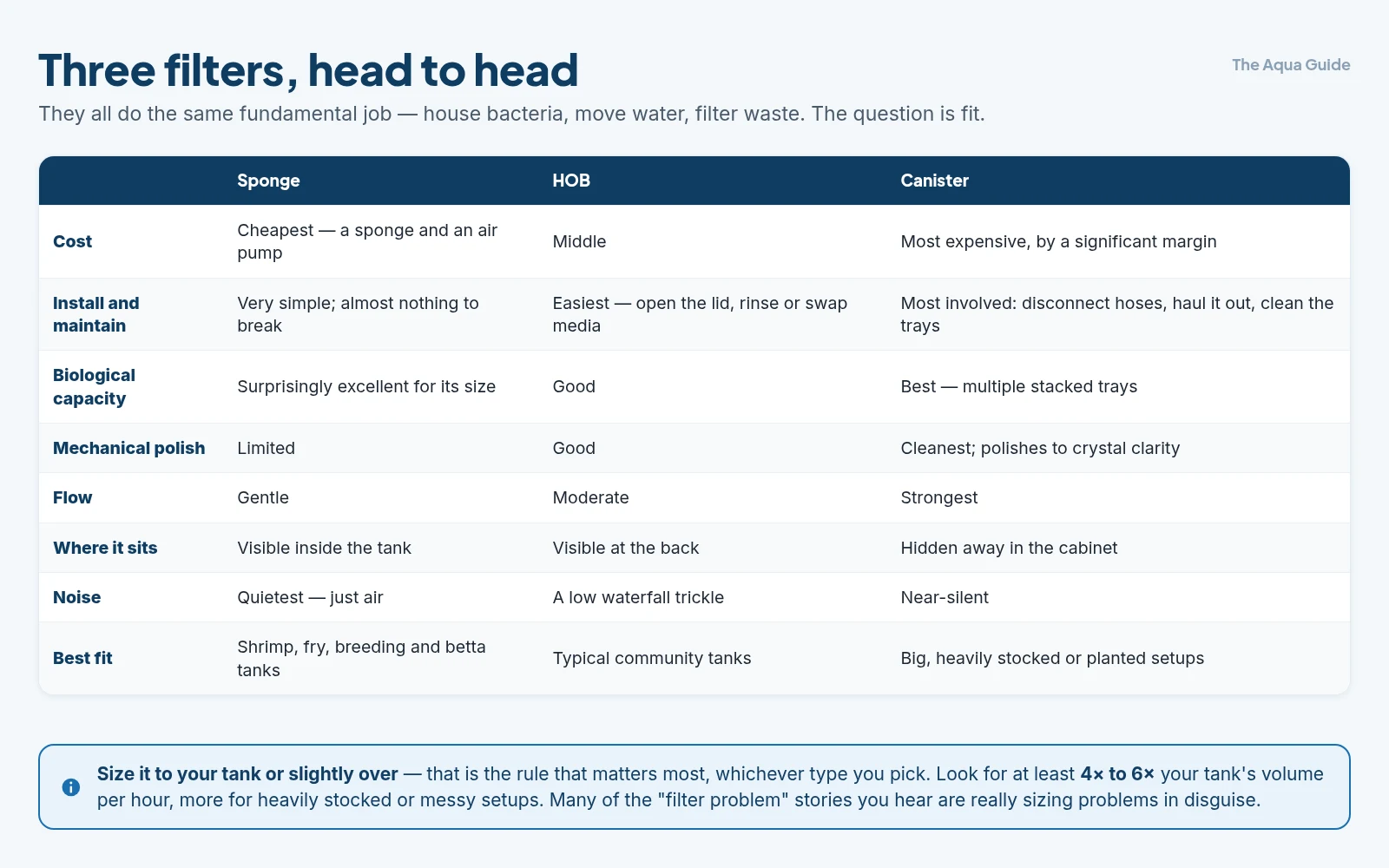
Cost: sponge cheapest, HOB middle, canister most expensive. Ease of installation/maintenance: HOB easiest, sponge very simple, canister most involved. Biological filtration capacity: sponge surprisingly excellent for size, HOB good, canister best. Mechanical / polish: canister cleanest, HOB good, sponge limited. Flow: canister strongest, HOB moderate, sponge gentle. Visibility / aesthetics: canister most hidden, HOB visible at back, sponge visible inside. Noise: sponge quietest (just air), HOB low waterfall trickle, canister near-silent. Best fit: sponge for delicate/breeding/shrimp tanks, HOB for typical community tanks, canister for big/heavily-stocked/planted setups.
Which Should You Choose?
For a typical first community tank, a HOB sized correctly for your tank is the default recommendation — affordable, easy, effective, and a clear step up from the very basic filters some kits include.
Choose a sponge filter when your inhabitants need gentle flow (shrimp, fry, breeding, bettas) or when you want a near-silent, ultra-reliable backup. They're also excellent as a supplemental filter to boost biological capacity cheaply.
Choose a canister filter when your tank is large (the size where HOBs strain), heavily stocked, or you want pristine water clarity and hidden equipment in a planted display setup. It's an investment that pays off in capacity and aesthetics, but it's overkill for a basic small tank.
A common excellent setup is even to run two filters — say a main HOB plus a small sponge — for redundancy and extra biological capacity. Bacteria colonize both, so if one fails (or you clean one), the other carries the load.
A Note on Sizing, Whatever You Choose
Whichever type you pick, size it to your tank or slightly over — that's the rule that matters most. Look for a filter rated to turn over at least 4× to 6× your tank's volume per hour, more for heavily-stocked or messy setups. An undersized filter is a slow disaster regardless of type; a properly-sized one of any type works well. Many of the "filter problem" stories you hear are really stocking/sizing problems in disguise.
The Bottom Line
All three filter types do the same fundamental job — house bacteria, move water, filter waste — and they all work; the question is fit. HOB filters are the sensible default for most community tanks: affordable, easy, effective. Sponge filters are cheap, silent, and gentle, making them ideal for shrimp, fry, breeding, and bettas, plus excellent as a supplemental filter anywhere. Canister filters offer the most media capacity, powerful flow, and hidden installation — worth the higher price for larger, heavily-stocked, or planted display tanks. Whichever type you choose, size it generously to your tank, and you'll have a filter that does its job reliably for years.
Related guides
- Filter media explained: mechanical, biological, chemical
- How to clean your filter without crashing the cycle
- Do I need an air pump or airstone?
- Sump filtration: setup and benefits
- The beginner's guide to aquarium equipment
- What equipment do you actually need vs store upsells
- How does the aquarium nitrogen cycle work?
- The nitrogen cycle, explained
Got questions about your specific setup? Drop them in our Community Forum — we love helping new fishkeepers get started right.