UV sterilizers are one of those pieces of equipment that get heavily promoted as "essential" in some corners of the hobby and dismissed as "unnecessary gadgetry" in others. The truth is in between, and it depends entirely on what you're trying to solve. Here's an honest look at what UV sterilizers actually do, when they're worth having, and how to size one if you decide you want one.
What a UV Sterilizer Does (and Doesn't Do)
A UV sterilizer is a unit that exposes water to ultraviolet light as it flows through. The UV light kills free-floating microorganisms — algae cells, parasites, bacteria, viruses — that pass through the sterilizer chamber. Critically, it only treats what passes through it; it doesn't sterilize the entire tank, surfaces, substrate, plants, or anything attached. So it's a tool for dealing with waterborne problems specifically.
It does not clean water in the chemistry sense — it doesn't remove ammonia, nitrate, or organic waste. It doesn't replace a filter or a water change. It also doesn't harm your beneficial bacteria, because those bacteria live on filter surfaces, not floating in the water. The UV only zaps what's free-floating in the flow.
When a UV Sterilizer Is Genuinely Useful
A UV sterilizer earns its place in a few specific situations.
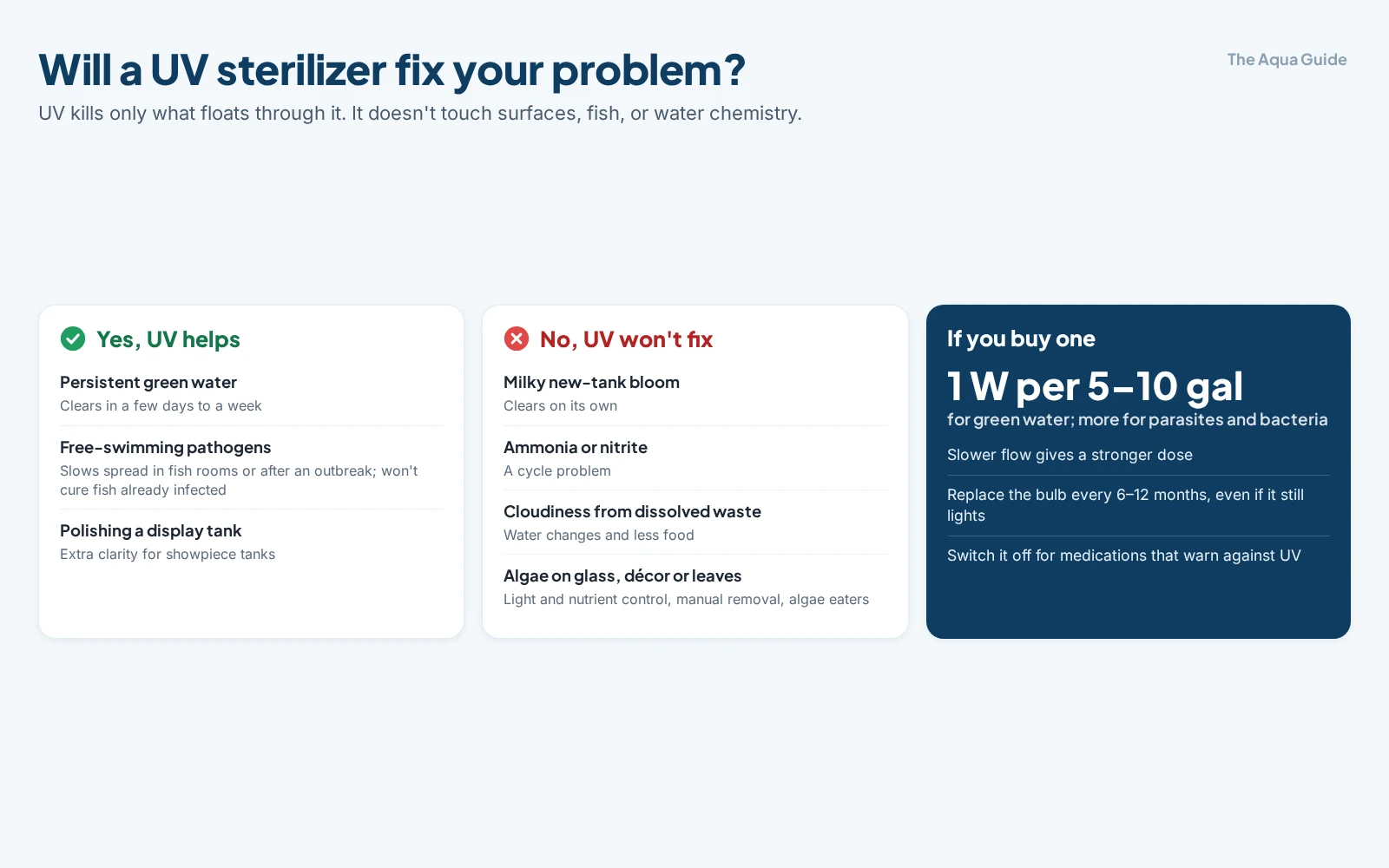
Persistent green water. The clearest case. Green water is caused by free-floating algae multiplying through the water column — exactly what UV sterilizers excel at killing. Run a UV sterilizer for a few days to a week and a stubborn green-water bloom clears, often dramatically. If you've tried other approaches and the bloom keeps coming back, UV is a near-guaranteed solution.
Reducing free-floating pathogens. Certain parasites and bacterial pathogens have free-swimming life stages. A UV sterilizer doesn't cure existing infections (it can't reach parasites already on a fish), but it can reduce the spread to other fish by killing pathogens during their waterborne phase. This is most relevant in fish-room setups, breeding operations, or after a known outbreak.
Polishing display tanks. Some aquascapers use UV sterilizers to keep water hyper-clear in showpiece display tanks, killing any micro-organisms that might cloud the water and ensuring crystal clarity for photos.
Specific quarantine or treatment situations. Used judiciously, UV can support certain treatment protocols, though it interacts with some medications and isn't a replacement for proper quarantine procedures.
When You Don't Need One (Most Beginners)
For the typical beginner aquarium that's properly cycled, well-maintained, and not suffering from a free-floating-algae or pathogen problem, a UV sterilizer is not necessary. Don't let anyone convince you it's standard equipment. A well-cycled tank with good filtration, regular water changes, and sensible stocking doesn't have the kinds of problems UV is designed to solve.
Specifically, UV is not the solution to:
- General bacterial blooms (the milky cloudiness in new tanks — those clear on their own).
- High ammonia or nitrite (a cycle issue, not a UV problem).
- Dissolved-organic cloudiness (water change and reduced feeding).
- Algae growing on surfaces (light/nutrient control, manual removal, algae eaters).
Buying a UV sterilizer for a healthy tank "just in case" is one of the equipment upsells beginners often regret. Get one when a real, specific problem calls for it.
Sizing a UV Sterilizer
If you do decide you want one, getting the size right matters more than for most equipment. UV sterilizers work by dwell time — the longer water is exposed to the UV bulb, the more thoroughly it's sterilized. So sizing depends on both wattage and the flow rate through the unit.
The basic principles:
Match wattage to tank size, generously. A rough guideline is around 1 watt of UV per 5–10 gallons of tank water for clearing green water, with more wattage required for parasite-killing applications (which need higher UV dose). Bigger is better — undersized UV doesn't kill effectively, while oversized UV simply does the job faster.
Control flow rate. UV works best when water passes slowly enough to absorb a meaningful dose. Many UV units include a pump or are plumbed inline with your filter; reducing flow through the UV (using a slower pump or a flow-reducing valve) increases dwell time and effectiveness. The manufacturer's specs typically state a maximum flow rate for the intended use — slower than that is fine, faster compromises effectiveness.
Different jobs need different doses. Killing free-floating algae (clearing green water) needs a lower UV dose than killing parasites or bacteria, which need higher doses or slower flow. If your goal is purely to clear green water, modest wattage at moderate flow works. If you're targeting pathogens, lean toward higher wattage and slower flow.
Manufacturers' sizing recommendations are usually a sensible starting point — and as with most equipment, leaning slightly larger than the minimum is better than barely meeting it.
Sizing at a glance (green water)
Using the rule above of roughly 1 watt per 5 to 10 gallons. For parasites and bacteria, go larger and slower.
| Tank size | UV wattage for green water |
|---|---|
| 10 gallons (38 L) | 1 to 2 W |
| 20 gallons (75 L) | 2 to 4 W |
| 40 gallons (150 L) | 4 to 8 W |
| 55 gallons (210 L) | 5.5 to 11 W |
| 75 gallons (285 L) | 7.5 to 15 W |
Practical Notes
A few things worth knowing if you use one. UV bulbs degrade — they look fine but their UV output drops significantly over time, and most need replacing every 6–12 months even if they still light up. Mark the install date and replace bulbs annually. Don't look directly at an unshielded UV bulb — UV light damages eyes; only run it inside its housing. UV can interact with some medications, so turn it off when treating with medications that explicitly warn against UV. And UV doesn't replace water changes or filtration — it's an addition, not a substitute.
The Bottom Line
A UV sterilizer is genuinely useful in specific situations — clearing persistent green water, reducing free-floating pathogens in fish rooms or breeding setups, and keeping display tanks crystal-clear — but it's not necessary equipment for the typical healthy aquarium. For most beginners, it's an upsell you can skip. If you do buy one, size it generously (roughly 1 watt per 5–10 gallons for green water, more for pathogen control), run water through it slowly enough to give the UV time to work, replace bulbs annually whether they still light up or not, and remember that it treats only what flows through it — not the whole tank. Use it for the specific problems it solves; don't expect it to fix problems it isn't designed for.
Related guides
- Green water and free-floating algae blooms
- How to clear green water without a UV sterilizer
- How long should you run a blackout for algae?
- Fish tank water cloudy? What's wrong and how to fix it
- What equipment do you actually need?
- Filter media explained
Got questions about your specific setup? Drop them in our Community Forum — we love helping new fishkeepers get started right.