Setting up an aquarium is like building a busy underwater city. For this city to stay healthy, its inhabitants and the invisible "helper workers" (beneficial bacteria) must live in balance. It's completely normal for a new tank to start crystal clear, then turn into "milky soup" a few days later. If you've found this page because you just searched why is my fish tank water cloudy, take a breath — in most cases it's harmless and fixable.
Why is my fish tank water cloudy?
In a new tank it is almost always a harmless bacterial bloom that clears on its own. Cloudiness only signals danger alongside gasping at the surface, sudden lethargy or clamped fins.
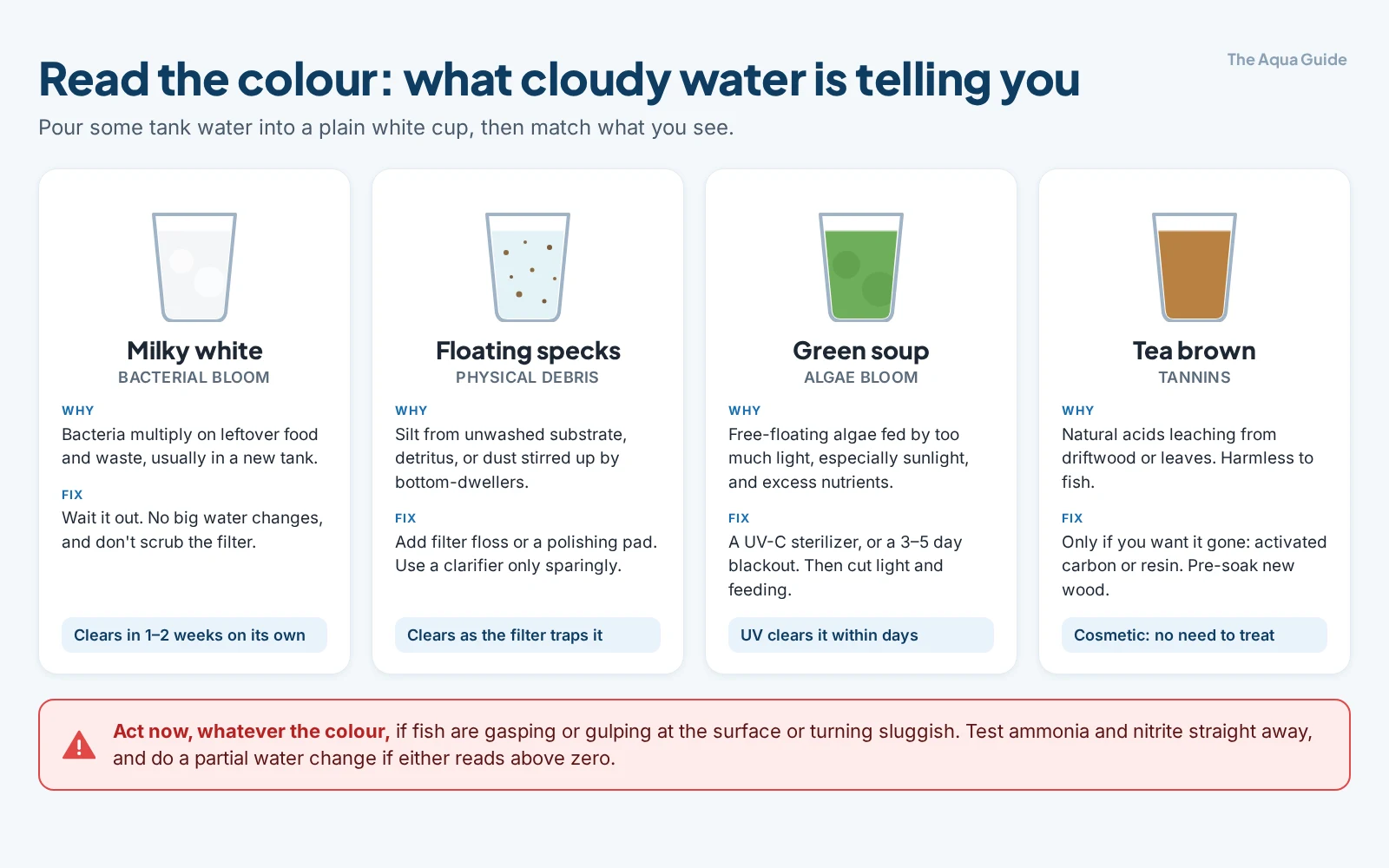
At a glance: the four kinds of cloudy water
| What you see | What it is | What to do | How long it lasts |
|---|---|---|---|
| Milky white haze | Bacterial bloom | Wait. No big water changes, don't clean the filter | 1 to 2 weeks, clears on its own |
| Floating specks | Silt, detritus or dust | Filter floss or a polishing pad; clarifier sparingly | Until the filter traps it |
| Green "pea soup" | Algae bloom | UV-C sterilizer, or a 3 to 5 day blackout; then less light and food | Days with UV |
| Tea-brown tint | Tannins from wood or leaves | Nothing needed; carbon or resin if you dislike it | Harmless, cosmetic only |
Whatever the colour: if fish gasp at the surface or turn sluggish, test ammonia and nitrite now. That is a water-quality emergency, not a cosmetic one.
Is Cloudy Water Dangerous to My Fish?
Usually, no. The most common type of cloudy water (a bacterial bloom in a new tank) looks alarming but doesn't directly harm fish. The exception is when cloudiness comes with warning signs — fish gasping at the surface, sudden lethargy, or clamped fins. That combination points to a water-quality problem, not just a cosmetic one, and you'll want to act fast (more on that below).
The "White Cup Test": Your First Diagnostic Step
Before treating the water, identify the type of cloudiness. Siphon a small amount of tank water into a solid white plastic cup or bucket. Seeing the water against a plain white background reveals its true color and particle type without interference from gravel, plants, or tank lighting.
This test is most useful for telling a milky bacterial haze apart from fine floating particles — the two that look similar inside the tank. Green and brown tints are usually obvious in the tank itself, but the cup still helps confirm the exact shade.
1. Milky White Water (Bacterial Bloom)
What it is: The most common mystery for new keepers. It's caused by millions of floating "helper" bacteria (heterotrophs) rushing into the water to eat leftover food and waste before they settle into permanent homes on the gravel and in the filter.
The fix — "Active Patience." This isn't dirt; it's your cleanup crew at work. Do not perform large water changes or scrub your filter. Doing so removes the very workers you need and makes the cloudiness come back even worse.
Timeline: It typically clears on its own within one to two weeks as the bacteria settle.
2. Floating Specks and Particles (Physical Debris)
What it is: Tiny "crumbs" drifting in the water, usually from unwashed substrate (sand or gravel silt), organic waste (detritus), or dust kicked up by bottom-dwellers like Corydoras catfish.
The fix:
- Mechanical filtration: Add a fine polyester polishing pad or filter floss to your filter to trap the smallest particles.
- Water clarifiers (optional): Products that act as flocculants clump tiny particles into larger "flocs" the filter can catch. Use these sparingly — they treat the symptom, not the cause, and overdosing can clog filter media or stress fish. The water often looks cloudier for a short while as particles clump, before it clears.
3. Green "Pea Soup" Water (Algae Bloom)
What it is: An explosion of tiny, free-floating green algae (suspended phytoplankton), driven by too much light — especially direct sunlight — combined with excess nutrients from overfeeding.
The fix:
- UV-C sterilizer: The most efficient solution. The UV light disrupts the algae's DNA so they can't reproduce, and the bloom clears within days.
- Blackout: Cover the tank completely for 3 to 5 days to starve the algae of light. Before you do this, remove or protect any live plants — they need light too — and don't feed during the blackout. Address the root cause as well (reduce lighting hours, move the tank out of direct sun, and cut back on feeding), or the bloom will simply return.
4. Tea-Brown or Orange Tint (Tannins)
What it is: A clear, tea-like color from natural humic acids and polyphenols leaching out of driftwood or botanical leaves. It's harmless — even mildly beneficial — for fish, so removing it is purely a cosmetic choice.
The fix: Use chemical filtration such as activated carbon or a synthetic adsorbent resin in your filter to soak up the color. Pre-soaking new driftwood in a bucket for a week or two before adding it also reduces tannin release.
When Should I Actually Worry?
Most cloudy water is harmless and clears on its own. Here's how to tell normal from genuinely dangerous:
Probably fine — just wait it out: Milky haze in a brand-new tank with no fish, or with fish behaving normally. This is a bacterial bloom doing its job.
Act immediately: Cloudy water plus fish gasping at the surface, gulping at the top, or acting sluggish. This usually signals an ammonia spike or low oxygen, not a cosmetic problem. Test your water for ammonia and nitrite right away, and do a partial water change if either reads above zero. Don't wait for it to "clear on its own" when fish are showing distress.
When in doubt, test the water. A liquid test kit tells you what your eyes can't — and the numbers, not the cloudiness, are what your fish actually respond to.
Three Golden Rules for a Sparkling Tank
To keep water clear long-term, follow these rules:
- Avoid overfeeding. Feed only a tiny pinch — leftover food rots and feeds the very bacteria that cloud your water.
- Don't overstock. Adding too many fish at once creates more "garbage" than your bacterial cleanup crew can process.
- Protect the filter workers. Never rinse your filter sponge under the tap — chlorine kills the beneficial bacteria living in it. Instead, gently squeeze it in a bucket of old tank water during a water change.
Stick with these and the cloudiness that scares so many beginners becomes a brief, predictable phase rather than a crisis. The tank settles, the water sparkles, and you get back to the fun part: watching your fish.
Related guides
- How to do the white cup test properly
- How to use a liquid test kit (and why strips fail)
- Why is my water still cloudy after a water change?
- How to clear green water without a UV sterilizer
- Do I need a UV sterilizer, and what wattage?
- How long should you run a blackout for algae?
- What it means if your water turns yellow or orange
- The nitrogen cycle, explained
Got questions about your specific setup? Drop them in our Community Forum — we love helping new fishkeepers get started right.