A healthy aquarium should smell like almost nothing — at most, a faint, fresh, earthy or "green" scent, like a pond or damp soil. So when your tank starts giving off a genuinely bad smell — rotten, swampy, or like sewage — it's a clear signal that something is off. The good news is that a smelly tank is almost always caused by one of a few identifiable problems, and the fixes are straightforward. Let's track down the source and clear the air.
At a glance: the general cure-all
| Do | What it fixes |
|---|---|
| A good water change with substrate vacuuming | Accumulated waste and detritus, and stagnant substrate |
| Clean the filter gently, in tank water | A filter that has become a source of smell rather than a solution |
| Check for and remove any dead fish or rotting plant matter | The sudden strong smells |
| Cut back on feeding going forward | The most common cause of all |
Together those four cover the large majority of cases — so if you are not sure which applies, do all of them rather than guessing.
What a Healthy Tank Smells Like
First, a baseline, because some smell is normal. A well-maintained aquarium has only a very mild, fresh, earthy odor — the natural scent of a living aquatic system. This is nothing to worry about. The concern is when the smell turns foul: rotten-egg, sulfurous, swampy, fishy-and-rancid, or sewage-like. That's the tank telling you there's decaying organic matter or a maintenance problem, and it's worth investigating.
Every bad aquarium smell comes down to the same root: decomposing organic material producing odorous gases. The question is just where the decay is happening. Here are the usual sources.
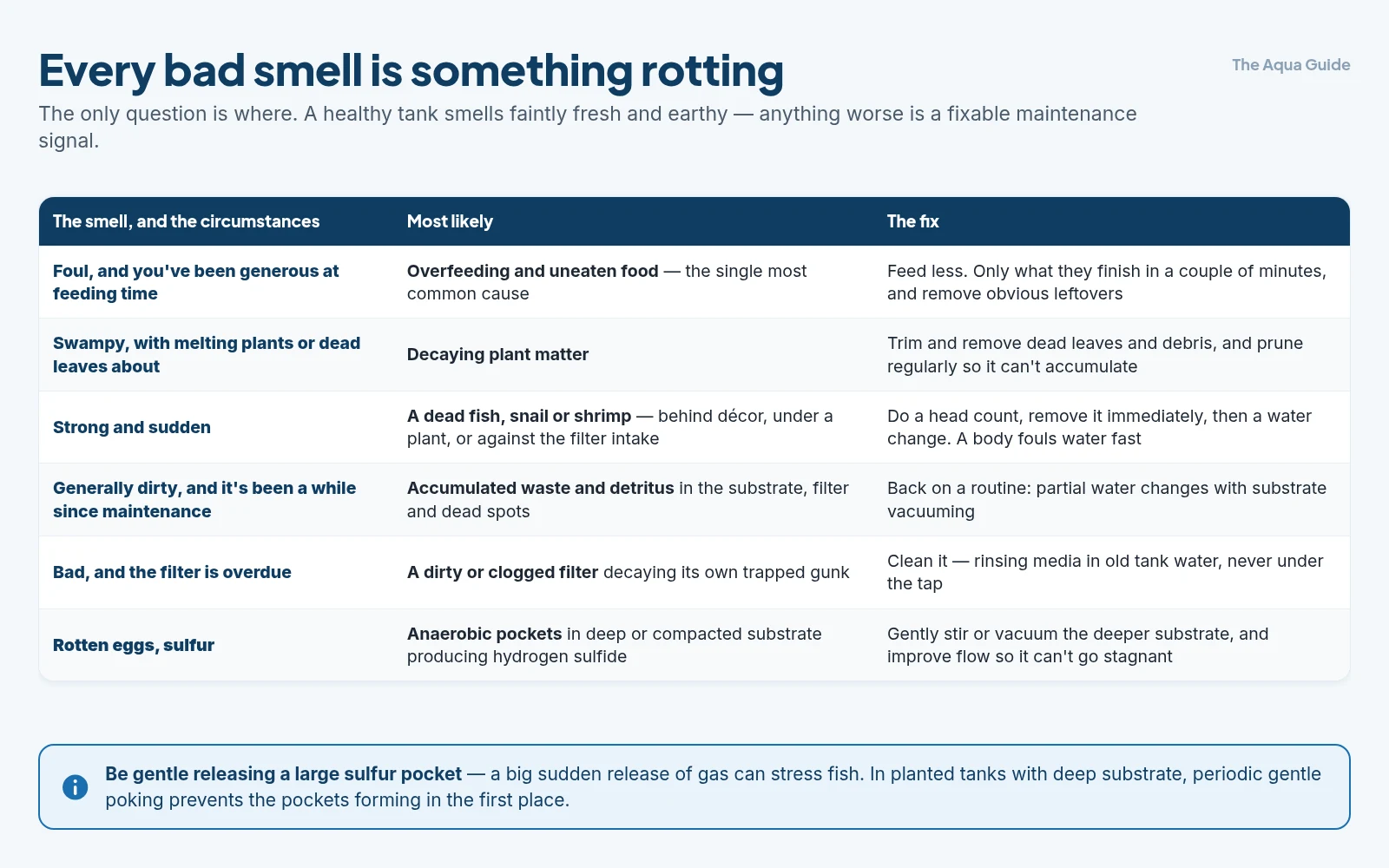
Cause 1: Overfeeding and Uneaten Food
The single most common cause. When you feed more than your fish eat, the leftover food sinks, settles into the substrate, and rots — producing foul smells (and feeding ammonia and bacterial blooms as a bonus). If your tank smells bad and you've been generous with feeding, this is the prime suspect.
The fix: feed less. Offer only what your fish finish in a couple of minutes, and remove any obvious uneaten food. Cutting back feeding alone resolves a great many smelly-tank cases.
Cause 2: Decaying Plant Matter
Dead and dying plant leaves, or bits of plants that have broken off and settled, rot just like uneaten food. A tank with melting plants or accumulated dead leaves can develop a swampy odor.
The fix: trim and remove dead or dying leaves and any decaying plant debris. Keep your plants healthy, and prune regularly so dead material doesn't accumulate and rot.
Cause 3: A Dead Fish (or Other Creature)
A fish that has died and gone unnoticed — hidden behind décor, under a plant, or sucked against the filter intake — will quickly produce a strong, unmistakable rotten smell. The same goes for a dead snail or shrimp. If the smell came on suddenly and strongly, do a head count.
The fix: locate and remove the deceased immediately, then do a water change. A decaying body fouls water fast and spikes ammonia, so prompt removal matters.
Cause 4: Accumulated Waste and Detritus (Poor Maintenance)
Over time, fish waste, detritus, and organic gunk build up in the substrate, in the filter, and in dead spots with poor flow. If this isn't removed through regular maintenance, it decays and smells — a general "dirty tank" or swampy odor. This is especially common in tanks that haven't had a water change or substrate clean in a while.
The fix: get back on a regular maintenance routine — partial water changes with substrate vacuuming to pull out the accumulated muck. This is usually the cure for a generally neglected, smelly tank.
Cause 5: A Dirty or Clogged Filter
Your filter traps a lot of organic waste — that's part of its job — but if it's not cleaned periodically, all that trapped gunk decays inside it and the filter becomes a source of smell rather than a solution. A filter overdue for cleaning can make the whole tank stink.
The fix: clean your filter — but rinse the media gently in old tank water, never under the tap (chlorine kills your beneficial bacteria). Remove the trapped debris while preserving the colony.
Cause 6: A "Rotten Egg" Sulfur Smell (Anaerobic Pockets)
A specific, distinctive smell — rotten eggs / sulfur — usually points to anaerobic pockets in the substrate. In areas of deep or compacted substrate with no oxygen and no flow, certain bacteria produce hydrogen sulfide gas, which smells like rotten eggs and is released when the substrate is disturbed.
The fix: gently stir or vacuum the deeper substrate during maintenance to release trapped gas and prevent dead zones, and improve water flow so the substrate doesn't go stagnant. In planted tanks with deep substrate, gentle periodic poking of the substrate prevents these pockets forming. Be gentle releasing a large pocket, as a big sudden release of gas can stress fish.
The General Cure-All
Notice the pattern: nearly every fix involves removing decaying organic matter and improving maintenance. So if you're not sure exactly which cause applies, a reliable general approach handles most cases. Do a good water change with substrate vacuuming to remove accumulated waste, clean your filter (gently, in tank water), check for and remove any dead fish or rotting plant matter, and cut back on feeding going forward. Together, those address overfeeding, detritus, decaying matter, a dirty filter, and stagnant substrate all at once — covering the large majority of smelly-tank causes.
Prevention
Keeping a tank smell-free is the same as keeping it healthy: feed sparingly so nothing rots, maintain a regular water-change and substrate-vacuuming routine, clean the filter periodically, remove dead leaves and check on your fish so nothing decays unnoticed, and avoid overstocking, which produces more waste than a tank can handle. A tank kept on top of these simply doesn't develop bad smells — the faint fresh earthiness of a healthy system is all you'll notice.
The Bottom Line
A foul-smelling aquarium is almost always decaying organic matter producing odor — most commonly from overfeeding and uneaten food, but also dead plants, an unnoticed dead fish, accumulated waste from poor maintenance, a dirty filter, or anaerobic "rotten egg" pockets in the substrate. Identify the source by the smell and circumstances, but when in doubt, a thorough water change with substrate vacuuming, a gentle filter clean, removal of any decaying matter, and reduced feeding will clear the vast majority of cases. A healthy tank should smell faintly fresh and earthy — anything worse is a fixable maintenance signal, not a mystery.
Related guides
- Why overfeeding is the #1 beginner mistake
- The correct step-by-step water change
- How to clean your filter without crashing the cycle
- The daily, weekly and monthly maintenance checklist
- Aquarium water quality: the complete guide
- Why are my plant leaves melting or yellowing?
- How many fish can my tank hold?
- Substrate choices for aquascapes
Got questions about your specific setup? Drop them in our Community Forum — we love helping new fishkeepers get started right.