If we had to name a single habit responsible for more beginner aquarium failures than any other, it would be overfeeding. Not equipment, not stocking, not species choice — overfeeding. It's the silent root cause behind cloudy water, ammonia spikes, algae blooms, stressed fish, and tanks that feel like they're constantly fighting problems. The frustrating part is that it doesn't feel like a mistake when you're doing it — feeding fish feels caring and generous. But the math says otherwise. Here's why overfeeding is so harmful, why it's so easy to do, and how to stop.
At a glance: the fix
| Do | The detail |
|---|---|
| Cut portions roughly in half | Yes, half. It will look like almost nothing — and that is right |
| Drop to one feeding a day if you've been doing two | Or skip every other day for a couple of weeks while things stabilise |
| Don't add a make-up feeding | If you cut a portion, stick with the smaller amount |
| Do an extra water change now | Flushes out the nutrients and waste that have accumulated |
| Judge by body condition, not by eagerness | A visible spine or a sunken belly is underfed; a plump, healthy fish is being fed plenty |
Within a couple of weeks the cloudy water clears, algae slows, ammonia normalises and the fish look more active. Recalibrate your sense of the right amount while it does.
Why Overfeeding Is So Damaging
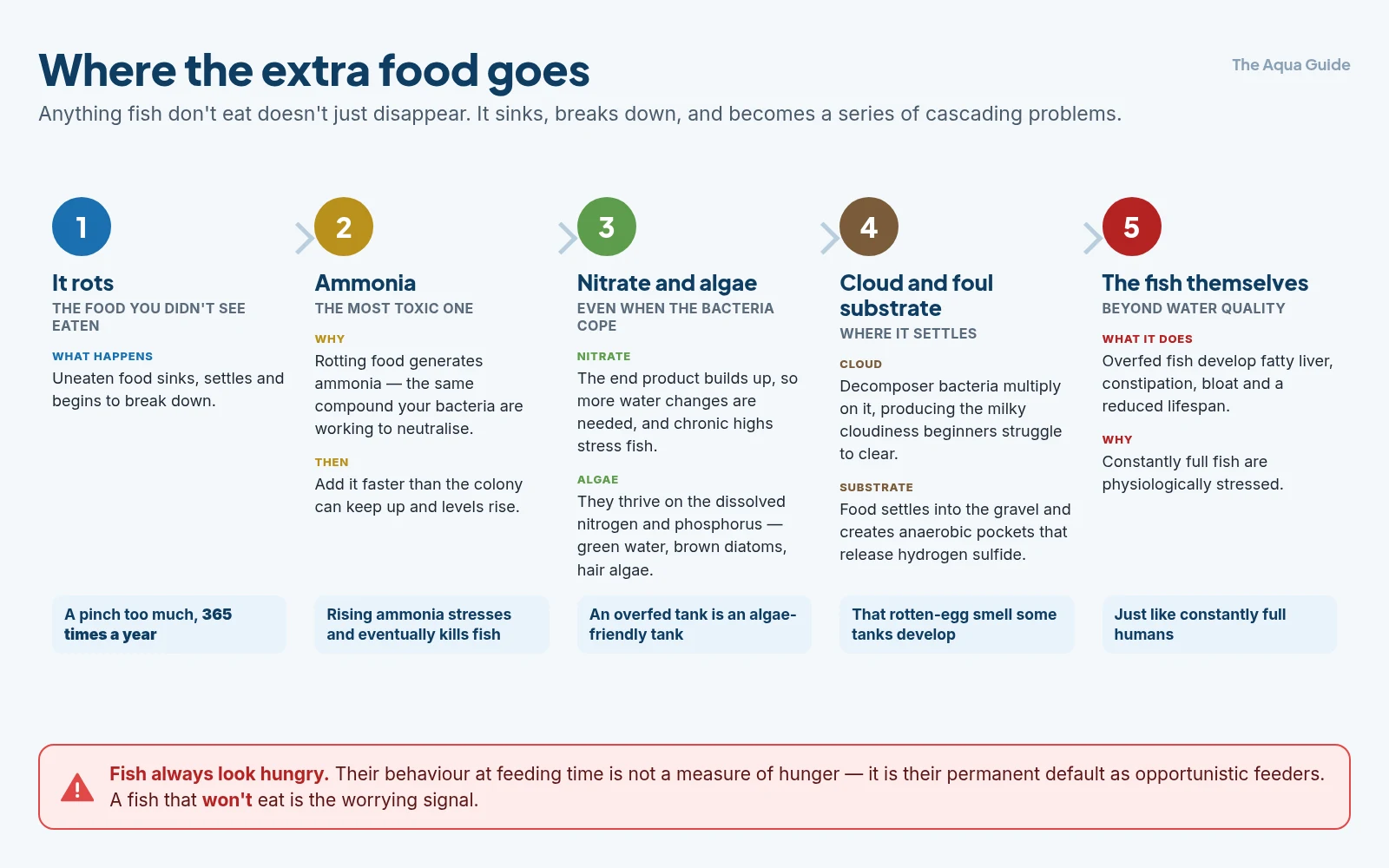
To understand the harm, it helps to follow what happens to that extra food. Anything fish don't eat doesn't just disappear — it sinks, breaks down, and becomes a series of cascading problems.
Decomposing food releases ammonia. As uneaten food rots, it generates ammonia — the most toxic nitrogen compound in your tank, the same one your beneficial bacteria are working hard to neutralize. Add ammonia faster than the bacteria can keep up, and levels rise; rising ammonia stresses and eventually kills fish.
Increased nitrate accumulates. Even when bacteria do convert the ammonia, the end product (nitrate) builds up in the water. Higher nitrate means more frequent water changes needed, and chronically high nitrate stresses fish over time.
Excess nutrients feed algae. Algae thrives on the dissolved nitrogen and phosphorus that uneaten food releases. An overfed tank is an algae-friendly tank — green water, brown diatoms, hair algae, the whole catalog.
Cloudy water from bacterial blooms. Uneaten food on the substrate hosts decomposer bacteria that multiply rapidly, often producing the persistent milky cloudiness beginners struggle to clear.
Substrate fouling. Food settles into the gravel, decomposes, and creates anaerobic pockets that release hydrogen sulfide — the rotten-egg smell some tanks develop, and a sign of seriously fouled substrate.
Fish health issues. Beyond water quality, overfed fish themselves suffer. They develop fatty liver, constipation, bloat, and reduced lifespan. Constantly-full fish are physiologically stressed, just like constantly-full humans.
All of this from a small amount of extra food, repeated day after day. A pinch too much per feeding doesn't seem like much; multiplied by 365 feedings a year, it's a serious load on your tank.
Why It's So Easy to Overfeed
Several factors stack against beginners.
Fish always look hungry. A common observation: "they ate it all immediately, they must be starving!" But fish are opportunistic feeders evolved to grab food whenever it appears. Their behavior at feeding time isn't a measure of hunger — it's their permanent default. They'll eat more whether they need it or not.
Food container directions are too generous. Most fish food packaging recommends feeding 2–3 times a day, "as much as fish will eat in 5 minutes" — almost always too much. Food manufacturers sell more food when you use more food, and that conflict of interest shows in the recommended amounts.
Caring instinct says "more food = more love." Feeding is the most direct way we express care for our fish, so it feels generous to feed well. The intuition is exactly backwards in this case — less food is more caring.
The proportions look tiny. A correct portion for a community tank looks startlingly small — a small pinch of flake. Many beginners feel they can't possibly feed that little and add "just a bit more" out of generosity.
Visible food disappearing fast feels like confirmation. Fast-disappearing food gets read as "they needed it." More often, it means fish are eager (always) and the portion was reasonable — adding more next time then becomes overfeeding.
How to Recognize Overfeeding
The signs are usually present long before fish look obviously sick. Watch for:
Food remaining on the substrate after feeding. A clear signal — and one of the easiest to spot. If you see flakes or pellets on the gravel five minutes after feeding, you fed too much.
Cloudy water that doesn't clear. Particularly persistent cloudiness several weeks into having fish points to overfeeding (or overstocking, which is essentially the same problem from the other direction).
Ammonia or nitrite readings above zero in a cycled tank. If your bacteria can't keep up, your bioload is too high — usually because of overfeeding.
Rapidly climbing nitrate between weekly water changes — much faster than baseline.
Increasing algae despite consistent lighting and reasonable maintenance.
Visible bloating, swollen bellies, or fish floating sideways or upside-down — symptoms of overfed fish suffering digestive issues.
Stringy, white, or trailing fish waste — a sign of digestive distress.
Smelly water — particularly an earthy or sulfurous smell — indicating decomposing organic matter in the substrate.
If you see two or three of these signs, you're almost certainly overfeeding.
The Fix Is Simple
When overfeeding is the problem, the fix is unusually direct: cut your feeding amount roughly in half, watch what happens over a week or two, and adjust.
Specifically:
Reduce portions. Half of what you've been feeding. Yes, half. It will look almost nothing — and that's right.
Drop to one feeding a day if you've been doing two. Or skip every other day for a couple of weeks while things stabilize.
Don't add a "make-up" feeding later if you cut a portion. Stick with the smaller amount.
Do an extra water change in the immediate term to flush out the accumulated nutrients and waste.
Watch the tank improve. Cloudy water clears, algae slows, ammonia normalizes, fish look more active and have better appetite. Within a couple of weeks, you'll see real improvements.
Recalibrate your sense of "the right amount." That small pinch is correct. Trust the 1–2 minute rule, not the urge to feed more.
What to Do When You're Worried Fish Are Hungry
The persistent worry: but they look so eager — won't they starve? No. A few facts that help:
Fish in the wild eat far less than aquarium fish are fed. Wild fish go through feast-and-famine cycles routinely. A fish that's slightly hungry between meals is biologically normal.
Healthy fish should eat eagerly. Eagerness at feeding time means a healthy fish, not a starving one. A fish that won't eat is the worrying signal.
Fish can go days without food. In a well-established tank, fish can go a week or more between feedings without harm. Going hungry for a couple of hours between meals is nothing.
Body condition is the real indicator. A fish that's getting thin, with visible spine or sunken belly, is being underfed. Plump healthy fish with no body-condition issues are being fed plenty. Use body condition — not feeding-time eagerness — as your gauge.
A Useful Mental Reframe
Think of feeding as dosing a chemical into your tank, not just feeding pets. Every pinch you add becomes a small amount of nutrient and waste in the water. The right dose keeps fish nourished without overwhelming the system; the wrong dose creates problems that cascade for weeks. From this angle, "less is more" stops being a slogan and becomes obvious chemistry.
The Bottom Line
Overfeeding is the single most common beginner mistake, responsible for the majority of cloudy water, ammonia, algae, and chronic-stress problems that new tanks experience — because uneaten food becomes waste, decomposes into ammonia, accumulates nitrate, fuels algae, and stresses fish. The harm is real but the fix is simple: feed less, follow the 1–2 minute rule strictly, watch for the signs (food on substrate, cloudy water, rising parameters), and cut portions in half if you see them. Trust that fish need much less food than instinct suggests; their constant eagerness at feeding time isn't hunger, it's their default behavior. Get this right and most beginner tank problems quietly disappear — and that's the whole point.
Related guides
- How often and how much to feed your fish
- Should you fast your fish, and when?
- The beginner's guide to aquarium algae
- Smelly aquarium water: causes and fixes
- What are safe ammonia, nitrite and nitrate levels?
- How many fish can my tank hold?
- How often should you do a water change — and how much?
- The nitrogen cycle, explained
Got questions about your specific setup? Drop them in our Community Forum — we love helping new fishkeepers get started right.