You've set up your tank, cycled it, added plants, chosen your fish, and now comes the day-after-day reality of fishkeeping: feeding and caring for them. This is the part that determines whether your tank thrives long-term, and it's also the part where small habits compound into either steady success or chronic problems. The good news is the daily rhythm is genuinely simple — once you know the principles. This is the hub for everything related to feeding and routine care. Each topic below has its own detailed guide, but by the end of this page you'll have the whole picture.
At a glance: the routine
| How often | What you do |
|---|---|
| Daily | Feed the 1–2 minute portion, then watch for two minutes: fish, behaviour, filter, heater, water level |
| Weekly | Test, then a partial water change with substrate vacuuming. Clean the glass, clear the filter intake |
| Monthly | Rinse the filter media in old tank water, inspect the equipment, run a fuller parameter test |
| Occasionally | A fast day — skip feeding entirely, and don't compensate before or after |
Consistency beats thoroughness. A modest routine you actually keep protects a tank far better than an ambitious one you do twice.
The Two Habits That Matter Most
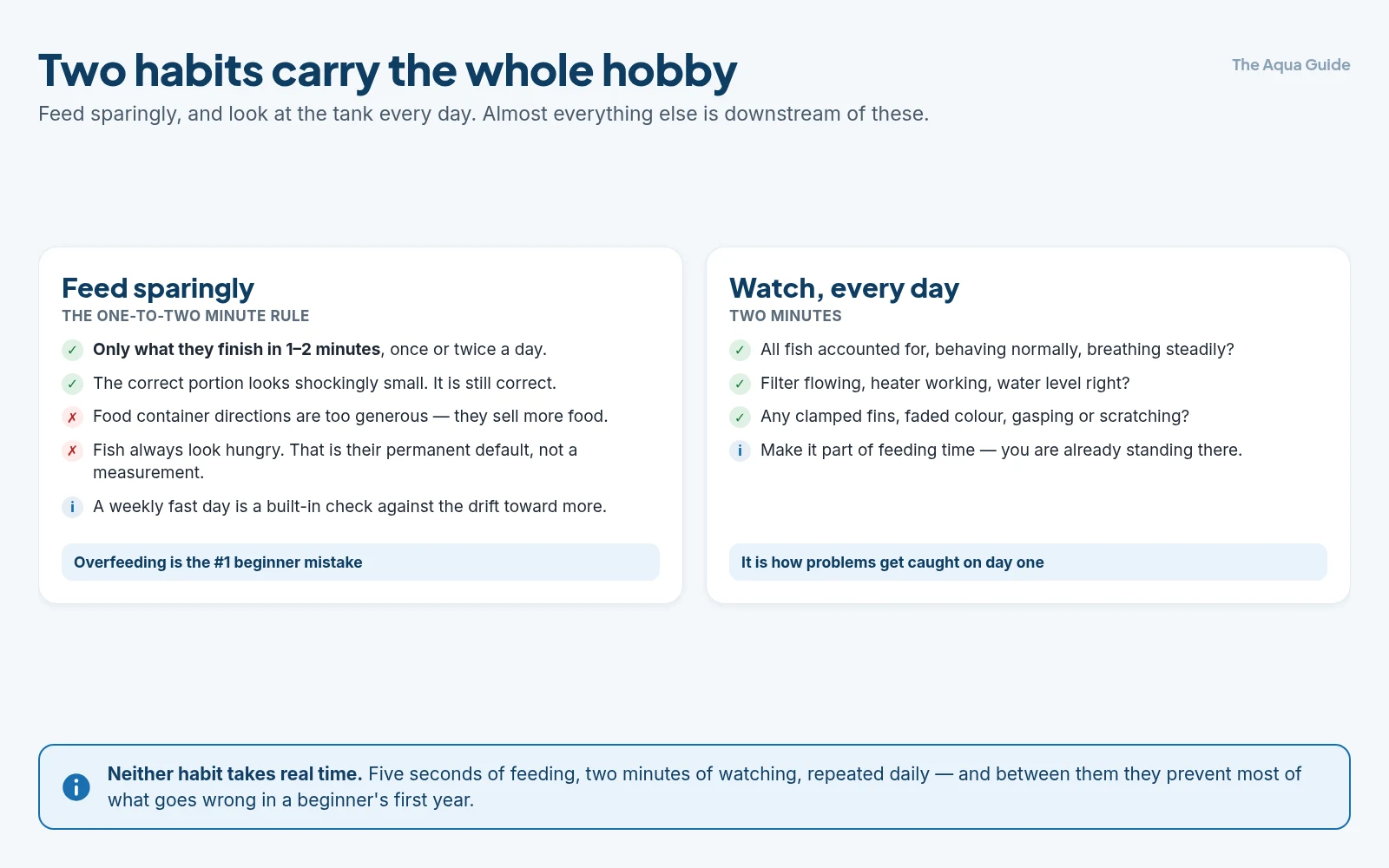
If you internalize just two things from this entire section, make them these:
Feed less than you think you should. Overfeeding is by far the single most common beginner mistake, and it's responsible for more aquarium problems than any other behavior — cloudy water, ammonia spikes, fouled substrate, algae blooms, fish health issues. Fish need much less food than instinct (or the directions on the food container) suggests, and uneaten food becomes waste that overwhelms your tank.
Stay consistent. Fish thrive on routine. Consistent feeding times, consistent maintenance, consistent water changes — these matter more than perfection. A "good enough" routine you actually follow beats an elaborate plan you keep skipping.
Master these two habits and most of the rest falls into place. Everything below is detail.
Feeding: How Much, How Often
The working rule is a small amount eaten within a couple of minutes, once or twice a day. How often and how much to feed covers the amount properly, including how it changes with species and temperature.
Choosing What to Feed
Flake, pellet, frozen and live each suit different fish and different situations. Choosing the right food compares them, and live and cultured foods covers what fry need.
Recognizing Overfeeding
Uneaten food on the substrate, a sudden ammonia reading and persistent cloudiness are the signs. Why overfeeding is the number one beginner mistake explains the chain from extra flake to a stressed fish.
Vacation Feeding
Most adult fish are fine unfed for a week, which is safer than a block feeder or an untrained neighbour. Vacation feeding covers the options and their failure modes.
The Daily Routine
A daily pass is a look, not a task list: fish behaviour, equipment running, nothing obviously wrong. The full schedule across day, week and month is in the daily, weekly and monthly checklist.
The Weekly Routine
The weekly job is the water change, done properly and on schedule — the correct step-by-step water change — at the interval set out in how often and how much.
Monthly Tasks
Filter maintenance and a closer equipment check, both of which have their own traps: see cleaning the filter without crashing the cycle and maintenance schedule templates.
Watching for Healthy vs. Stressed Fish
Behaviour changes before appearance does, which is why the daily look matters. How to spot a healthy vs stressed fish covers what to watch for.
When to Skip a Feeding (Fasting)
A weekly fast day suits many species and is a normal part of care rather than a punishment. Should you fast your fish, and when covers which fish benefit.
The Mistakes Daily Care Prevents
A well-maintained, modest-feeding routine prevents almost all the chronic beginner problems: ammonia spikes (from overfeeding waste), nitrate buildup (from missed water changes), algae blooms (from excess nutrients and inconsistent light), stressed fish (from poor water quality), disease outbreaks (from chronic stress and dirty conditions), and the broad sense of a tank that's "always struggling." Most tanks that constantly battle problems are tanks where the daily and weekly fundamentals slip. Get the basics right and most problems never appear.
The Bottom Line
Feeding and daily care come down to a small set of habits done consistently: feed less than you think you should (what fish finish in 1–2 minutes, once or twice a day), choose appropriate foods for your species, watch carefully for overfeeding signs, do a weekly 20–30% water change with gravel vacuuming, observe your fish daily for two minutes, and clean equipment monthly when needed. Add in the skill of recognizing healthy versus stressed behavior, and you've got everything that goes into long-term aquarium success. The detailed guides in this section take each piece further — but if you internalize "feed less, stay consistent, observe daily," you've already mastered the most important parts.
Related guides
- How often and how much to feed your fish
- Why overfeeding is the #1 beginner mistake
- Choosing the right food: flakes, pellets, frozen, live
- Should you fast your fish, and when?
- Vacation feeding: what to do when you're away
- How to spot a healthy vs stressed fish
- The daily, weekly and monthly maintenance checklist
- The correct step-by-step water change
Got questions about your specific setup? Drop them in our Community Forum — we love helping new fishkeepers get started right.
Daily care, task by task
The two habits above are the whole of it. Each task below is covered properly on its own page.
- How often and how much to feed — the amount, and how it varies
- Choosing the right food — flake, pellet, frozen and live
- Why overfeeding is the number one mistake — the chain from extra flake to ammonia
- Should you fast your fish? — which species benefit, and how often
- Vacation feeding — what to do when you are away
- The maintenance checklist — daily, weekly and monthly
- Maintenance schedule templates — ready-made schedules to adapt
- The correct water change — the weekly job, done properly
- Water change frequency — how much, how often
- Cleaning the filter — without losing the bacteria
- Healthy vs stressed fish — what the daily look is for