In the fishkeeping community, you'll often hear keepers recommend a weekly "fast day" — a day with no feeding at all. To beginners, the idea of deliberately not feeding seems strange, even cruel. Surely fish need to eat every day? Actually, no — and a regular fast can genuinely benefit your fish and your tank. Here's the case for fasting, when it makes sense, when it doesn't, and how to do it.
At a glance: how often to fast
| Pattern | What it looks like | Who it suits |
|---|---|---|
| Weekly | Six days of feeding, one day of fasting — the same day each week | The reasonable default for beginners: easy to remember, real benefits, and not aggressive enough to harm |
| Every two weeks | The lower-impact version | Anyone who doesn't want to fast weekly |
| Monthly | Minimal, but still beneficial | A light touch |
| Not at all | Fed every day | Fine for healthy fish if portions are correct, but loses the digestive rest |
Sunday is a common choice, because it lines up with the weekly water change when you are already paying attention to the tank. A day without food is a day without new waste — across a year that is 52 days of reduced bioload.
Why Fasting Helps
Fasting works with fish biology, not against it. A few reasons it's beneficial:
Fish are evolved for intermittent feeding. In the wild, fish don't eat three measured meals a day — they go through cycles of feast (when food is plentiful) and famine (when it isn't). Their digestive systems and metabolism are built for this rhythm. Aquarium feeding, by contrast, is uniformly abundant — which can lead to chronic minor overfeeding and digestive issues.
Fasting gives the digestive system a rest. Fish eating constantly never empty their digestive tract fully. A periodic fast day lets them clear their system, reducing the chance of constipation, bloat, and digestive problems. Many fish that struggle with bloat or "swim bladder issues" improve markedly with a fast day.
It reduces tank bioload. A day without food is a day without new waste being added. Your bacteria, plants, and water get a slight breather. Across a year, that's 52 days of reduced bioload — meaningful for tanks that run close to capacity.
It encourages natural foraging behavior. On fast days (or in the day after), fish search the tank more actively for any natural food (biofilm, micro-organisms, plant matter). This is normal natural behavior and often makes fish more interesting to watch.
It can prevent overfeeding habits. A weekly fast day is a built-in reset against the human tendency to overfeed. If you fast on Sunday, you're effectively reducing the weekly food total — usually a good thing.
How Often to Fast?
The most common recommendation is one fast day per week. Some keepers do every other week. Some don't fast at all. There's no single right answer, but here are the main approaches:
Weekly fast day — once a week, completely skip feeding. Pick the same day each week (Sunday is a common choice — it lines up with the weekly water change, when you're already paying attention to the tank). Six days of feeding, one day of fasting.
Bi-weekly fast day — every two weeks, skip feeding. Lower-impact version for those who don't want to fast weekly.
Monthly fast day — once a month. Minimal but still beneficial.
No fasting — fed every day. Fine for healthy fish if portions are correct, but loses the digestive-rest benefit.
For beginners, weekly is a reasonable default. It's easy to remember (the same day every week), gives real benefits, and isn't aggressive enough to harm fish.
Which Fish Should Fast (and Which Shouldn't)?
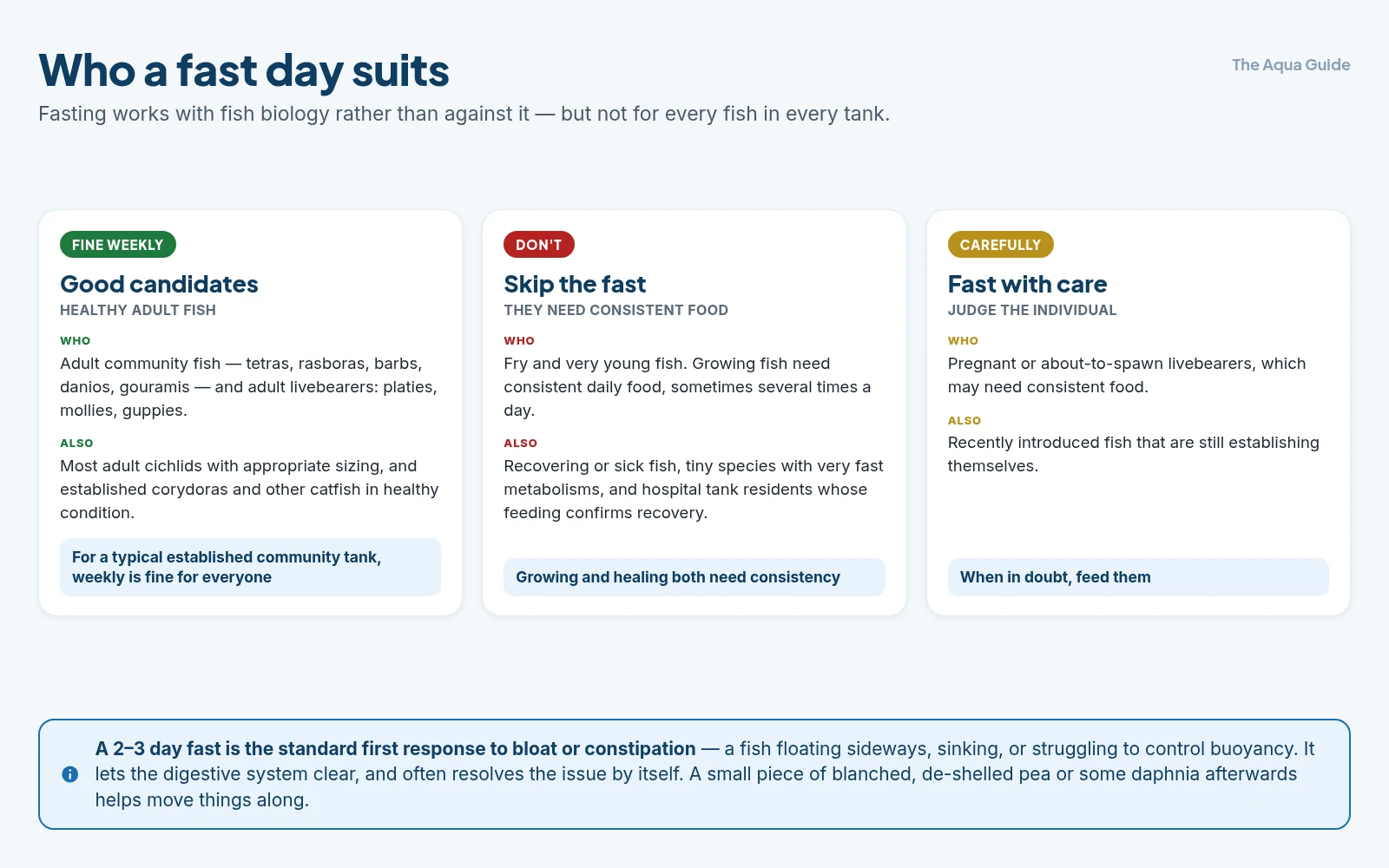
Fasting suits most adult community fish, but a few specific cases warrant care.
Good candidates for fasting:
- Adult community fish (tetras, rasboras, barbs, danios, gouramis, etc.)
- Adult livebearers (platies, mollies, guppies)
- Most adult cichlids, with appropriate sizing
- Established corydoras and other catfish in healthy condition
Don't fast — or fast less aggressively:
- Fry and very young fish. Growing fish need consistent daily food, sometimes multiple times a day. Don't fast them.
- Recovering or sick fish that need consistent nutrition to heal.
- Tiny species with very fast metabolisms. Some very small species (chili rasboras, certain killifish) can be more sensitive to long gaps.
- Hospital tank residents who need observable feeding to confirm recovery.
Fast carefully:
- Pregnant or about-to-spawn livebearers may need consistent food
- Recently-introduced fish that are still establishing themselves
For the typical established community tank with adult fish, a weekly fast day is fine for everyone.
What Happens on Fast Day
Practically nothing. That's the point. The routine:
- Skip the feeding. That's literally it.
- Don't compensate with extra food before or after. A fast is undermined if you "make up" for it with double portions surrounding it.
- Observe normally. Fish are typically a bit more active and exploratory on fast days, often picking at biofilm and plants.
- Resume normal feeding the next day with your usual portion. Not extra; just normal.
Fish typically don't show distress on fast days. They might come up to the surface expectantly at usual feeding time, but they handle the missed meal without issue.
Common Concerns
A few worries that come up:
"Won't they be hungry?" Yes, slightly. That's healthy. A slightly hungry fish is biologically normal — wild fish are routinely hungrier than well-fed aquarium fish. Brief hunger is not harm.
"Won't they eat each other / eat plants / eat shrimp?" A regular fast day doesn't suddenly turn peaceful community fish predatory. Aggressive or predatory species may indeed get more active foraging — but if they were going to eat tankmates, they'd already be doing it. Fast days don't change the underlying behavior.
"Won't they lose weight?" Healthy fish handle weekly fast days with no measurable weight or condition impact. They're not dieting; they're just having one normal-rhythm day per week instead of constant abundance.
"Doesn't this feel cruel?" Only by mammalian standards. From a fish's perspective, it's the most natural feeding pattern they could experience.
Fasting and Treatment
A few situations where fasting plays a specific role:
Treating constipation or bloat. If a fish is bloated, constipated, or having swim bladder issues (floating sideways, sinking, struggling to control buoyancy), a 2–3 day fast is the standard first response. It lets their digestive system clear. Often this alone resolves the issue. Sometimes a small piece of blanched de-shelled pea or daphnia after fasting helps move things along.
After fighting or stress. Fish that have been through stressful events (transport, fighting, tank changes) often don't eat well anyway — and a day or two of fast lets them recover without uneaten food fouling the water.
During medication treatments. Some treatments work better with reduced feeding to keep water quality high while medications are active.
These are situational uses on top of (or in addition to) the routine weekly fast.
When Fasting Goes Wrong
The main way to misuse fasting:
Fasting too long or too often. A weekly or bi-weekly fast day is fine. Fasting frequently — multiple days per week, or week-long fasts repeatedly — does start to harm fish, particularly smaller species. Stick to occasional fast days, not extended starvation.
Fasting unhealthy fish unnecessarily. Sick, recovering, or struggling fish typically need consistent nutrition to heal. Don't fast them as routine.
Fasting fry or actively-growing fish. They need consistent feeding.
If you're fasting once a week for healthy adult community fish, none of these issues apply.
A Simple Weekly Schedule
Combining fasting with the normal routine:
- Monday–Saturday: normal feeding (1–2 times per day, 1–2 minute portions)
- Sunday: fast day. No food.
- (And do your weekly water change on Sunday too, while everyone's a bit hungrier and more attentive.)
That's the whole arrangement. Easy to remember, easy to do, and your fish benefit.
The Bottom Line
Fasting your fish once a week is a small, easy, beneficial practice with real upside: it gives the digestive system a rest, reduces tank bioload by ~14%, encourages natural foraging behavior, and acts as a built-in check against overfeeding habits. Pick a day (Sunday is common), skip feeding, don't compensate before or after, and resume normally the next day. It's fine for healthy adult community fish; skip fasting for fry, sick fish, or very tiny species with fast metabolisms. The 2-day fast also doubles as the standard first response to bloat or constipation. If "deliberately not feeding" felt strange when you started reading this — that's exactly the kind of instinct that drives overfeeding. A weekly fast day quietly improves nearly every aquarium it's added to.
Related guides
- How often and how much to feed your fish
- Why overfeeding is the #1 beginner mistake
- Vacation feeding: what to do when you're away
- Choosing the right food: flakes, pellets, frozen, live
- How to spot a healthy vs stressed fish
- Aquarium medications: when to use what
- Setting up and using a hospital tank
- The beginner's guide to feeding and daily care
Got questions about your specific setup? Drop them in our Community Forum — we love helping new fishkeepers get started right.