Walk into the fish food aisle and you'll see flakes, pellets, granules, wafers, freeze-dried cubes, frozen blocks, and live foods — plus dozens of "specialty" formulas marketed for color, growth, health, breeding, and more. What do your fish actually need? Here's a practical guide to choosing the right foods, with a focus on what genuinely matters versus what's marketing.
At a glance: flakes or pellets?
| Flakes | Pellets and granules | |
|---|---|---|
| What they are | Thin, light flakes that float at the surface and slowly sink | Denser discs or balls, in many sizes, floating or sinking |
| Best for | Top and mid-water feeders | Larger or messier fish eat them more cleanly — and bottom-dwellers need the sinking sort |
| Portioning | Easy to portion in small amounts | Easier to portion precisely |
| In the water | Dissolve quickly if not eaten, and the smallest can be too small for larger fish | Hold their shape better than flakes |
For most beginner community tanks either works. A common approach is mostly pellets or granules as the staple, with small flake as a supplement or for small surface-feeding fish.
Start With a Good Staple
The foundation of fish feeding is a single high-quality staple food that meets daily nutritional needs. For most community fish, that's either flake food or pellet/granule food — formulated as complete nutrition for everyday use.
What makes a staple food good is straightforward:
- Quality protein source listed first in the ingredients (fish meal, shrimp meal, krill — not "fish meal byproducts" or unidentified protein).
- Reasonable variety of ingredients — vitamins, minerals, some vegetable content.
- Appropriate size for your fish — small flakes/granules for tetras and small fish; larger pellets for bigger fish.
- Sinking or floating to match your fish (top-feeders need floating; mid-water fish take either; bottom-feeders need sinking).
You don't need to spend extravagantly — mid-range named brands are typically excellent. The cheapest unbranded foods often have lower-quality ingredients and more fillers; the most expensive boutique foods are often only marginally better than mid-range. A good mid-range staple is the sensible choice.
Flakes vs. Pellets: Which Should You Use?
Both work; the right pick depends on your fish.
Flakes are the classic choice — thin, light flakes that float at the surface and slowly sink. Good for top and mid-water feeders, easy to portion in small amounts, widely available. The downside: they can dissolve quickly if not eaten, and the smallest flakes can be too small for larger fish.
Pellets and granules are denser little discs or balls, available in many sizes. They hold their shape better than flakes, are easier to portion precisely, and come in floating or sinking varieties. Larger or messier fish often eat pellets more cleanly. Bottom-feeders need sinking pellets specifically.
For most beginner community tanks, either works fine. A common approach is mostly pellets/granules as the staple (less mess, easier to gauge portions) with small flake as a supplement or for small surface-feeding fish.
Feeding Bottom-Dwellers
This is where many beginners go wrong. Corydoras, otocinclus, plecos, loaches, and other bottom-dwellers can't easily reach floating flakes — most of the food is eaten before it sinks. Solution: include sinking pellets, wafers, or granules in your feeding routine.
A small piece of an algae wafer or sinking shrimp pellet at lights-out (or a few times a week) gives bottom-dwellers food they can find on the substrate. Make sure they actually find and eat it — if it's still there hours later, you've fed too much.
Important: feeding bottom-dwellers is part of your total daily food, not extra. Don't feed full portions of flake plus full portions of sinking food — that's double-feeding. Split the total appropriately.
Frozen Foods: The Best Supplement
Beyond your daily staple, frozen foods are the highest-value supplement for most community tanks:
Frozen bloodworms — small red larvae, eagerly eaten by most community fish. Excellent protein boost. Many fish that pick at flakes go crazy for bloodworms.
Frozen brine shrimp — small, easily digested, suitable for almost all fish. Often used as a treat or a feeding for picky eaters.
Frozen daphnia — small crustaceans, good roughage, said to help with constipation.
Frozen mysis shrimp — larger meaty shrimp, good for medium-to-large fish.
Frozen foods are sold in trays of small cubes that you thaw before feeding. A small portion of one cube, once or twice a week, is plenty — they're treats, not staples. Don't dump in a whole cube unless you have many fish. Thaw the small amount in tank water first, then drop in.
The benefit: frozen foods are very close to natural food in form and nutrition, and most fish respond strongly. They also boost color, energy, and breeding behavior. Two frozen feedings a week is a good practical schedule.
Freeze-Dried Foods
Freeze-dried versions of the same foods (bloodworms, brine shrimp, krill, tubifex) are shelf-stable and convenient. They're a reasonable middle option between flakes and frozen — easier to store than frozen, but less appealing than fresh-thawed frozen to most fish.
One important note: soak freeze-dried foods in tank water briefly before feeding. Dry freeze-dried foods can cause digestive issues — particularly bloat — in fish that eat them directly. A 30-second soak rehydrates them and prevents this.
Live Foods
Live foods (live bloodworms, brine shrimp, daphnia, blackworms) are the most natural food fish can eat, and they trigger strong feeding responses. They're also more expensive, harder to source, harder to keep alive at home, and they carry some disease risk if not from reliable sources.
For a beginner, live foods aren't necessary — frozen versions of the same foods give most of the benefit without the hassle. As you advance, especially if breeding or keeping picky species, live foods become more relevant. Many keepers culture their own (brine shrimp from eggs, daphnia in a separate container) as a sustainable food source.
Vegetable Foods for Herbivores
Some fish need significant plant matter:
Plecos and many catfish thrive on algae wafers, blanched vegetables (zucchini, cucumber, spinach), and vegetable-based pellets.
Some species (silver dollars, mollies, certain barbs) appreciate vegetable matter in their diet.
If you keep herbivorous or omnivorous fish that lean plant-eater, include vegetable-based foods regularly. A piece of blanched zucchini clipped to the tank wall is a popular standby, eaten over a day or two, then removed before it fouls the water.
Specialty Foods: Mostly Optional
The fish food aisle is full of specialty foods:
Color-enhancing foods contain pigments (typically astaxanthin and carotenoids) that boost reds and oranges in fish. They work, modestly, for fish whose color is genetically capable of being enhanced. A reasonable occasional supplement, not a must.
Growth foods are high-protein formulas marketed for breeders and young fish. Useful for that specific purpose, otherwise overkill.
Pre-conditioning foods, breeder foods, hospital foods, etc. — niche tools for specific purposes. Most beginners don't need these.
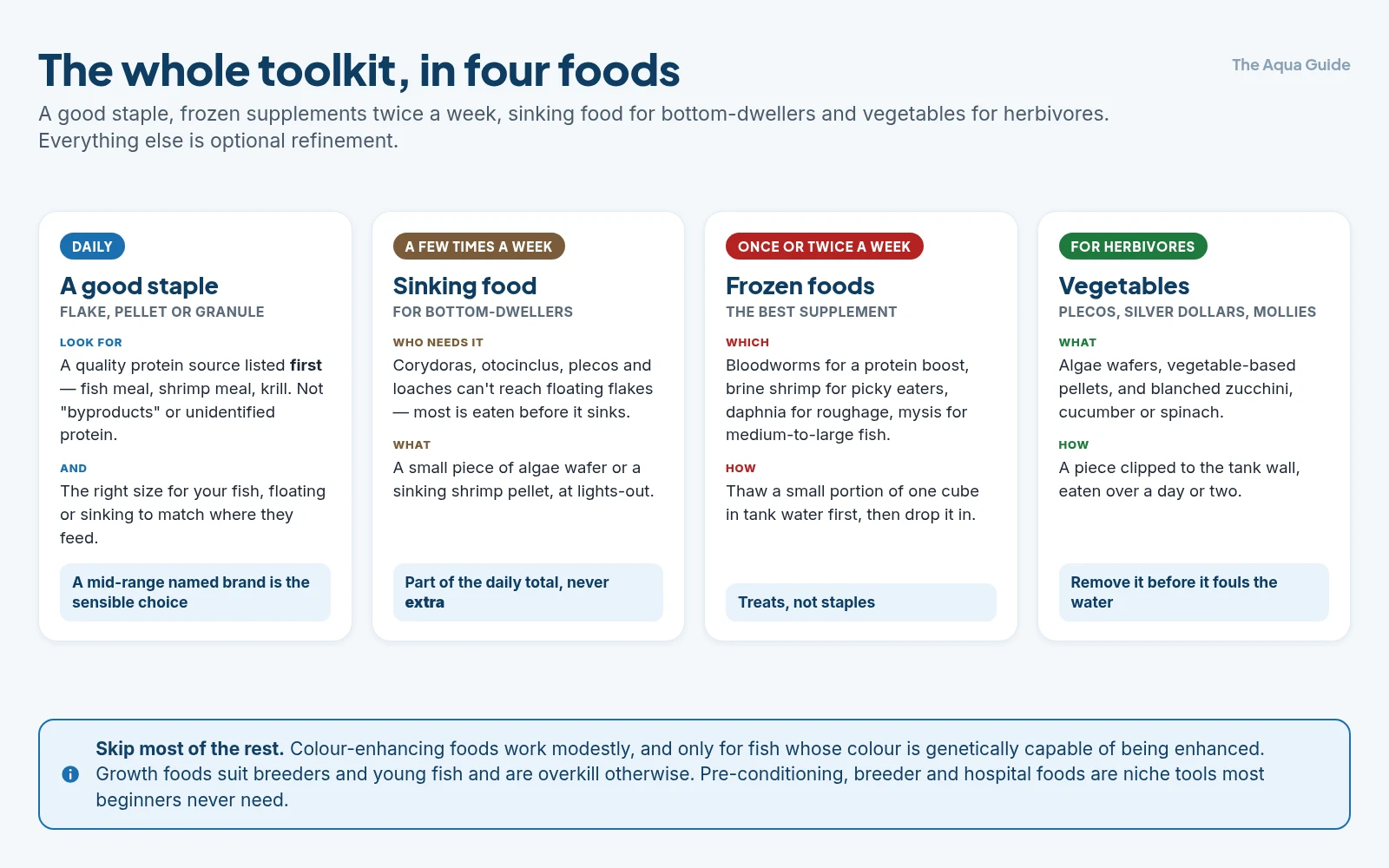
The honest summary: a good staple food, plus frozen supplements twice a week, plus appropriate sinking food for bottom-dwellers, plus vegetables for herbivores — that's the full nutritional toolkit for most community tanks. Everything else is optional refinement.
Storage Matters
Fish food loses nutritional value over time, especially after opening. A few practices that help:
- Buy smaller containers if you have a small tank — a large container will go stale before you finish it.
- Store in a cool, dry place — not in direct sun or above a heat-producing appliance.
- Replace flake containers every 6 months or so even if not empty — vitamins degrade.
- Keep frozen foods properly frozen and use within their freezer life.
A fresher, smaller container of food beats a stale large one.
A Practical Weekly Schedule
A simple workable feeding plan for a community tank:
- Daily: small portion of high-quality flake or pellet staple, once or twice a day, 1–2 minute rule.
- Once or twice a week: small portion of thawed frozen bloodworms or brine shrimp as a treat.
- A few times a week: small sinking pellet or piece of algae wafer for bottom-dwellers (counted in the day's total feeding).
- For herbivores: a small piece of blanched vegetable, attached to the tank, replaced every day or two.
- Optional: one fast day per week (covered elsewhere).
This rotation gives variety, covers all fish types, and remains within the modest portions that keep your tank healthy.
The Bottom Line
Build your feeding routine on a good high-quality staple flake or pellet — sized appropriately for your fish and chosen based on whether they're top, mid, or bottom feeders — and supplement with frozen foods (bloodworms, brine shrimp) once or twice a week as a treat. Include sinking food for bottom-dwellers (as part of the total daily portion, not in addition), vegetables for herbivores, and rotate variety modestly. Skip the niche "color-enhancing" and growth supplements unless you specifically need them, and replace your staple food container every 6 months for freshness. Good nutrition for fish is simpler than the food aisle suggests: a quality staple, occasional frozen variety, and the right form for each fish.
Related guides
- How often and how much to feed your fish
- Why overfeeding is the #1 beginner mistake
- Should you fast your fish, and when?
- Live and cultured foods for fry
- The beginner's guide to feeding and daily care
- Community tank compatibility: what gets along
- Vacation feeding: what to do when you're away
- How to spot a healthy vs stressed fish
Got questions about your specific setup? Drop them in our Community Forum — we love helping new fishkeepers get started right.