You can have a tank full of "peaceful" fish that nevertheless turns into a stressful, conflict-ridden setup — because compatibility is about more than just "peaceful vs. aggressive." It's also about activity level, water-column space, temperament, and tank-size needs. Here's how to actually evaluate whether two species will get along, the common compatibility traps beginners fall into, and a framework for building a community that works.
Which fish can live together in a community tank?
Compatibility is more than peaceful versus aggressive: match activity levels, keep fin-nippers away from long-finned fish, spread the stocking across top, middle and bottom, match adult sizes so nobody becomes a meal, give every schooling species a group of at least six, and check that all of them want the same water conditions. Three species in proper groups make a better community than six species kept in pairs and singles.
At a glance: the traps that come up over and over
| The trap | What happens |
|---|---|
| Long-finned fish with known fin-nippers | Tiger barbs with angelfish or bettas; serpae tetras with guppies. Ragged tails and stress within days |
| Fast active fish with slow shy fish | Zebra danios with bettas; active barbs with timid corydoras. The slow fish hides constantly and doesn't eat well |
| Territory-holders with anything in their territory | Many cichlids defend their patch from peaceful tankmates that wander in — and so do male bettas |
| Big fish with small fish that fit in their mouths | A peaceful fish whose mouth opens wide enough will eat your tetras at night, however docile it seems by day |
| Under-schooling a schooling species | Three tetras "to see how they do" become stressed and sometimes nippy. Always 6+, from day one |
| Mismatched water requirements | One species wanting soft acidic, another hard alkaline. Both survive your tap water; neither thrives, and disease risk rises |
| Too many species, too few of each | Singletons of schooling species are stressed, and pairs aren't enough |
If two species you want both carry warnings against each other, believe the warnings. And check the label's claim against at least two reliable sources, not the store's.
Compatibility Is More Than "Peaceful"
The label "peaceful community fish" gets attached to a huge range of species, but they don't all behave the same way. Real compatibility depends on several factors stacking together.
Temperament. Some fish are calm and slow-moving; others are calm but boisterous and busy. A frantic, fin-nipping zebra danio is technically "peaceful" — it won't kill anyone — but its constant darting energy stresses calm, slow species like bettas, gouramis, or fancy guppies. Match general activity levels.
Fin-nipping tendency. Several otherwise-peaceful species are notorious fin-nippers: tiger barbs, serpae tetras, some larger tetras in too-small groups, and various others. They'll nip long-finned tankmates (bettas, fancy guppies, angelfish) into shredded misery. Avoid mixing fin-nippers with long-finned species.
Water-column zone. Top-dwellers, mid-swimmers, and bottom-dwellers compete less with each other than with their own zone-mates. Stuffing the middle with five species while leaving the bottom empty creates pressure; spreading species across zones reduces it.
Adult size mismatch. Even "peaceful" larger fish will eat smaller ones if the size gap is big enough. A general guide: tankmates should be similar enough in size that no one views anyone else as food. A 6-inch peaceful fish in with 1-inch neons may eat the neons regardless of personality.
Schooling needs. Schooling fish kept alone or in inadequate groups (1–3 instead of 6+) get stressed and become nippy or aggressive toward other species — a peaceful school becomes a problem school if undersized.
Water conditions overlap. Two species that both prefer soft acidic water are compatible for water. Two species, one needing soft acidic and one needing hard alkaline, are not — even if both are peaceful, one will struggle. Match conditions, not just temperaments.
The Common Compatibility Traps
The mistakes that come up over and over.
Mixing long-finned fish with known fin-nippers. Tiger barbs with angelfish or bettas. Serpae tetras with guppies. The long-finned fish gets ragged tails and stress within days.
Mixing fast active fish with slow shy fish. Zebra danios with bettas. Active barbs with timid corydoras. The slow fish hides constantly and doesn't eat well.
Mixing aggressive territory-holders with anything in their territory. Many cichlids will defend their patch from peaceful tankmates that wander into it. Some otherwise-peaceful fish (like male bettas) defend territory aggressively too. Always check territorial behavior, not just "aggressive vs. not."
Putting big fish with small fish that fit in their mouths. A peaceful fish whose mouth opens wide enough for your tetras will eat your tetras at night, no matter how docile it seems by day. Size compatibility matters.
Under-schooling schooling fish. Buying three tetras "to see how they do" and ending up with stressed, sometimes nippy fish. Always 6+ of any schooling species, from day one.
Mismatched water requirements. Stocking a tank with one species that wants soft acidic water and another that wants hard alkaline. Both can technically survive your medium tap water, but neither thrives, and disease risk goes up.
Too many species, too few of each. A tank with eight species in pairs is worse than the same tank with three species in proper groups. Singletons of schooling species are stressed; pairs aren't enough.
The Three-Layer Framework
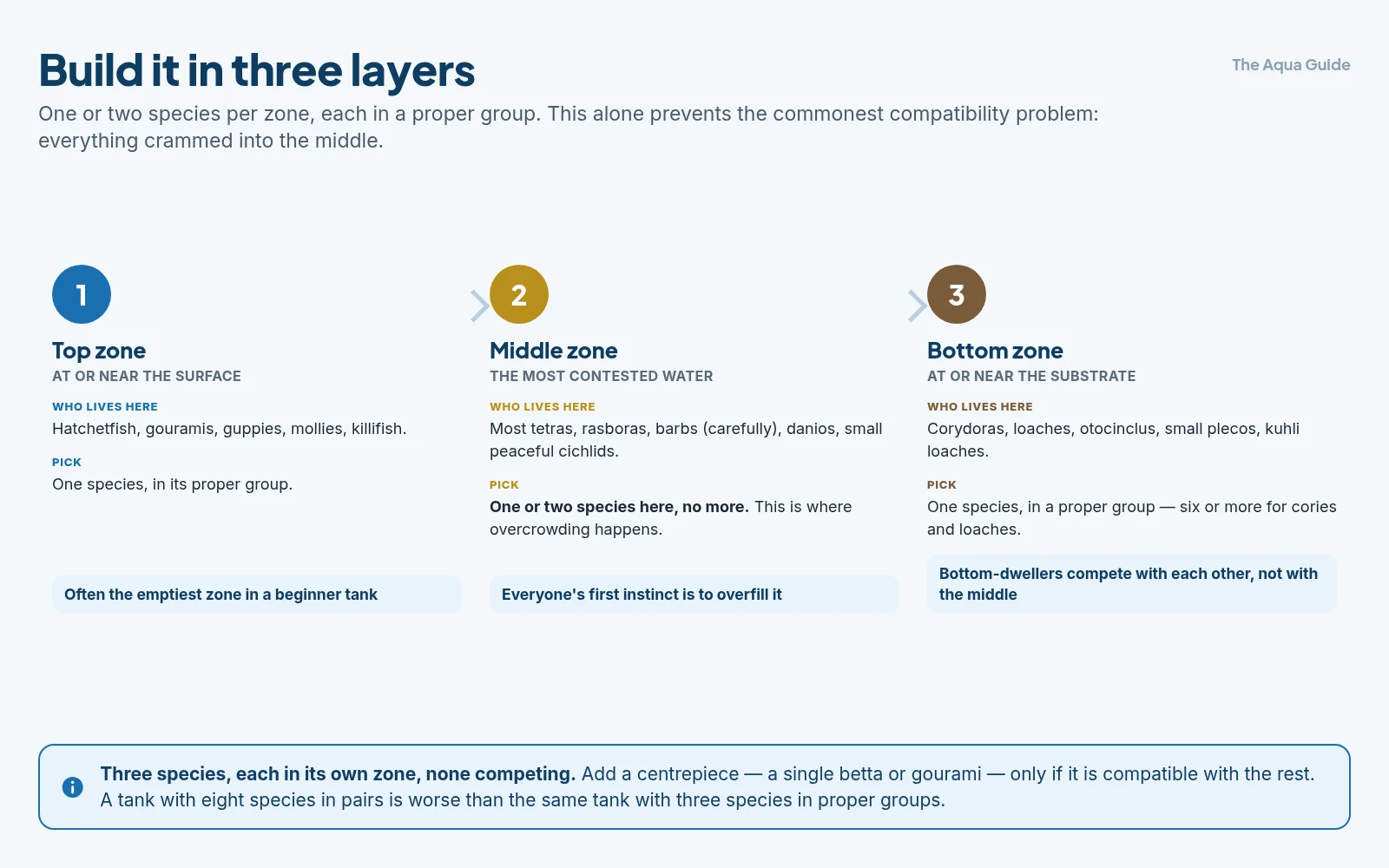
A useful structure for building a community is to plan stocking across the three water-column zones, with one or two species per zone, in proper groups.
Top zone (surface or upper water): hatchetfish, gouramis, guppies, mollies, killifish. These fish hang out at or near the surface.
Middle zone: most tetras, rasboras, barbs (carefully), danios, small peaceful cichlids. The most contested zone — pick one or two species here, no more.
Bottom zone: corydoras, loaches, otocinclus, small plecos, kuhli loaches. Lives at or near the substrate.
A balanced community might pick one schooling species for the middle, one species for the top, and one species (in a proper group) for the bottom — three species, each in their own zone, none competing. Add a centerpiece fish (a single betta or gourami, for instance) only if compatible with the rest.
This structure prevents the most common compatibility problem of all: too many species crammed into the middle zone, all competing for the same space.
Researching Compatibility Properly
Before buying any fish, look it up — not on the store label, but on at least two reliable sources. Note especially:
- Adult size (current size is misleading)
- Group size required for the species
- Temperament beyond the simple "peaceful" label — is it active, shy, territorial?
- Water-column zone preference
- Water parameter range it actually needs
- Specific compatibility warnings ("known fin-nipper", "predatory on small fish", "needs species-only tank", etc.)
If two species you want both have warnings against each other, believe the warnings. If they have different water requirements, pick one direction or find species that overlap.
Watching Your Community
Once stocked, watch for the signs that compatibility is wrong: persistent hiding by one species (stress); fin damage appearing on long-finned fish (nipping); one fish dominating feedings while others can't get food; frequent chasing or harassment; gradual weight loss or lethargy in any species. Small amounts of normal hierarchical behavior between fish are fine; chronic harassment or visible stress signals a real problem and usually means rehoming or rearranging.
When to Separate
Sometimes compatibility just doesn't work out, even when the research suggested it should — fish have individual personalities, and aggression can develop unexpectedly. The right response is to act before things escalate: separate the troublemaker, rehome it, or restructure your community. Tolerating ongoing harm "hoping it'll settle down" rarely works; the harassed fish weakens and the harasser doesn't change.
The Bottom Line
Community tank compatibility is about more than the simple "peaceful vs. aggressive" binary — it's about matching activity levels (don't mix frantic with slow), avoiding fin-nippers with long-finned species, spreading stocking across top/middle/bottom water-column zones, matching adult sizes so no one is a meal for someone else, providing proper schooling group sizes (6+ of each schooling species), and ensuring all your fish want similar water conditions. Avoid the common traps — barbs with angels, danios with bettas, under-schooled tetras, big-fish-little-fish mismatches — and research each species' adult size, temperament, group needs, and warnings before adding it. Plan as a three-species community in proper groups rather than a six-species menagerie of pairs and singles, and watch for the real-world signs of compatibility problems once stocked. Get this right and your community is calm, your fish are healthy, and the tank works as a coherent display rather than a stressed collection.
Related guides
- Fish compatibility quick reference
- Schooling vs shoaling: how many of each species?
- How many fish can my tank hold?
- Beginner-friendly fish species
- The beginner's guide to choosing fish
- How to spot a healthy vs stressed fish
- Understanding pH, KH and GH
- How to acclimate new fish properly
Got questions about your specific setup? Drop them in our Community Forum — we love helping new fishkeepers get started right.