You've set up your tank, cycled it, added plants, and now comes the part everyone is actually waiting for: putting fish in it. This is also the part where the most preventable mistakes happen — wrong species for the setup, too many at once, incompatible roommates, or beautiful fish that turn out to need a tank twice the size. The good news is choosing fish well isn't complicated; it just takes thinking through a few questions in the right order. This is the hub for everything fish-selection. Each topic below opens into a more detailed guide, but by the end of this page you'll know how to choose fish that will actually thrive in your tank.
How do I choose the right fish for my aquarium?
Ask three questions before every purchase: will this fish thrive in my water and tank size, will it get along with what is already in there, and do I have room for its adult size and its group needs. Plan the whole stocking as one community across the top, middle and bottom of the tank rather than buying one fish at a time.
Three Questions Before You Buy Anything
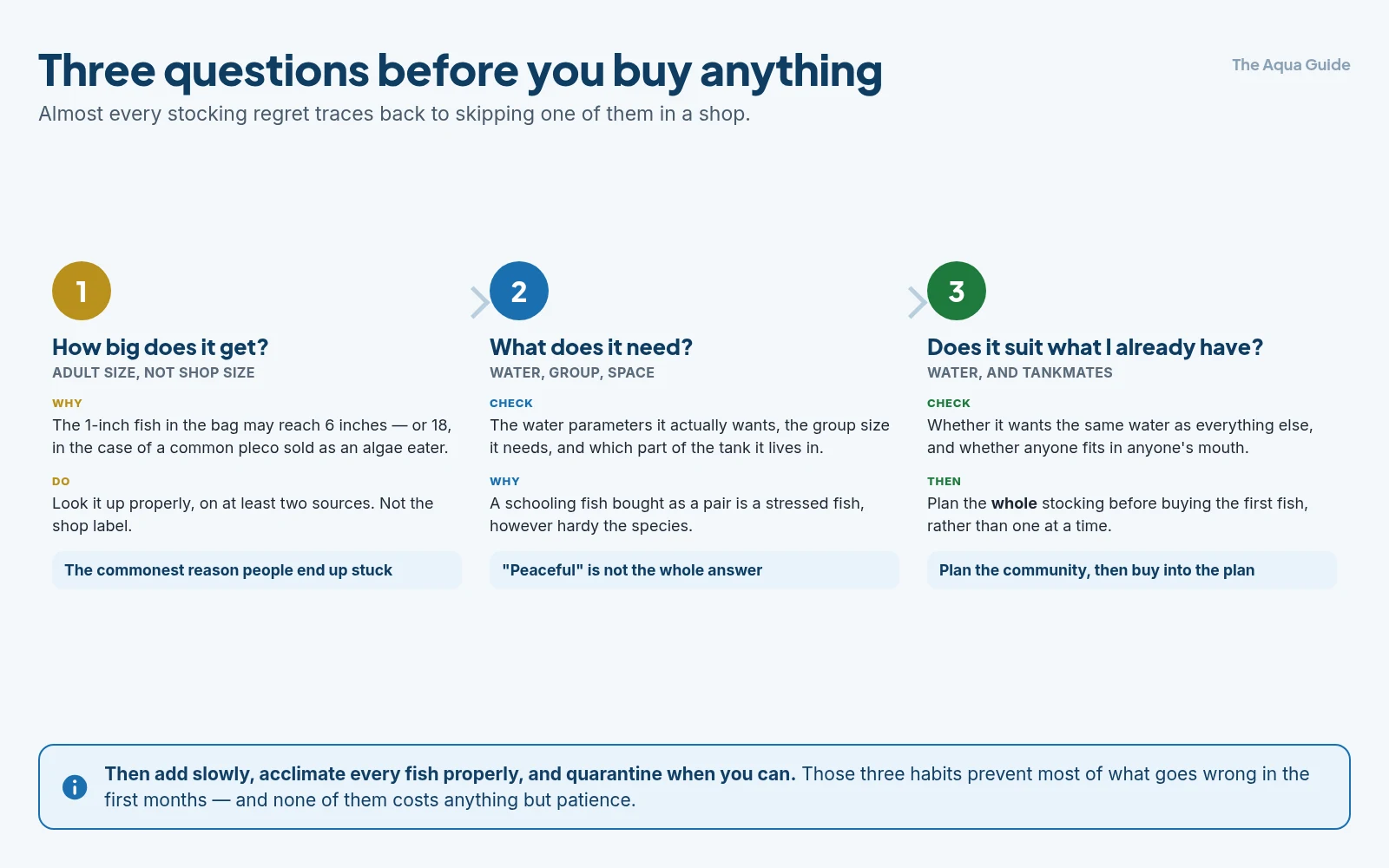
The single best habit you can develop is asking three questions about every fish that catches your eye, before you put it in your cart.
Is this fish suited to my water and tank size? Every species has needs — temperature range, water hardness, swimming room, group size. A fish whose needs don't match your setup will struggle no matter how careful you are. This is why so many beginner heartbreaks happen with fish that were never going to work in the tank they were put in.
Will this fish get along with what I already have (or plan to have)? Compatibility isn't just "peaceful vs. aggressive." It's also about activity level, water-column preference, and stress dynamics. A peaceful but boisterous fish can still ruin life for a shy, slow one. (Community tank compatibility is its own detailed topic.)
Do I have room for this fish at its adult size and in the group size it needs? A 1-inch baby fish at the store may grow to 6 inches. A schooling fish needs 6+ of its own kind to feel safe — so it's not "one fish," it's "a school." Account for the real tank load, not the cute small version you see today. (Stocking limits and schooling/shoaling deserve their own guides.)
If you can answer "yes" to all three for a particular species, it's a real candidate. If any answer is "no" or "I'm not sure," do more research before buying.
At a glance: popular fish that aren't beginner fish
| Sold as easy | Why it isn't |
|---|---|
| Goldfish | Messy, waste-heavy, and they grow large. The bowl image is badly wrong |
| Common plecostomus | Sold small as an algae eater; reaches 18+ inches and produces enormous waste |
| Bettas in small bowls | Bettas can be wonderful pets — the "betta in a cup" marketing is what's misleading |
| Oscars, Jack Dempseys and other large cichlids | Personable and intelligent, and 12+ inches of highly aggressive fish |
| Discus | Beautiful, but picky about parameters, disease-sensitive, expensive and unforgiving |
| Wild-caught oddities | Specialty needs that aren't obvious from a quick look in a shop |
Being cheap and available everywhere is not the same as being easy. Several of the most commonly sold species are on this list for exactly that reason.
Start With Hardy, Beginner-Friendly Species
The advice given to every beginner is good advice: start with hardy species that tolerate the inevitable bumps of a new tank. Even with a cycled tank, beginners are still learning maintenance rhythms, feeding habits, and parameter management — and fragile or demanding fish suffer most when those bumps happen.
Classic beginner-friendly choices include common community fish that are widely available, peaceful, adaptable to a range of conditions, and forgiving of imperfect care: things like various tetras, common platies and mollies, peaceful corydoras catfish, certain rasboras, and a handful of other forgiving species. (Specific beginner species recommendations have their own guide.)
Avoid, at least at first: anything labeled "expert only" or "advanced," fish with very specific water requirements (some discus and altum angels, certain wild-type cichlids), large or messy species that will outgrow a beginner tank (common plecos, oscars), known aggressors that limit who else you can keep, and fragile delicate species (some killifish, wild-caught oddballs). There's plenty of time for those later, once you've built confidence with the easy ones.
Plan the Whole Stocking, Not One Fish at a Time
A common beginner pattern is buying fish one species at a time, choosing on the spot whatever catches the eye — and ending up with a chaotic tank where nothing quite fits. A better approach: plan your stocking on paper before you buy.
Think about your finished tank a year from now. What's the "theme" or focal point? Maybe a peaceful community of tetras and corydoras. Maybe a single statement fish like a betta with a few compatible tankmates. Maybe a livebearer tank, or a small cichlid setup. Picking a direction lets you choose species that work together, fill different parts of the water column (top, mid, bottom), and add up to a coherent display rather than a random collection.
A common useful framework: think in three layers — top dwellers (like hatchetfish or guppies), mid-swimmers (most tetras, rasboras, barbs), and bottom dwellers (corydoras, loaches, some catfish). A balanced community fills each layer without overcrowding any. This is more interesting visually and easier biologically than stacking five species that all want the same middle zone.
Respect Stocking Limits
The most overlooked piece of fish selection is honest stocking math. Tanks have real biological limits on how much fish life they can support — driven by waste production, oxygen consumption, and swimming room. Cramming a tank past those limits causes chronic stress, disease, water-quality battles, and shortened lifespans.
The old "inch per gallon" rule is a rough starting point but oversimplifies things. Bigger and messier fish produce far more waste per inch than small, slim ones, and active species need more swimming room than the rule suggests. The better mindset is to understock slightly rather than push the limit — your filter, your bacteria, and your fish all benefit. (Stocking limits in more detail are their own topic.)
Add Fish Slowly
Once you've chosen your fish, you can't add them all at once — even into a cycled tank. Your bacteria colony has grown to handle the current bioload; adding a big new batch all at once spikes ammonia faster than the colony can scale, often triggering a mini-cycle and stress.
The safer pattern is to add fish in small batches over weeks, letting the bacteria adjust between additions. Start with the hardiest species first (which tolerate any bumps best), then layer in the others. Test water frequently in the first weeks of each addition. (Adding fish in batches has its own guide.)
Acclimate Every New Fish Properly
When you bring fish home, the difference between water in the bag and water in your tank — temperature, pH, hardness — can be a real shock. Plopping a fish directly into your tank without acclimation is a major and avoidable source of new-fish stress and deaths.
Proper acclimation is a simple slow-mix process that lets the fish adjust gradually to your tank water. It takes 15–60 minutes depending on the method and the differences in water parameters. (How to acclimate properly is a topic of its own.)
Quarantine When You Can
The single best habit serious keepers have, and one beginners often skip, is quarantining new fish in a separate tank for a couple of weeks before adding them to the main display. This catches diseases and parasites that come home with new fish before they can spread to the rest of your community.
For a true beginner with a single tank, this isn't realistic — but as your hobby grows, a small quarantine tank pays for itself the first time it catches an outbreak. At minimum, know what diseases look like (a future guide) and observe new fish very carefully in their first weeks. (Quarantine deserves its own dedicated treatment.)
Where to Buy Matters
Not all sources for fish are equal. Healthy tanks at the seller's location, knowledgeable staff who ask you questions about your tank, fish that look active and alert (not lethargic, gasping, or hiding in corners), and a willingness to let you observe before buying are all signs of a good source. Crammed tanks, dead or visibly sick fish in display tanks, staff pushing you to buy more or bigger, and no questions about your setup are warning signs. Whether that's a local fish store, a specialty breeder, or an online retailer, the principle is the same: healthy fish come from places that take care of them.
The Bottom Line
Choosing fish well comes down to thinking through a few simple questions before every purchase: Will this fish thrive in my water and tank size? Will it get along with what's already there? Do I have room for its adult size and group needs? Start with hardy beginner-friendly species, plan your whole stocking as a balanced community filling top, middle, and bottom layers, respect stocking limits (and understock slightly), add fish in small batches over weeks rather than all at once, acclimate every new fish properly, and quarantine when you can. Get those habits right and you'll skip almost every avoidable mistake of new-fish disasters. The detailed guides in this section take each piece further.
Related guides
- Beginner-friendly fish species
- Community tank compatibility: what gets along
- How many fish can my tank hold?
- Schooling vs shoaling: how many of each species?
- How to acclimate new fish properly
- Quarantine: why and how
- Adding fish in batches: how slow is slow enough?
- Fish compatibility quick reference
Got questions about your specific setup? Drop them in our Community Forum — we love helping new fishkeepers get started right.