When you walk into a fish store, the wall of tanks can be overwhelming — dozens of species, all bright and tempting, and almost none labeled clearly enough for you to know what's actually beginner-appropriate. So here's a curated list of fish that are genuinely good first-tank inhabitants: hardy, peaceful, adaptable, widely available, and forgiving of the inevitable bumps a new keeper encounters. Plus a few popular fish that aren't beginner-friendly despite often being sold that way.
What are the best fish for a beginner?
Hardy, peaceful, widely available community species: livebearers such as platies, mollies and guppies; schooling fish such as neon or ember tetras and harlequin rasboras; corydoras catfish for the bottom; and otocinclus or cherry shrimp alongside them. Avoid the fish marketed as easy that are not — goldfish, common plecos, bettas sold for tiny containers, and large cichlids.
At a glance: what makes a fish beginner-friendly
| Trait | Why it matters in a first tank |
|---|---|
| Hardy | A new tank swings more than an established one. A forgiving fish survives the learning |
| Peaceful | You are building a community, and aggression in a small tank has nowhere to dissipate |
| Small at adult size | Stocking limits are about the adult, not the fish in the bag |
| Widely available | Easy to replace, easy to add to a group, and easy to find advice about |
| Tolerant of a parameter range | You will not have perfect water for a while, and that has to be survivable |
A fish being sold cheaply in every shop is not the same as a fish being easy. Several of the most commonly sold species are poor beginner choices for exactly that reason.
What Makes a Fish "Beginner-Friendly"
Before the list, a quick framework. Truly beginner-appropriate fish share most of these traits:
Tolerant of a range of water conditions — not requiring a narrow pH window or unusual hardness. Hardy and disease-resistant — survives the small mistakes new keepers make. Peaceful in community settings — won't bully or eat tankmates. Reasonably-sized at adulthood — fits a beginner-sized tank long-term. Widely available — easy to find at most stores. Affordable — losing one to a beginner mistake isn't a financial disaster. Known dietary needs — eats standard flake or pellet food without fuss.
The species below check most of these boxes. None is bulletproof — every fish will struggle in genuinely bad conditions — but these forgive the small bumps of learning.
Top Beginner-Friendly Community Fish
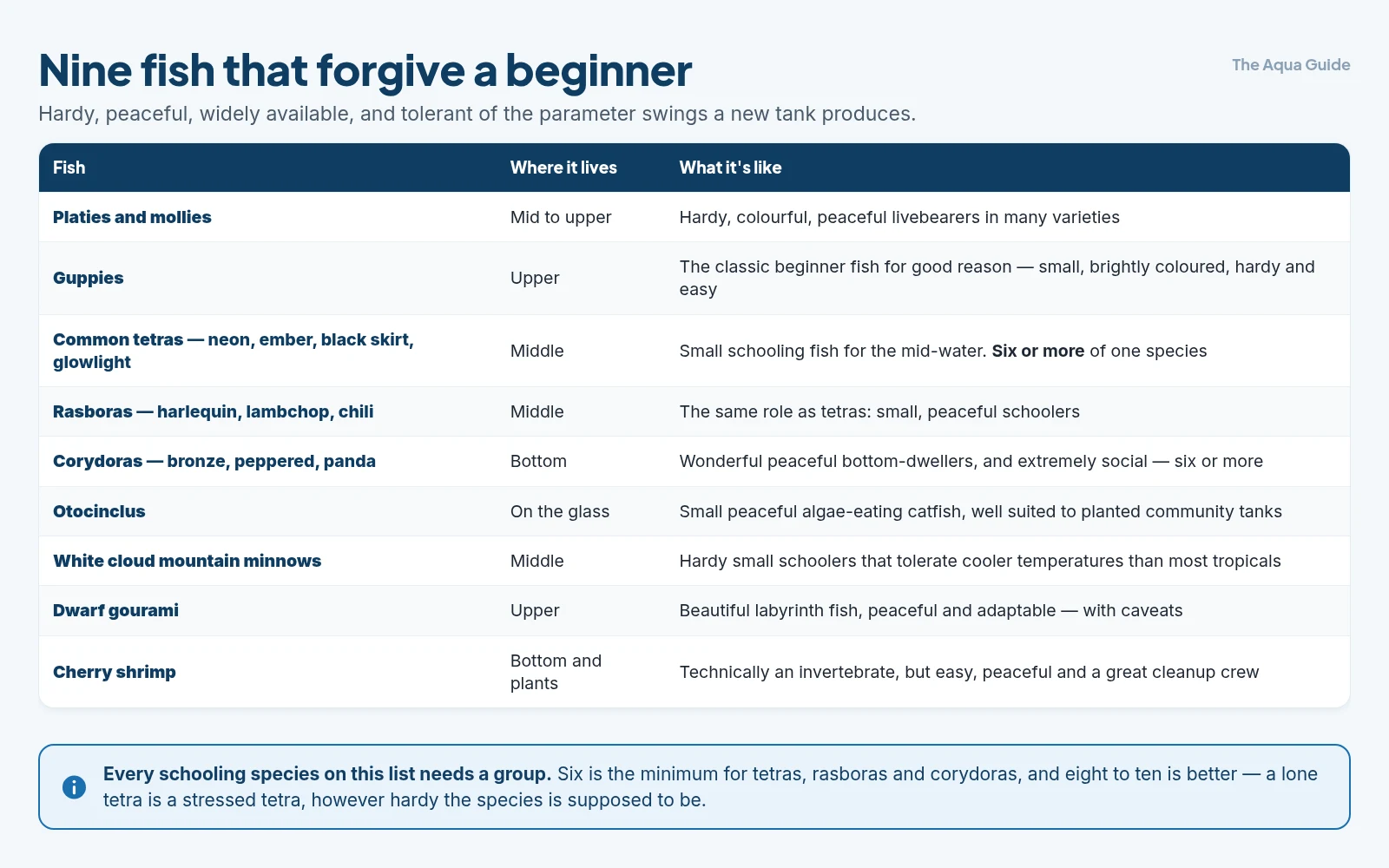
Platies and Mollies (livebearers). Hardy, colorful, peaceful livebearing fish in many varieties. Tolerate a wide range of water conditions, eat anything, and breed easily (sometimes too easily — be prepared for fry). Platies are particularly trouble-free; mollies are nearly as easy but prefer slightly harder water. Get a small group, ideally with more females than males to spread out male attention.
Guppies. The classic beginner fish for good reason — small, brightly colored, hardy, and easy to keep. Like other livebearers they breed prolifically. Males have the showy fins; females are plainer but produce the fry. Best kept in groups with skewed female ratios to reduce harassment.
Common Tetras (neon, ember, black skirt, glowlight, etc.). Small schooling fish that swim in the middle of the tank, peaceful and active. Most beginner-friendly tetras tolerate a fair range of conditions once acclimated. Always keep in groups of at least six — more is better — since they school for security and stress alone. Neon tetras are perhaps the most iconic; ember and glowlight are also very hardy.
Rasboras (harlequin, lambchop, chili, etc.). Similar role to tetras — small peaceful schoolers for the middle of the tank — but a different look. Harlequins are particularly hardy; chili rasboras are smaller and great for nano tanks. Same group rules apply: 6+ minimum.
Corydoras Catfish (bronze, peppered, panda, etc.). Wonderful peaceful bottom-dwellers, often called "cories." Active, social, and great cleanup crew for uneaten food (though not algae). Keep in groups of 6+ of the same species — cories are very social and stress when kept alone or in pairs. They need smooth substrate (sand or rounded gravel) to protect their delicate barbels.
Otocinclus. Small peaceful algae-eating catfish, well-suited to planted community tanks. Less commonly stocked than the others above but very beneficial when they fit. Keep in small groups; they're peaceful and won't bother other fish, but need an established tank with algae available since they don't take well to having only prepared food.
White Cloud Mountain Minnows. Hardy small schooling fish that tolerate cooler temperatures than tropicals, making them great for unheated tanks or rooms where temperature is variable. Peaceful, active, and undemanding. Keep in groups of 6+.
Dwarf Gourami (with caveats). Beautiful labyrinth fish that are peaceful and adaptable for community tanks. The caveat: some farmed dwarf gouramis have been bred with disease susceptibility (DGD), so source matters. When healthy, they're a great addition; keep one male, or a male with multiple females.
Cherry Shrimp (technically an invertebrate, but worth mentioning). Easy, peaceful, and great cleanup crew in tanks without fish small enough to view them as food. Tolerate a wide range of conditions and breed readily.
Popular Fish That Are NOT Beginner-Friendly
A few species frequently sold to beginners that you should approach with caution.
Common Goldfish and Fancy Goldfish. Despite their image as easy bowl fish, goldfish are messy, waste-heavy, grow large (a common goldfish can reach a foot), and need substantial tanks (75+ gallons for a single common goldfish, with strong filtration). They're also cold-water fish — not compatible with tropical communities. Not a great beginner pick despite the marketing.
Common Plecostomus. Sold as small algae-eaters, common plecos grow to 18+ inches and produce enormous amounts of waste. They quickly outgrow most beginner tanks. If you want a pleco, choose a small species like a bristlenose (max ~5 inches), not the common variety.
Bettas in small bowls. Bettas can be wonderful pets, but the marketed-as-easy "betta in a cup" idea is misleading — they do far better in proper heated, filtered tanks of at least 5 gallons. They're also generally not community fish (most males are highly territorial), so plan a species-appropriate setup rather than treating them as a beginner community add-on.
Oscars, Jack Dempseys, and other large cichlids. Personable and intelligent, but grow to 12+ inches, are highly aggressive, and need 75+ gallon tanks. Beautiful, not beginner-appropriate.
Discus. Beautiful but demanding — picky about water parameters, sensitive to disease, expensive, and not at all forgiving. Advanced-keeper territory.
Wild-caught or "exotic" oddities. Specialty species often have very specific needs that aren't obvious from a quick look. Stick to commonly-bred community species at first.
Putting Together a Beginner Community
A common, very successful first community might look like:
A school of 8–10 small tetras or rasboras (middle of the tank), a group of 6 corydoras (bottom), and a small group of livebearers like platies (mostly middle, with some surface activity). That's a balanced three-layer community in a modest tank, with hardy species that tolerate learning curves.
Or a single-species focus: a school of 12 cardinal tetras in a planted tank, with a small group of cories. Simple, beautiful, and forgiving.
Or a livebearer-focused setup: a trio of platies plus a few guppies, with a couple of otocinclus for plant algae. Active, colorful, and very beginner-friendly.
The specific mix matters less than the principles: peaceful, hardy, properly grouped, properly stocked, and matched to your tank.
A Note on Group Sizes
Mentioned in passing throughout — but worth emphasizing: schooling and shoaling fish need to be in groups. A single tetra is a miserable, stressed fish; six is a content school. Cories kept alone or in pairs hide and pine; in groups of six they're active and confident. Don't try to maximize species variety at the cost of group sizes. A community of three species in proper groups beats six species in pairs every time. (Schooling and shoaling has its own dedicated guide.)
The Bottom Line
For your first tank, choose hardy, peaceful, widely-available community species that forgive learning bumps: livebearers like platies, mollies, and guppies; schooling fish like neon and ember tetras or harlequin rasboras; bottom-dwellers like corydoras catfish; and supplements like otocinclus or cherry shrimp. Avoid the deceptively-marketed "easy" fish that actually have demanding requirements — goldfish, common plecos, bettas in tiny containers, and large cichlids. Group schooling species properly (6+), balance your stocking across top/middle/bottom layers, and respect adult sizes. With these species and these habits, you'll have a thriving community that builds your confidence and your skill before you take on anything fancier.
Related guides
- The beginner's guide to choosing fish
- Community tank compatibility: what gets along
- Schooling vs shoaling: how many of each species?
- How many fish can my tank hold?
- Fish compatibility quick reference
- How to acclimate new fish properly
- Adding fish in batches: how slow is slow enough?
- Freshwater shrimp: cherry, amano and more
Got questions about your specific setup? Drop them in our Community Forum — we love helping new fishkeepers get started right.