It's the question every beginner asks at the store: "how many can I put in?" — and the answers people get vary wildly, from cramped overstocked tanks to rules so cautious you'd think a 20-gallon could hold three fish. The truth is there's no single magic number, but there are clear principles that get you to a sensible answer for your tank. Here's how stocking limits actually work, why the famous "inch per gallon" rule is a rough start, and how to set a stocking level your fish will actually thrive in.
How many fish can I put in my tank?
There is no single number — it depends on your filter capacity, the tank footprint and the adult size, activity and mess of the species involved. The inch-per-gallon rule is a rough first pass for slim peaceful fish; plan for adult sizes and full group sizes, spread the stocking across all three water levels, and deliberately stop at 70–80% of what the arithmetic allows.
At a glance: where the inch-per-gallon rule breaks
| What the rule assumes | Where it goes wrong |
|---|---|
| Slim, peaceful fish | A 6-inch goldfish is not equivalent to six 1-inch neons. Waste output scales with mass, not length, so a 4-inch fish may need four to six times the water of a 2-inch one |
| That all fish use space the same way | Active swimmers like danios need more room per inch; territorial fish need space, not just water. Footprint matters as much as volume |
| The size in the bag | Always plan for the adult size. This is the commonest reason beginners end up with fish they cannot keep |
| That filtration is a constant | A well-filtered tank with regular water changes supports more than the rule suggests; a struggling filter cannot even support the rule's number |
Treat it as a first-pass sanity check — roughly 1 inch of slim adult fish per gallon — and refine from there.
Why Stocking Limits Exist
A tank is a closed system. Every fish you add produces waste (ammonia from gills and feces), consumes oxygen, and needs swimming room. Your filter and beneficial bacteria can only process so much waste, your water can only dissolve so much oxygen, and your tank's footprint can only host so much swimming. Push past these limits and three things happen, usually together: water quality slips (because waste outpaces filtration), fish stress chronically (which weakens immune systems and shortens lifespans), and aggression rises (because crowded fish defend territory more fiercely).
So stocking limits aren't arbitrary — they're the boundary where your system stops working comfortably. The goal is to stay well inside that boundary, not flirt with it.
The "Inch Per Gallon" Rule: A Rough Start
The classic rule of thumb is roughly 1 inch of slim adult fish per gallon of water. A 20-gallon tank, by this rule, holds about 20 inches of fish — say, ten 2-inch tetras.
It's useful as a starting ballpark, but oversimplifies things in important ways:
It assumes slim, peaceful fish. A 6-inch goldfish is not equivalent to six 1-inch neons — goldfish are messy, waste-heavy, and need far more water per inch. Bigger or chunkier fish need disproportionately more space.
It ignores activity and species needs. Active swimmers (like danios) need more room per inch than sedentary species. Territorial fish need more space, not just more water.
It uses adult size. The 1-inch baby fish at the store may grow to 6 inches. Always plan for the adult size, not what's in the bag.
It doesn't account for filtration and maintenance. A well-filtered tank with regular water changes can support more fish than the rule suggests; a struggling filter can't even support the rule's number.
So treat the inch-per-gallon rule as a first pass sanity check — and refine from there.
Better Mental Models
A few principles that get you closer to reality than the simple rule.
Plan for adult size, not current size. Look up the actual adult length of every species you're considering. If it grows bigger than your tank can comfortably host, don't buy it — even if it's tiny right now. This is the most common reason beginners end up with fish they can't keep.
Bigger and messier fish need disproportionately more space. A 4-inch fish doesn't need just twice as much water as a 2-inch fish; it might need four to six times as much because waste output scales with mass, not length. For chunky, messy species, be especially generous.
Active and territorial fish need swimming room, not just gallons. A 20-gallon "tall" tank has the same volume as a 20-gallon "long" but far less floor space — bad for bottom-dwelling and territorial fish. Footprint matters as much as volume for these species.
Schooling fish count as a group, not a number. A school of six small tetras is one stocking unit, not six separate fish. If you want three different schooling species, you're planning for 18+ fish.
Consider stocking by water-column zone. A balanced tank fills top, mid, and bottom. Overstocking one layer (say, ten bottom-dwelling corydoras crammed onto the substrate) is worse than spreading the same number across three layers. Think layers, not just totals.
The Honest Practical Approach
Combining these into a workable method:
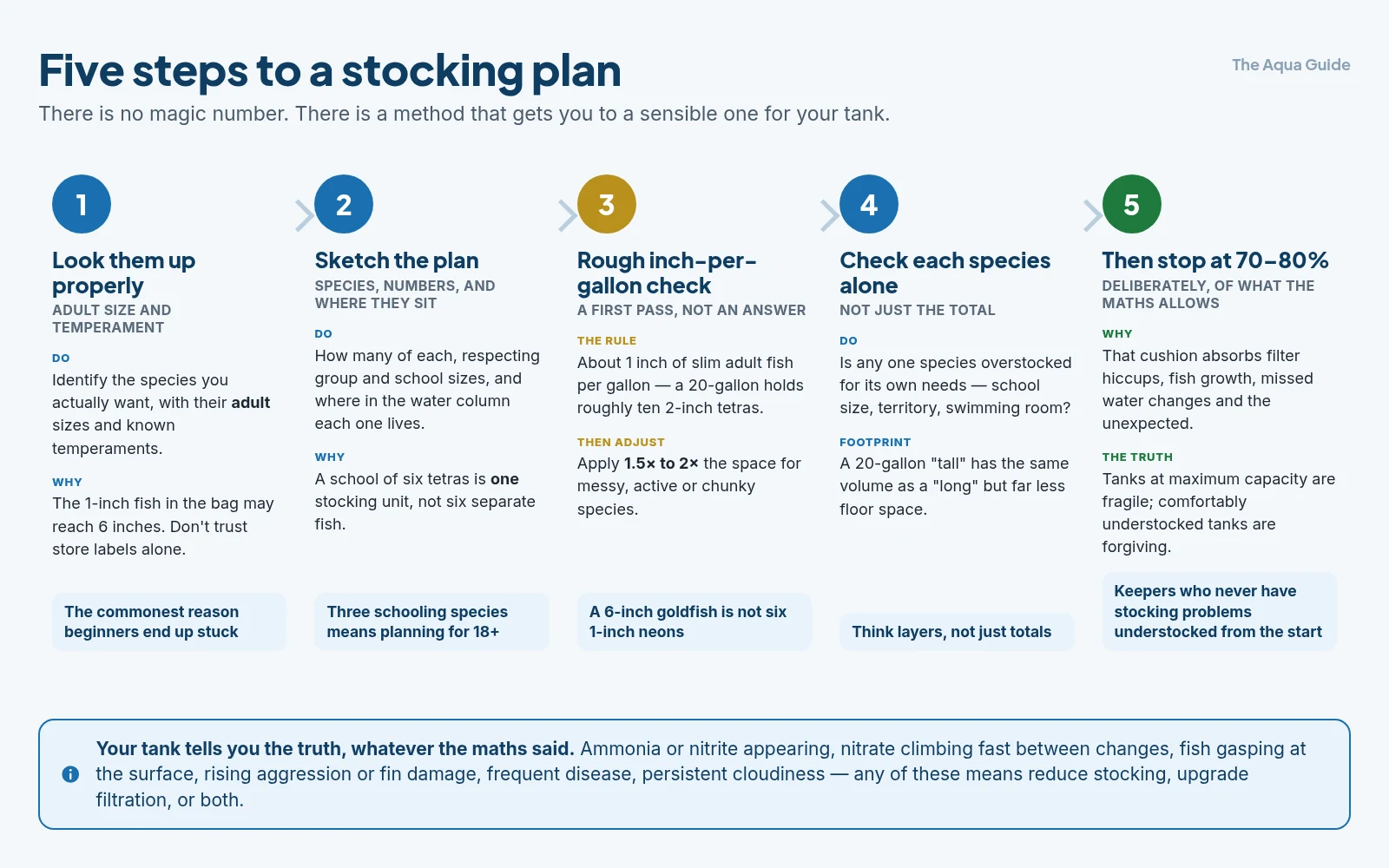
Step 1. Identify the species you actually want, with their adult sizes and known temperaments. Look these up properly, don't trust store labels alone.
Step 2. Sketch your stocking plan: which species, how many of each (respecting group and school sizes), and where in the water column each sits.
Step 3. Do a rough inch-per-gallon check on slim peaceful fish — and apply a generosity multiplier (1.5× to 2× the inch-per-gallon space) for messy, active, or chunky species.
Step 4. Check that no single species is overstocked relative to its needs (schooling group, territory, swimming room).
Step 5. Then deliberately stock at 70–80% of what your math allows. That cushion absorbs filter hiccups, fish growth, missed water changes, and the unexpected. Tanks at maximum capacity are fragile; tanks comfortably under-stocked are forgiving.
This sounds conservative, and it is — and that's why it works. The keepers who never have stocking problems aren't lucky; they understocked from the start.
Signs You're Overstocked
Whether or not your math says you're fine, your tank tells you the truth. Watch for: ammonia or nitrite appearing in tests (the clearest sign your filter can't keep up); nitrate climbing fast between water changes (heavy bioload); fish gasping at the surface (oxygen demand exceeding supply); rising aggression or fin damage (territorial pressure); frequent disease outbreaks (chronic stress from crowding); water cloudy persistently despite good maintenance. Any of these signal it's time to either reduce stocking, upgrade filtration, or both.
What "Heavily Filtered" Buys You
Some experienced keepers run tanks stocked above the typical guidelines, supported by oversized filtration, dense planting, very frequent water changes, and constant monitoring. It's possible, but it's also more demanding and less forgiving. For a beginner, this isn't a license to overstock — it's a reason to under-stock so a beginner-friendly maintenance routine is enough. As you gain experience and your filtration is mature, you can push stocking up if you want. Not on day one.
A Note on Tank Size and Choices
Bigger tanks aren't just better for stability — they're better for stocking options too. A 10-gallon meaningfully limits your choices to small species in modest groups. A 30-gallon opens up far more options. A 55-gallon and up brings most community-fish dreams within reach. If you find yourself drawn to species that don't fit your current tank, the answer is usually "wait until your next upgrade" rather than "force it." Trying to make a too-small tank hold too much fish ends badly for everyone.
The Bottom Line
Stocking limits aren't a hard number — they're a range driven by your filter's capacity, your tank's footprint and water volume, and the specific needs (size, activity, schooling, mess level) of the fish you want. The "inch per gallon" rule is a useful first pass for slim peaceful fish, but be generous for bigger, messier, or more active species; plan for adult sizes and proper group sizes; balance stocking across top/middle/bottom zones; and deliberately stock at 70–80% of what your math allows, to give yourself margin. Watch your tank for the real signs of overstocking — ammonia, climbing nitrate, gasping, aggression — and adjust if you see them. Get this right and your tank stays stable, your fish stay healthy, and the hobby stays enjoyable.
Related guides
- Schooling vs shoaling: how many of each species?
- Community tank compatibility: what gets along
- Adding fish in batches: how slow is slow enough?
- What size aquarium should a beginner start with?
- The beginner's guide to choosing fish
- What are safe ammonia, nitrite and nitrate levels?
- How often should you do a water change — and how much?
- Beginner-friendly fish species
Got questions about your specific setup? Drop them in our Community Forum — we love helping new fishkeepers get started right.