It seems logical: you're new, so start small, right? It's one of the most common beginner assumptions — and one of the most counterproductive. The truth surprises almost everyone: bigger tanks are easier for beginners, not harder. Let's explain why, recommend a sensible starting size, and help you choose the right tank for your space and goals.
What size aquarium should a beginner start with?
Around 20 gallons (roughly 75 liters) or larger. A bigger volume dilutes mistakes and changes chemistry slowly, which makes it more forgiving than a nano tank — the opposite of what most beginners assume.
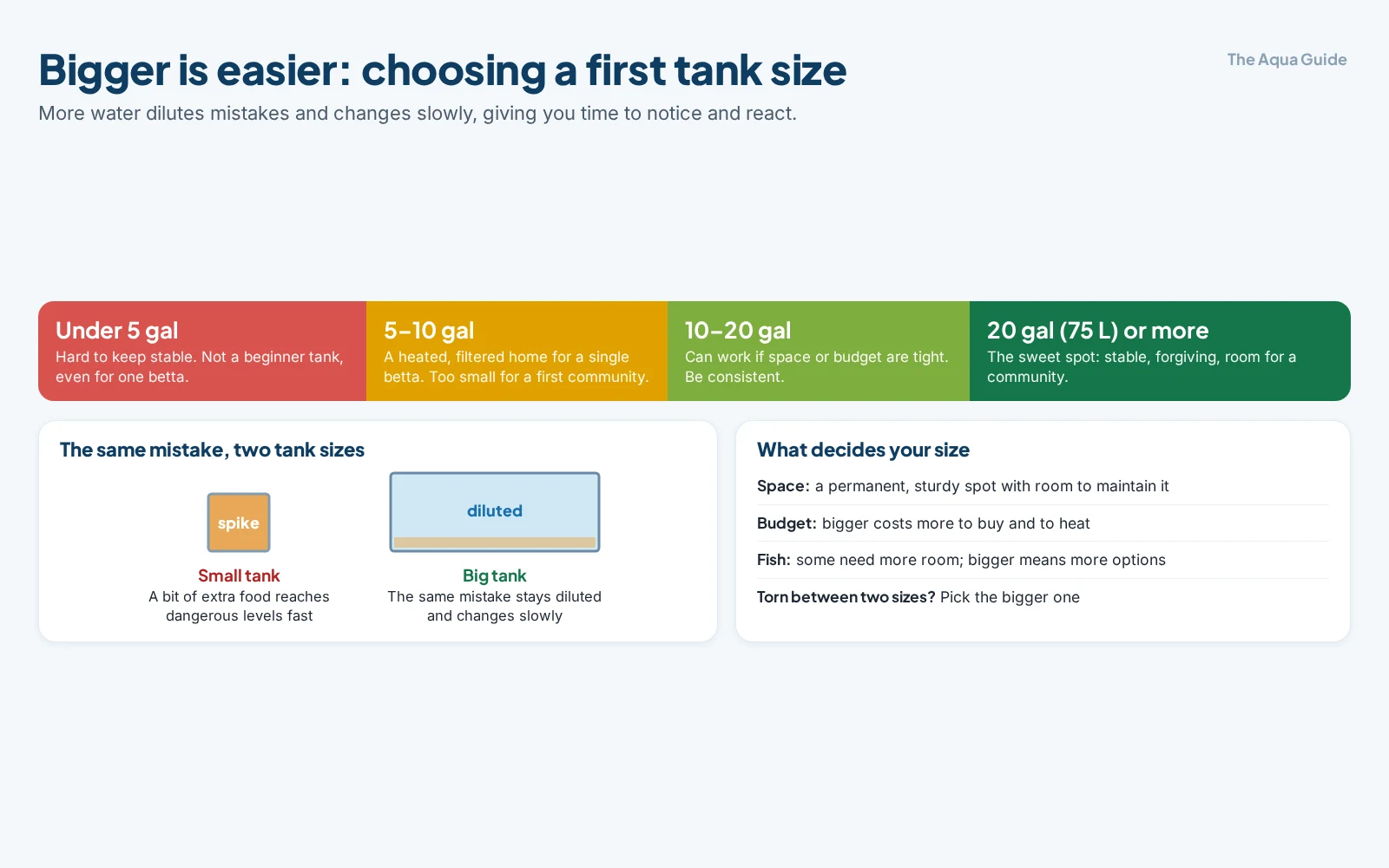
The Counterintuitive Truth: Bigger Is Easier
Here's the principle that flips most beginners' expectations: a larger volume of water is more stable and more forgiving than a small one.
Why? Because in a big tank, problems develop slowly and stay diluted. If a fish dies unnoticed, or you overfeed, or something throws off the chemistry, a large volume of water absorbs the impact — the ammonia spike is gentler, the temperature drifts slowly, the pH holds steadier. You have time to notice and react before anything reaches a dangerous level.
In a tiny tank, the opposite happens. The same mistake — a bit of extra food, a missed water change — spikes to lethal levels almost immediately, because there's so little water to dilute it. Temperature swings fast. Chemistry crashes quickly. Small tanks are unforgiving, fast-moving environments where beginner mistakes turn fatal before you can respond. That's exactly the wrong environment to learn in.
So the small-tank instinct is backwards. The bigger the water volume, the more margin for error — and beginners need margin for error most of all.
The Recommended Starting Size
For most beginners, a tank in the range of around 20 gallons (roughly 75 liters) or larger is a sweet spot. It's big enough to be stable and forgiving, big enough to keep a satisfying community of fish, but not so large that it's unwieldy or expensive to set up in a typical home.
If 20 gallons doesn't fit your space or budget, something in the 10-to-20-gallon range can work — but try not to go below about 10 gallons for a first community tank, and be aware that the smaller you go, the more careful and consistent you'll need to be. Tanks under 5 gallons (the tiny "desktop" bowls and cubes) are genuinely difficult to keep stable and are not good beginner choices, despite often being marketed that way.
The reassuring message: you don't need a giant tank, but err on the larger side of what your space and budget comfortably allow. A bigger tank is a gift to your future self.
At a glance: what shapes the choice
| Factor | How it pulls |
|---|---|
| Your space | A full tank is heavy and needs a permanent, sturdy spot. Measure where it will go, with room around it for maintenance |
| Your budget | Bigger costs more to buy and to run, mainly heating. Take the largest you can comfortably afford on both — without the running cost becoming a burden |
| The fish you want | Some need more swimming room or produce more waste. Let their needs set your minimum, and note that bigger tanks give more stocking options |
| Your commitment to maintenance | Bigger is more stable but moves more water per change. Smaller is quicker but far less forgiving if you skip |
Around 20 gallons — roughly 75 litres — or larger is the sweet spot: stable and forgiving, enough for a satisfying community, and not so large it becomes unwieldy. Below about 10 gallons for a first community tank, the margin for error gets thin.
What Determines the Right Size for You
A few practical factors shape the choice beyond "bigger is more stable."
Your space. A full tank is heavy and needs a permanent, sturdy spot. Measure where it'll go and make sure the size you want fits with room around it for maintenance.
Your budget. Bigger tanks cost more to buy and to run (mainly heating). Choose the largest size you can comfortably afford on both fronts — but don't stretch so far that the running cost becomes a burden.
The fish you want. Some fish need more swimming room or produce more waste, requiring a bigger tank; others are happy in less. If you have specific fish in mind, let their needs inform your minimum size. Bigger tanks also simply give you more stocking options.
Your commitment to maintenance. A bigger tank is more stable but takes a bit more effort per water change (more water to move). A smaller tank is quicker to maintain but less forgiving if you skip maintenance. Be honest about which trade-off suits you.
Why People Choose Too Small (and Regret It)
The tiny-tank trap catches beginners for understandable reasons: small tanks are cheaper, they fit anywhere, and they're marketed heavily to newcomers as easy starter setups. But the reality is that small tanks demand more skill and consistency to keep stable, not less — and many beginners who start tiny lose fish, get frustrated, and either quit or quickly upgrade to a bigger tank, having wasted money on the first one.
This is the same "buying twice" trap that applies to cost: starting too small often means buying again soon. Starting with a sensible size saves money and heartache.
The Special Case of Bettas and "Desktop" Tanks
A quick note, because it's a common point of confusion: those tiny bowls and tiny cubes sold for bettas are not ideal even for a single betta. A betta does far better in a small proper tank (several gallons, heated and filtered) than in a tiny unheated bowl. "It's just one small fish" doesn't mean "any tiny container will do" — even one fish needs stable water, and stable water needs adequate volume.
The Bottom Line
Start bigger than your instinct tells you. A larger water volume is more stable, more forgiving, and far more beginner-friendly, because it dilutes mistakes and slows down problems, giving you time to react. Aim for around 20 gallons or more if your space and budget allow, stay above roughly 10 gallons for a first community tank, and avoid the tiny sub-5-gallon bowls that are deceptively hard to keep alive. Choose your size based on your space, budget, and the fish you want — but whenever you're torn between two sizes, the bigger one is almost always the better beginner choice.
Related guides
- How much does a fish tank cost to set up and run?
- Where to place your aquarium at home
- Setting up the stand: levelling and weight safety
- How many fish can my tank hold?
- Glass vs acrylic: which tank should you buy?
- First aquarium setup: a day-by-day guide
Got questions about your specific setup? Drop them in our Community Forum — we love helping new fishkeepers get started right.