Once you've decided to get a tank, you'll quickly hit a fork in the road: glass or acrylic? Both are common, both hold water and fish perfectly well, but they have genuinely different strengths and weaknesses. The right choice depends on your priorities — budget, weight, durability, and how the tank will look over time. Let's compare them honestly so you can pick with confidence.
At a glance: which one, and why
| Choose | When | The trade-off you accept |
|---|---|---|
| Glass | A standard rectangular tank, on a budget, that you want to stay clear and be easy to clean | It is heavy, and if it breaks it shatters |
| Acrylic | A very large tank where the weight saving genuinely helps; a shatter-proof option for safety; or a curved or custom shape that only comes in acrylic | It scratches easily, so you commit to careful, acrylic-safe cleaning |
Both hold water and fish perfectly well. The choice is about priorities, not quality — pick the one whose trade-offs fit your situation.
The Quick Verdict
For most beginners, glass is the sensible default — it's cheaper, more scratch-resistant, and stays clear over time. Acrylic wins if weight, shatter-resistance, or unusual shapes matter to you, and you're willing to be careful about scratches. Neither is "better" outright; they're suited to different priorities. Here's the detail.
Glass: The Traditional Choice
Glass aquariums are the classic, and they remain the most popular for good reasons.
Advantages: Glass is generally cheaper, especially in standard sizes. It's much more scratch-resistant — everyday cleaning won't mark it, and it shrugs off contact that would scratch acrylic. It stays optically clear and doesn't yellow or cloud with age, so a glass tank looks the same in ten years as on day one. It's also rigid, so it doesn't flex.
Disadvantages: Glass is heavy — significantly heavier than acrylic for the same size, which matters for moving it and for what your stand and floor must support. And it's brittle: a hard knock can chip or crack it, and if it breaks, it shatters. It's also limited mostly to standard rectangular shapes.
Glass is the right pick if you want the lowest cost, the best long-term clarity, and the easiest cleaning — which describes most beginner setups.
Acrylic: The Modern Alternative
Acrylic (a clear plastic) tanks have their own distinct profile.
Advantages: Acrylic is much lighter than glass for the same size — often around half the weight — which makes large tanks far easier to handle and reduces the load on stands and floors. It's far more impact-resistant; it won't shatter, instead flexing or at worst cracking without exploding, which is safer. And because it's molded, it comes in shapes glass can't easily do — curved fronts, bowfronts, cylinders, and seamless designs. Acrylic also insulates slightly better, marginally helping with heating.
Disadvantages: Acrylic scratches easily — even careful cleaning with the wrong material can leave marks, and algae scrapers must be acrylic-safe. (The upside: minor scratches can often be buffed out, which you can't do with glass.) It's usually more expensive than glass, especially in standard sizes. Over many years, cheaper acrylic can yellow or cloud, though quality acrylic resists this. And it can flex if not properly supported, so it needs a fully flat, solid base.
Acrylic is the right pick if you want a large tank that's manageable in weight, a shatter-proof option (good with kids or in earthquake-prone areas), or a non-rectangular shape — and you're prepared to clean it carefully.
Head-to-Head on What Matters
To make the trade-offs plain:
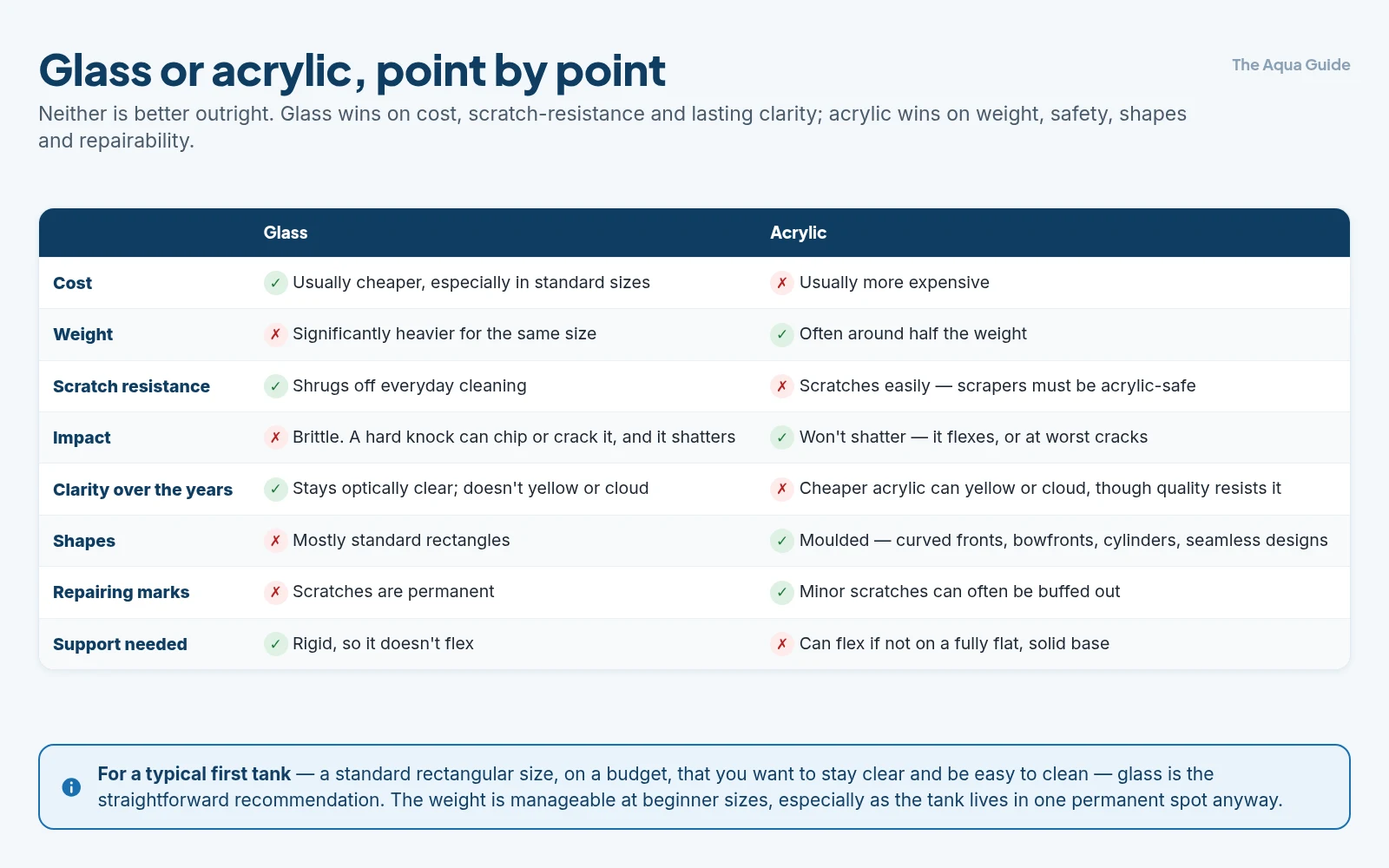
Cost: Glass is usually cheaper (advantage glass). Weight: Acrylic is much lighter (advantage acrylic). Scratch resistance: Glass resists scratches far better (advantage glass). Shatter/impact: Acrylic won't shatter and is safer on impact (advantage acrylic). Long-term clarity: Glass stays crystal clear; cheap acrylic can yellow (advantage glass). Shapes: Acrylic offers curved and custom shapes (advantage acrylic). Repairing marks: Acrylic scratches can be buffed out; glass scratches are permanent (advantage acrylic).
You can see the pattern: glass wins on cost, scratch-resistance, and lasting clarity; acrylic wins on weight, safety, shapes, and repairability.
Which Should a Beginner Choose?
For a typical first tank — a standard rectangular size, on a budget, that you want to stay clear and be easy to clean — glass is the straightforward recommendation. It's cheaper, it tolerates everyday cleaning without scratching, and it'll look great for years. The weight is manageable at beginner-friendly sizes, especially since the tank lives in one permanent spot anyway.
Consider acrylic instead if you specifically want a very large tank (where the weight savings genuinely help), you need a shatter-proof option for safety reasons, or you've fallen for a particular curved or custom shape that only comes in acrylic. In those cases acrylic's strengths outweigh its scratch-proneness — just commit to careful, acrylic-safe cleaning.
The Bottom Line
Glass and acrylic both make perfectly good aquariums; the choice is about priorities. Glass is cheaper, far more scratch-resistant, and stays optically clear for life, but it's heavy and shatters if it breaks. Acrylic is much lighter, won't shatter, and comes in custom shapes, but it scratches easily and costs more. For most beginners — a standard tank, on a budget, that's easy to keep clear — glass is the sensible default. Choose acrylic when weight, shatter-resistance, or a special shape genuinely matters to you and you're ready to clean it gently. Either way, you'll have a tank that does its job; pick the one whose trade-offs fit your situation.
Related guides
- What size aquarium should a beginner start with?
- Setting up the stand: levelling and weight safety
- Where to place your aquarium at home
- What equipment do you actually need vs store upsells
- The beginner's guide to aquarium equipment
- Heater sizing and placement
- First aquarium setup: a day-by-day beginner's guide
- How much does a fish tank cost to set up and run?
Got questions about your specific setup? Drop them in our Community Forum — we love helping new fishkeepers get started right.