It's easy to treat tank placement as an afterthought — you find a spot that looks nice and put the tank there. But where you place your aquarium has real consequences for your fish's health, your maintenance routine, and even your home's safety. A poorly chosen spot can mean algae problems, temperature swings, stressed fish, and a lot of awkward cleaning. A well-chosen one makes everything easier. Here's how to pick the right place.
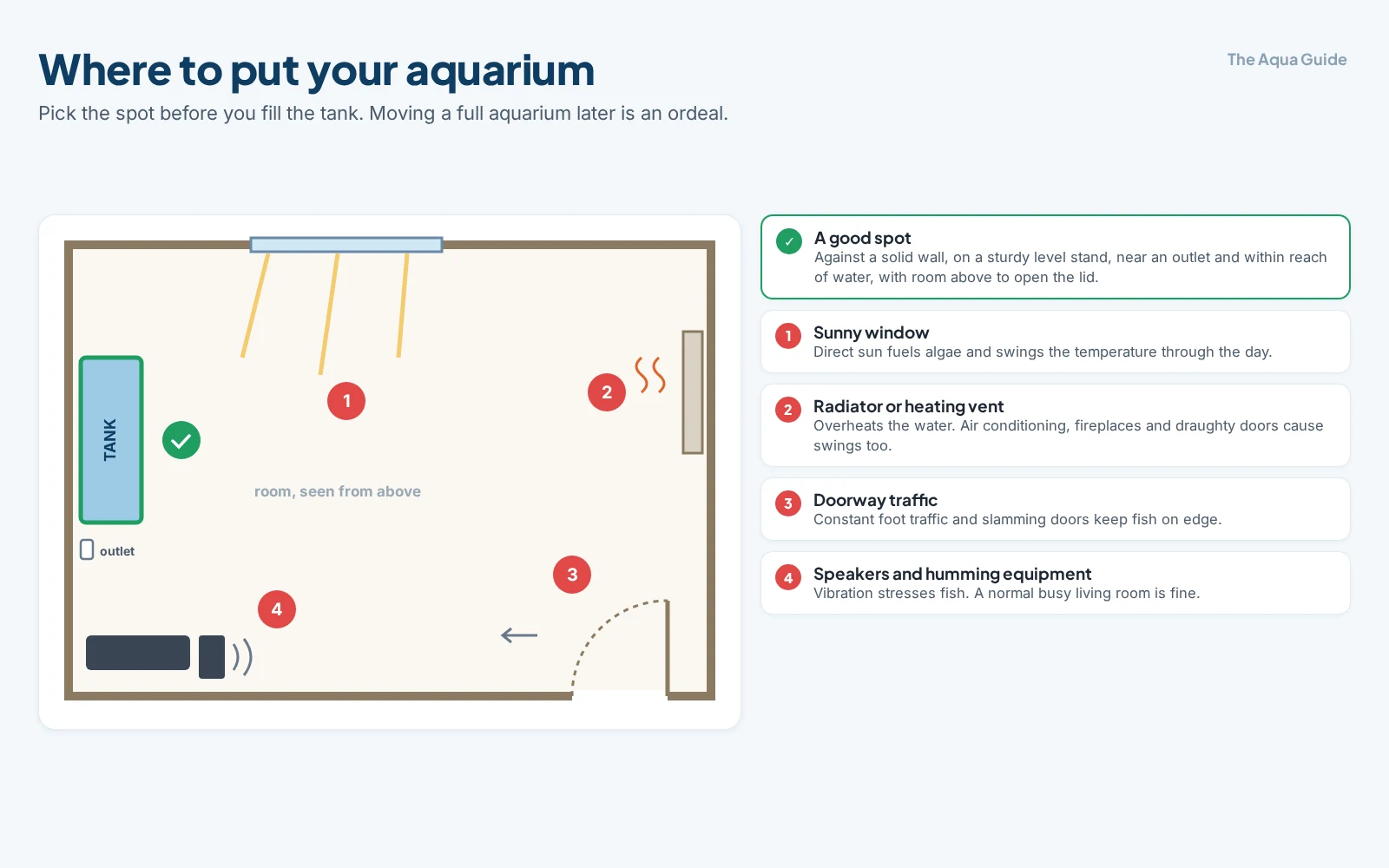
At a glance: what to avoid, and why
| Avoid | What it does |
|---|---|
| Direct sunlight | A massive energy source for algae — a sunlit tank is a near-guaranteed recipe for green water — and it heats the water unpredictably |
| A flimsy table or shelf | A filled tank plus substrate and décor weighs hundreds of pounds even at modest sizes. It needs a proper stand or furniture rated for the weight |
| An uneven surface | An unevenly supported tank puts dangerous stress on the glass |
| Heating vents and radiators | They overheat the tank |
| Air conditioning and drafty exterior doors | They chill it — and it is the swing, not the temperature, that does the harm |
| Heavy traffic, slamming doors, loud speakers | Fish are sensitive to vibration and sudden movement, and a tank in a noisy spot keeps them stressed |
| Anywhere awkward to reach | A tank you can't easily reach is a tank you'll maintain less often |
Think about the room, not just the wall: a spot reasonably near a water source, with space above the tank to lift the lid and equipment out, away from where curious pets or small children can disturb it.
The Big One: Avoid Direct Sunlight
If you remember a single rule about placement, make it this: keep your tank out of direct sunlight. A spot by a sunny window might look beautiful, but sunlight causes two real problems.
First, it fuels algae. Direct sun is a massive energy source for algae, and a sunlit tank is a near-guaranteed recipe for green water and algae outbreaks that are a constant battle to control. Second, sunlight heats the water unpredictably — a tank in the sun can swing in temperature through the day, stressing fish that need stability. Both problems vanish if you simply place the tank away from windows and direct sun. Ambient room light is fine; direct beams are the enemy.
Choose a Stable, Sturdy Surface
A full aquarium is astonishingly heavy — water weighs a lot, and a filled tank plus substrate and décor can weigh hundreds of pounds even at modest sizes. This drives several placement requirements.
The tank must sit on something genuinely strong enough to hold it — a proper aquarium stand or furniture rated for the weight, never a flimsy table or shelf. The surface must be level and flat, because an unevenly-supported tank puts dangerous stress on the glass or seams and can crack or leak. And the floor beneath needs to bear the load, which for large tanks means thinking about where in the room the weight sits (near a wall, over a floor joist) rather than the middle of a weak floor. (The mechanics of stands, leveling, and weight safety deserve their own detailed treatment — but the placement principle is: sturdy, level, and on a floor that can take it.)
Mind the Temperature of the Spot
Beyond sunlight, the general temperature stability of the location matters. Avoid placing the tank near anything that causes temperature swings: heating vents or radiators (which overheat it), air-conditioning units or drafty exterior doors (which chill it), and fireplaces. Fish need stable temperature, and your heater works best when it isn't fighting against an external source constantly heating or cooling the water. A spot with a steady, moderate room temperature is ideal.
Keep It Practical for Maintenance
A tank you can't easily reach is a tank you'll maintain less often — so think about access. You'll be doing regular water changes, which means hauling water to and from the tank, so a spot reasonably near a water source and not buried behind furniture makes life much easier. You'll need room to open the lid, reach in, and get a bucket and siphon to it. And you'll want access to a power outlet nearby for the filter, heater, and light, ideally without trailing cords across walkways. Convenience here directly affects whether you keep up with maintenance, which directly affects your fish's health.
Think About Traffic and Disturbance
Fish are sensitive to vibration and sudden movement, and a tank in a high-traffic, high-noise, or high-vibration spot can keep them stressed. Avoid placing it somewhere with constant heavy foot traffic, slamming doors, loud speakers, or vibration sources (like on top of or beside equipment that hums and shakes). A calmer location helps fish feel secure. That said, a normally-busy living room is generally fine — fish acclimate to regular household activity; it's extremes and sudden disturbances to avoid.
A Few More Practical Considerations
Some smaller factors worth a thought: keep the tank away from where curious pets or small children might knock things in or disturb it constantly. Make sure there's space above the tank to lift the lid and equipment out. Consider whether the floor or surroundings would tolerate the occasional water splash or spill (water changes are rarely perfectly tidy). And place it where you'll actually enjoy looking at it — the aquarium is meant to be a pleasure, so a spot where you'll see and appreciate it adds to the hobby.
The Bottom Line
The best spot for your aquarium is out of direct sunlight (to avoid algae blooms and temperature swings), on a sturdy, level surface over a floor that can bear the considerable weight, away from heat and cold sources that cause temperature instability, convenient for maintenance and near a power outlet, and in a reasonably calm location free of constant vibration or disturbance. Get those right — especially the sunlight and the sturdy-level-surface points — and you've set your tank up for healthier fish and easier care. Choose the placement thoughtfully before you fill the tank, because moving a full aquarium later is a genuine ordeal.
Related guides
- Setting up the stand: levelling and weight safety
- What size aquarium should a beginner start with?
- Green water and free-floating algae blooms
- Aquarium lighting basics
- First aquarium setup: a day-by-day guide
- How much does a fish tank cost to set up and run?
Got questions about your specific setup? Drop them in our Community Forum — we love helping new fishkeepers get started right.